
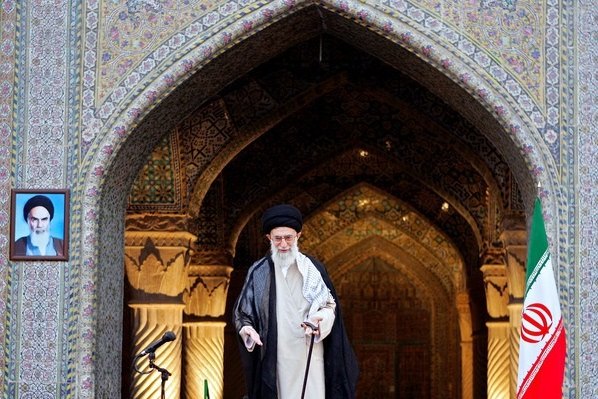
The formal U.S. war notification delivered this week has placed the full weight of Iran’s response on one man: Ayatollah Ali Khamenei, the country’s Supreme Leader since June 4, 1989. As the United States and Iran confront what analysts describe as the most serious military standoff in years, Khamenei’s constitutional authority as head of state and commander-in-chief of the armed forces makes his decisions the decisive factor in how Iran will proceed.
Under Iran’s constitution, he holds final authority over foreign policy, including the nuclear program and relations with the United States, and possesses the sole power to declare war and peace.
Supreme Leader’s Constitutional Powers Central to Crisis
Khamenei, born April 19, 1939, succeeded Ruhollah Khomeini, the founder of the Islamic Republic. His position atop Iran’s political hierarchy is absolute in matters of national security.
While the president manages day-to-day governance, the Supreme Leader controls the military, the judiciary, state media, and key economic institutions. The Islamic Revolutionary Guard Corps (IRGC) answers directly to him, not to the elected government. This centralized structure means that any decision to escalate or de-escalate the current confrontation rests with Khamenei alone. Early intelligence assessments indicate he has been in near-constant consultation with senior military commanders since the U.S. notification arrived.
The Iranian leadership appears to be weighing two competing imperatives: the need to project strength to maintain domestic credibility, and the recognition that a direct military confrontation with the United States could be catastrophic for the country’s economy and infrastructure. Khamenei’s rise to this position was shaped by a long trajectory through Iran’s revolutionary politics.
He was a student of Khomeini and opposed the government of Mohammad Reza Pahlavi, leading to several arrests and a period of exile. After the 1979 revolution, he held various government roles and served as president from 1981 to 1989, a period that included the Iran-Iraq war. During that conflict, he developed strong ties with the IRGC.
When he became Supreme Leader in 1989, the constitution was changed to allow his appointment despite his clerical rank. His subsequent leadership focused on expanding regional influence through Shia Islamism, supporting a coalition of allies in conflicts across Syria, Yemen, Iraq, and Gaza.
He also pushed for the privatization of state industries to leverage oil and gas reserves, helping Iran grow into a regional power. Throughout his tenure, he has remained a consistent critic of Israel and Zionism.
A Record of Opposition and Tactical Flexibility
Khamenei has consistently opposed American influence in the Middle East throughout his decades in power. He has publicly described the United States as the “Great Satan,” a phrase that has become a staple of official Iranian rhetoric since the 1979 revolution.
His stance on nuclear negotiations, however, has shown some tactical flexibility. In 2015, he supported the Joint Comprehensive Plan of Action (JCPOA), the multilateral agreement that limited Iran’s nuclear activities in exchange for sanctions relief. But after the U.S. withdrawal from the deal in 2018, he sharply criticized Washington’s decision and has since overseen a steady expansion of Iran’s nuclear program beyond the deal’s limits.
This pattern provides diplomats with both encouragement and caution: Khamenei has shown he can endorse a negotiated settlement when it serves his strategic interests, but he has also demonstrated a willingness to endure economic pain rather than capitulate to what he frames as American domination.
Signals and Channels in the Days Ahead
In the coming days, analysts will be watching for any public statement from Khamenei himself. His Friday prayer sermons and addresses to officials are the traditional channels through which he signals major policy shifts. A speech is expected within the week.
Regional mediators, including Iraq and Qatar, are known to maintain backchannel communication with Khamenei’s office. Whether those channels are active now remains unclear, but their involvement could provide a path toward de-escalation if both sides seek one.
For now, the world watches the man who has led Iran for nearly four decades—through sanctions, protests, wars, and negotiations. Because the Supreme Leader possesses the sole authority to declare war, his decisions dictate the risk of wider conflict. His long tenure has created a centralized power structure in which a single person determines whether diplomatic efforts succeed or military escalations begin.
{“@context”: “https://schema.org”, “@type”: “NewsArticle”, “headline”: “Iran’s Supreme Leader Holds Final Say in U.S. Standoff”, “description”: “TEHRAN, July 14 — The formal U.S. war notification delivered this week has placed the full weight of Iran’s response on one man: Ayatollah Ali…”, “datePublished”: “2026-07-14T09:30:00+00:00”, “author”: {“@type”: “Person”, “name”: “Muhammad Asim”}, “publisher”: {“@type”: “Organization”, “name”: “InfoPulse Today”, “url”: “https://newsfeed.infopulsetoday.com/”}}




