
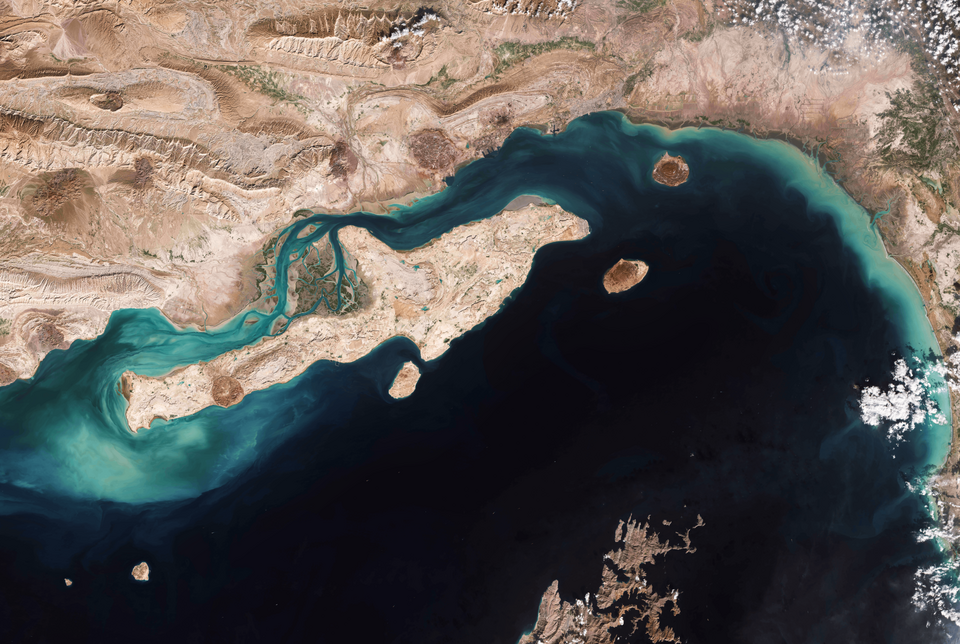
TEHRAN, April 28 — On April 28, 2025, Iran’s Islamic Revolutionary Guard Corps Navy announced the closure of the Strait of Hormuz until further notice, according to state media reports. The announcement came without details on enforcement or duration, but the strategic waterway between Oman and Iran immediately became the focal point of a new phase in long-running tensions between Tehran and Washington. The strait is a narrow chokepoint connecting the Persian Gulf to the Gulf of Oman and the Arabian Sea.
At its narrowest point, the waterway measures 33 kilometers wide, with shipping lanes only 3 kilometers wide in each direction. According to 2022 data from the U.S. Energy Information Administration, approximately 21 million barrels of oil and petroleum products pass through daily, representing roughly 21 percent of global petroleum consumption.
The IRGC Navy and Iran’s Dual Naval Command
The IRGC Navy, established after the 1979 Islamic Revolution, operates independently from Iran’s regular navy. The force controls the country’s missile and speedboat units, giving Tehran a layered capability in the narrow confines of the strait. Iran has previously threatened to close the waterway in response to sanctions or military pressure, including during the Iran-Iraq War from 1980 to 1988 and again in 2018-2019 amid the reimposition of U.S. sanctions.
The April 2025 closure escalates ongoing tensions between Iran and the United States. The U.S. Fifth Fleet, based in Bahrain, maintains a naval presence in the region.
Immediate Implications for Global Energy Security
The Strait of Hormuz is the only sea passage for oil exports from Saudi Arabia, Iraq, Kuwait, the United Arab Emirates, and Qatar. The closure has immediate implications for global oil prices and energy security, as these Gulf states depend entirely on the waterway to move their crude and refined products to international markets. The IRGC Navy’s announcement did not specify how the closure would be enforced or what triggers would lead to its reopening.
The record shows that Iran’s previous threats have often been calibrated to apply maximum economic and political pressure without triggering a full military confrontation. Sources familiar with the region’s dynamics note that the narrow shipping lanes make any closure difficult to sustain indefinitely without direct confrontation with naval forces.
The timeline of events now points to a sustained period of uncertainty for global energy markets. The U.S. Fifth Fleet’s posture in Bahrain will likely be a key indicator of Washington’s next moves. What to watch next: whether the IRGC Navy begins physical enforcement of the closure with speedboat and missile patrols, and how Gulf oil producers adjust their export routes or storage capacity in response.
The absence of details from Iranian state media leaves open the possibility that the announcement is a negotiating tactic, but the strategic stakes leave little room for miscalculation.




