
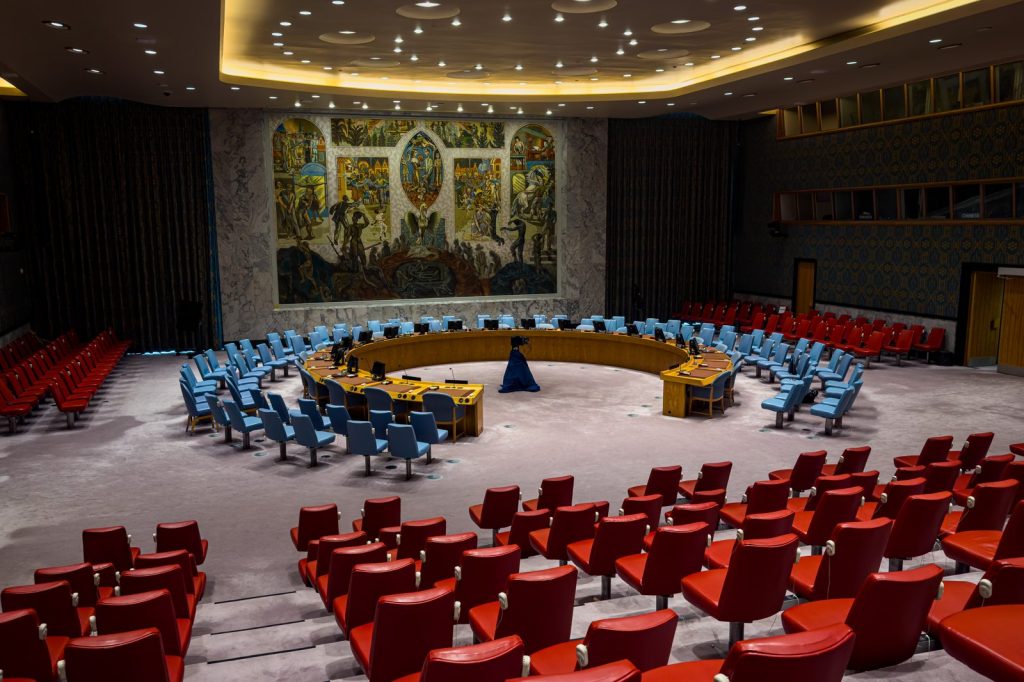
UNITED NATIONS, July 7 — The mechanics of the Security Council’s emergency session on February 3 tell a story of a world fracturing along predictable lines, with the United States and its allies on one side and a bloc of Russia and China on the other. The session, requested by Moscow and Beijing, was a direct response to American strikes on Iranian targets. On the surface, it was a procedural debate about sovereignty and self-defense.
On closer reading, it was a stage for each permanent member to lay down its markers for the next phase of escalation. Russia’s ambassador, Vasily Nebenzya, did not mince words.
He condemned the US strikes as a violation of Iran’s sovereignty and called for an immediate ceasefire. China’s ambassador, Fu Cong, echoed the call for restraint, warning against further escalation. The Western response was more nuanced, though no less revealing.
The United Kingdom’s ambassador, Barbara Woodward, expressed support for the US right to self-defense but immediately pivoted to a call for de-escalation. France’s ambassador, Nicolas de Rivière, urged all parties to avoid civilian casualties.
The catch is that neither London nor Paris condemned the strikes outright, nor did they join the Russian-Chinese call for a ceasefire. That distinction matters: it signals that the US’s European allies are willing to back its right to act, even if they are uneasy about the consequences. The European Union’s foreign policy chief, Kaja Kallas, issued a separate statement on the same day, February 3, calling for a return to diplomatic negotiations.
The statement was notable for what it did not say: there was no condemnation of the US, no endorsement of the Russian-Chinese ceasefire demand, just a plea for talks. Saudi Arabia’s Foreign Minister, Prince Faisal bin Farhan Al Saud, expressed concern over regional stability and urged restraint. The Gulf Cooperation Council issued its own statement on February 3, calling for a peaceful resolution.
Israel’s Prime Minister Benjamin Netanyahu voiced support for the US action, stating it was necessary to counter Iranian aggression. This is the bluntest statement of the entire session, and it cuts through the diplomatic fog.
His support carries weight in Washington, but it also reinforces the perception among Russia and China that the US-Israel axis is driving the escalation. Iran’s Foreign Minister Abbas Araghchi condemned the strikes and announced that Tehran would file a complaint with the International Court of Justice. This is a predictable procedural move — Iran has used the ICJ before to challenge US sanctions and military actions, with mixed results.
The court’s rulings are binding in theory, but enforcement is another matter entirely. The complaint will likely drag on for years, providing Iran with a diplomatic talking point but little else.
The US Department of State stated that diplomatic channels remained open. That sentence, in the context of live airstrikes and a Security Council session called to condemn them, is the kind of boilerplate that tells you everything and nothing. The channels are open, but the question is whether anyone is actually talking through them.
What to watch next is the interplay between the ICJ complaint and any further Security Council action. Russia and China have the votes to block any resolution critical of Iran, but they cannot stop the US from acting unilaterally or with a coalition of the willing. The diplomatic machinery is grinding, but the real decisions are being made in capitals, not in the council chamber.




