
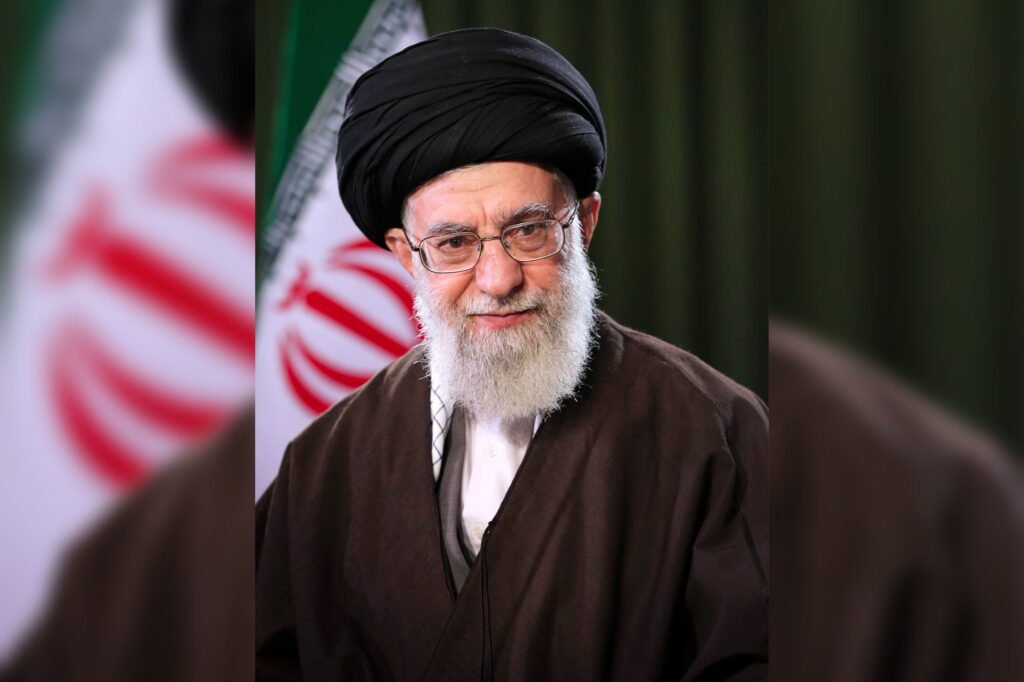
The tiny coffin was the one people noticed. Fourteen months old. Draped in the Iranian flag, same as the four larger coffins beside it.
The child was Khamenei’s granddaughter, killed alongside her father, mother, sister, and grandfather in the same Israeli airstrike that ended 37 years of rule. Her coffin sat on the raised platform at the Imam Khomeini Grand Mosalla in Tehran, a detail that shifted the tone of the mass funeral from political ceremony to something more intimate and raw.
This was not the first time Iran buried a supreme leader. But the circumstances were unprecedented. Ayatollah Ruhollah Khomeini’s death in 1989 came after illness, at age 89, in the tenth year of the Islamic Republic.
The nation had time. The succession was planned.
The mourning was ritualized. Khamenei’s death was sudden. Violent.
An airstrike that also took his daughter, his son-in-law, his daughter-in-law, his grandchild. State media listed the dead without elaboration. The five coffins told the story more plainly than any official statement could.
Khamenei himself had been supreme leader for nearly four decades. He took power in 1989 after Khomeini’s death, a cleric who had served two terms as president during the Iran-Iraq war.
He was not Khomeini’s original choice for successor — the constitution had to be amended to allow a mid-ranking cleric to assume the role. But he outlasted every challenge. He consolidated control over the military, the judiciary, the media, the economy.
He became the face of the Islamic Republic’s defiance, the man who called America the Great Satan and meant it. The war that killed him began with a US-Israeli strike on Iran.
The report does not specify the date or the pretext. What it does specify is the aftermath: tens of thousands of Iranians filling a vast outdoor prayer complex to view his coffin and the coffins of his family. Television footage showed the scene.
Mourners held up posters of Khamenei and his son Mojtaba, the man now supreme leader. Women in black chadors wore white visors against the July sun. Some carried umbrellas.
The heat was mid-morning and hot. A compere worked the crowd through a loudspeaker.
“Let us wail!” he shouted. “Everybody chant oppressed, everyone say Hussein.” The reference was deliberate. Hussein, the Prophet Mohammad’s grandson, killed at Karbala in 680 AD, became the central martyr of Shi’ite Islam.
His death is mourned annually with chest-beating, self-flagellation, and ritual weeping. The compere was mapping Khamenei’s death onto that older, deeper story.
The crowds understood. They wailed. They chanted.
Iran’s military and security institutions have promised revenge. The crowds chanted “Death to America.” The banners of the Islamic Republic mixed with those of historic Shi’ite martyrs. The scene was a public display of devotion to the theocratic state, according to Getty.
But it was also something else — a display of grief for a family wiped out in a single moment. Khamenei had been lying in state indoors for senior Iranian leaders and foreign officials before the public viewing.
The outdoor stage allowed the general public to see the coffins from a distance. The crowds filed into the courtyard, beating their chests, wailing, waving banners. The tiny coffin for the 14-month-old girl was impossible to miss.
Mojtaba Khamenei now leads the country. The succession was swift.
The posters bearing his face alongside his father’s suggested the regime understood the need to project continuity. But the airstrike that killed the old leader also killed the narrative of invulnerability the Islamic Republic had cultivated for 37 years. The war is ongoing.
The revenge is promised. The coffins are buried.




