
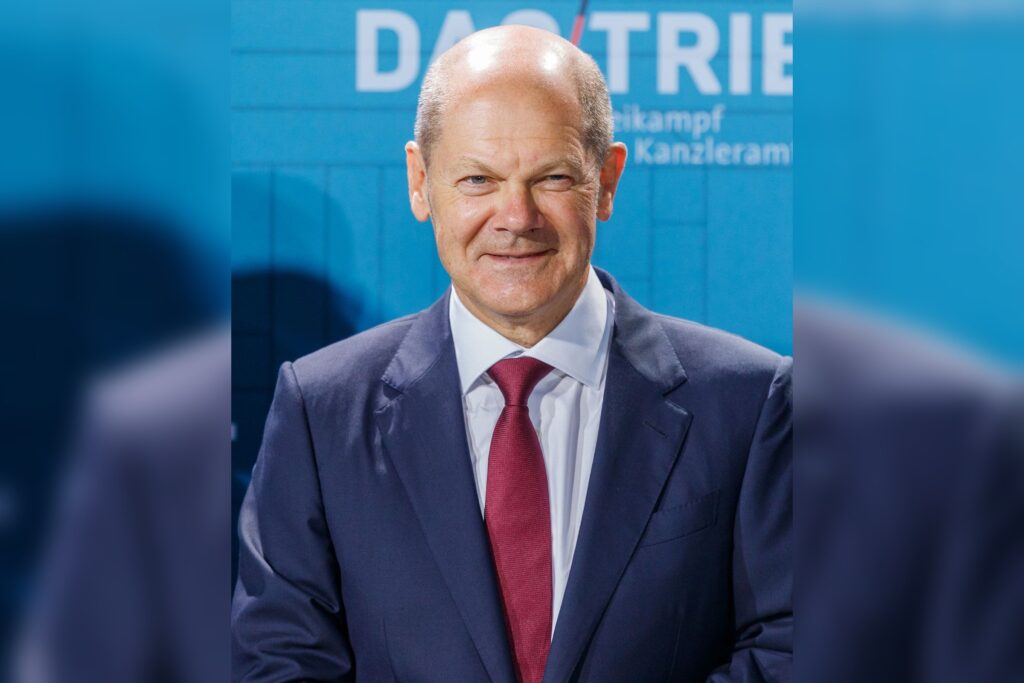
BERLIN, July 12 — Against this backdrop of a grinding continental war and a fundamental rethinking of German defence policy, Chancellor Olaf Scholz finds himself once again at the centre of a debate that defines his chancellorship. The decision to supply Ukraine with a package of 50,000 strike drones is the latest chapter in a tenure that has been, from its very beginning, shaped by the Russo-Ukrainian War.
Scholz, who took office on December 8, 2021, leads a coalition government uniting the Social Democrats (SPD), the Greens, and the Free Democrats (FDP). Born in Osnabrück on June 14, 1958, he is a lawyer by training, holding a degree from the University of Hamburg.
Before reaching the chancellery, he served as mayor of Hamburg from 2011 to 2018, and then as Vice Chancellor and Finance Minister under Angela Merkel from 2018 to 2021. It was a trajectory of steady, technocratic ascent, but the war in Ukraine transformed the context of his leadership entirely.
A Policy of Cautious Substance
The hallmark of Scholz’s approach to the conflict has been a policy of what observers describe as cautious but substantial military support for Ukraine. This has included the delivery of Leopard 2 tanks and IRIS-T air defence systems. The new commitment of 50,000 strike drones fits squarely within that pattern: significant hardware, provided with a deliberateness that frustrates some allies and reassures others.
In the corridors of European power, the question of pace and scale is never far from the conversation. What is at stake for Scholz is a delicate political balance.
He has faced sustained criticism from two opposing flanks. On one side, hawks argue that Germany is still moving too slowly, that the aid, while real, is not arriving in sufficient quantity or speed to make a decisive difference on the battlefield. On the other side, doves within his own party and beyond warn of escalation, of the risk that deeper involvement could draw NATO into a direct confrontation with Moscow.
Navigating this tension has defined his political survival.
The Domestic Picture
The wider picture for the Chancellor at home is one of persistent political fragility. His approval ratings have fluctuated, and by 2024, the SPD was polling in the range of 15 to 18 percent. Those numbers reflect a coalition government that has often appeared fractious, struggling to present a unified front on energy policy, the economy, and the pace of military spending.
The war has exposed structural weaknesses in Germany’s energy dependence on Russia, a dependence Scholz has worked to dismantle, pushing for energy independence as a strategic imperative. Alongside that effort, he championed a €100 billion military modernisation fund for the Bundeswehr.
It was a landmark decision, a break with decades of post-war restraint in defence spending. Yet the implementation of that fund, the translation of billions into actual combat readiness, has been a slow and bureaucratic process. The drone package for Ukraine is, in part, a signal that the production capacity and the political will are still being mobilised.
Looking ahead, the Chancellor’s ability to sustain this middle course will be tested by the evolving dynamics of the war and the patience of his coalition partners. The Greens have generally pushed for a more assertive stance, while the FDP has focused on fiscal discipline.
Scholz, the former mayor of Hamburg and the man who once managed Germany’s finances, must now manage a crisis that has no clear endpoint. The 50,000 drones are a fact on the ground, but the debate over what comes next is only just beginning.




