
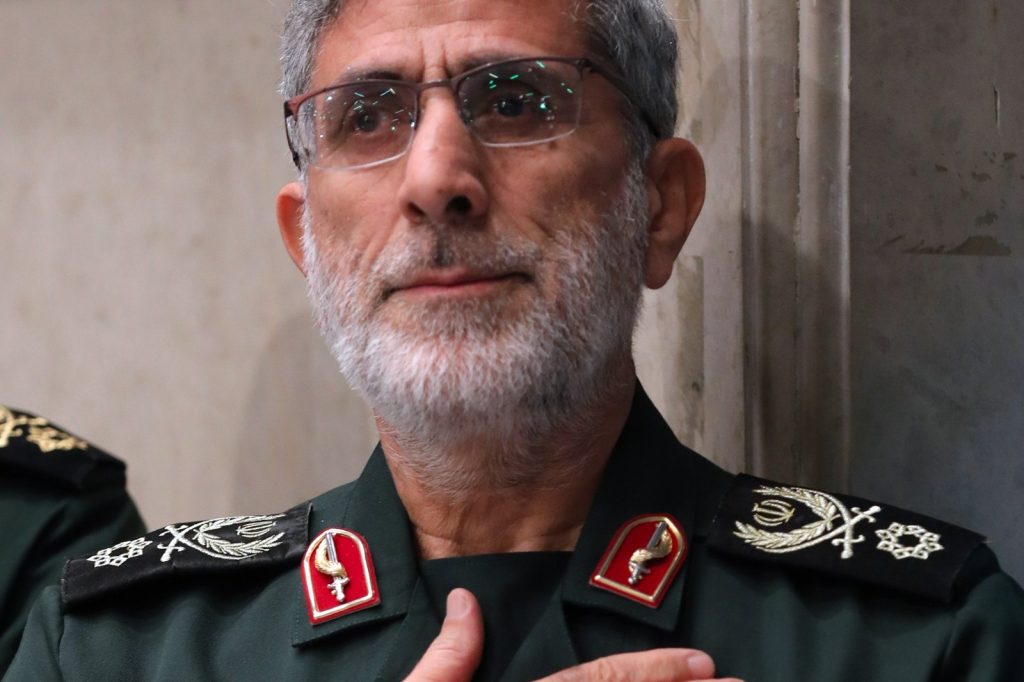
TEHRAN, July 7 — For years, Esmail Qaani has operated in the shadows. The commander of Iran’s Quds Force, the elite foreign operations branch of the Islamic Revolutionary Guard Corps (IRGC), Qaani succeeded Qasem Soleimani after Soleimani’s assassination in a U.S. drone strike in January 2020. Born in 1957 in Mashhad, Iran, Qaani joined the IRGC in 1980.
His low public profile stands in stark contrast to his predecessor’s charismatic, almost mythical stature. Where Soleimani courted cameras and built a personal brand as Iran’s master strategist, Qaani has remained a quiet, bureaucratic figure.
That does not mean his work is any less consequential. Under Qaani, the Quds Force has continued operations against U.S. and allied forces. He has overseen Iran’s support for proxy groups in Yemen, Syria, Iraq, and Lebanon, including the Houthis and Hezbollah.
These are not small operations. They are the backbone of Iran’s regional influence.
Qaani has been sanctioned by the U.S. and the European Union. His role in coordinating attacks in the Strait of Hormuz is not directly confirmed, but the IRGC Navy operates under the Quds Force’s broader command structure. This means any escalation in the Persian Gulf could trace back to his desk.
The Quds Force remains a designated terrorist organization by the U.S. government. Its commander is a high-value target. The question for Washington is whether Qaani’s lower profile makes him harder to track — or simply less of a priority.
A commander shaped by war
Qaani’s formative experience was the Iran-Iraq War, a brutal eight-year conflict that killed hundreds of thousands. He joined the IRGC during that war, rising through the ranks. His loyalty to the Supreme Leader is unquestioned.
His operational focus has been on building and maintaining Iran’s network of proxy forces across the Middle East. Hezbollah in Lebanon.
The Houthis in Yemen. Shia militias in Iraq. The Assad regime in Syria.
These are the assets Qaani manages. They are not just allies.
They are extensions of Iranian military power, armed, trained, and directed by the Quds Force.
A low profile, a high threat
Qaani is known for his low public profile compared to Soleimani. He rarely gives speeches. He does not post on social media.
He does not pose with fighters for propaganda videos. This makes him harder to target, but also harder to read.
Some analysts suggest this is deliberate. Qaani may be avoiding the spotlight to reduce his risk of assassination. Others argue it reflects a different leadership style — more managerial, less theatrical.
Either way, the result is the same: the Quds Force continues its operations, but with less public fanfare.
The Strait of Hormuz question
One of the most sensitive areas of Qaani’s responsibility is the Strait of Hormuz. The IRGC Navy operates under the Quds Force’s broader command structure. This means Qaani has at least indirect authority over any naval operations in the Persian Gulf.
His role in coordinating attacks in the Strait is not directly confirmed. But the structure is clear.
The Quds Force sets strategic priorities. The IRGC Navy executes them. If Iran decides to disrupt oil shipments, Qaani will be involved in the planning.
Sanctions and isolation
Qaani has been sanctioned by the U.S. and the European Union. This means his assets are frozen. He cannot travel.
He cannot do business with Western entities. He is a designated individual, cut off from the global financial system.
This isolation has practical consequences. It makes it harder for Qaani to coordinate with proxy groups that need money and weapons. It limits his ability to travel to Syria or Lebanon for face-to-face meetings.
It forces him to rely on intermediaries and encrypted communications. Qaani remains in command.
The Quds Force remains active. The network of proxies remains intact. The commander of the Quds Force is always a figure of consequence.
Under Qaani, that consequence is quieter, but no less real. The world should watch him carefully.




