
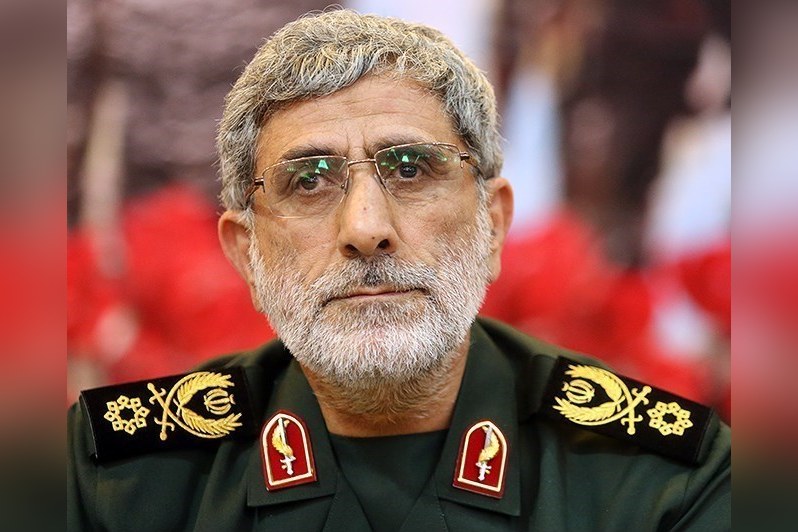
TEHRAN, July 7 — Esmail Qaani, the commander of Iran’s elite Quds Force, remains one of the most consequential yet least visible figures in the Islamic Republic’s military establishment. Qaani has led the extraterritorial special operations arm of the Islamic Revolutionary Guard Corps (IRGC) since January 3, 2020, the day a US drone strike killed his predecessor, Qasem Soleimani. Born in 1957 in the northeastern city of Mashhad, Qaani joined the IRGC in 1980 during the Iran-Iraq War.
For 23 years, from 1997 until Soleimani’s death, he served as the deputy commander of the Quds Force, overseeing operations in Afghanistan and Iraq. Those years gave him deep familiarity with the network of proxy forces that Iran relies on to project power across the Middle East.
Today, Qaani commands a sprawling constellation of armed groups. Hezbollah in Lebanon, Hamas in Gaza, the Houthis in Yemen, and Shia militias in Iraq and Syria all fall under his purview. These are not merely allied groups; they are assets Iran has cultivated, funded, and armed for decades.
Under Qaani’s leadership, the Quds Force has also supplied drones and missiles to Russia for use in the Ukraine war since 2022, extending Iran’s military reach into a European conflict. Qaani reports directly to IRGC commander Major General Hossein Salami and to Supreme Leader Ali Khamenei.
That chain of command places him at the centre of Iran’s most sensitive military decisions. The US Treasury Department sanctioned Qaani in 2012 for providing support to the Syrian government of Bashar al-Assad, a designation that froze any assets he might hold under US jurisdiction and barred Americans from dealing with him. His public profile is deliberately low.
Unlike Soleimani, who cultivated an almost cult-like public image through battlefield photographs and speeches, Qaani keeps to the shadows. He rarely appears in media, and when he does, it is usually in tightly controlled settings. This opacity makes him harder to track and, some analysts suggest, harder to deter.
A low profile, a heavy hand
Qaani is believed to have been involved in planning the January 28, 2025, attack on US forces in Iraq that triggered American retaliatory strikes. That attack marked a significant escalation in a region already bristling with tensions. The US response was swift, though the full details of those strikes remain classified.
What is clear is that Qaani’s fingerprints were on the operation, according to US and allied intelligence assessments. The January attack was not an isolated incident.
It came after months of escalating exchanges between Iranian-backed militias and US forces stationed in Iraq and Syria. For Qaani, managing these proxy forces requires a delicate balance: he must keep them active enough to pressure American and Israeli interests, but not so aggressive that they provoke a full-scale war that Iran cannot win. His network has proven resilient.
Hezbollah in Lebanon fields tens of thousands of rockets and an experienced fighting force. The Houthis in Yemen have disrupted Red Sea shipping and fired missiles at Israel.
Hamas, despite heavy losses in its 2023-2024 war with Israel, retains the capacity to rebuild. Shia militias in Iraq have periodically attacked US bases and personnel. Each of these groups operates with Iranian guidance, funding, and weapons — much of it coordinated through the Quds Force.
Sanctions and consequences
The 2012 US Treasury sanctions against Qaani were part of a broader effort to isolate the Assad regime and its backers. At the time, the US government stated that Qaani had provided material support to the Syrian government as it cracked down on a popular uprising that had spiralled into civil war. Those sanctions remain in effect, and they have been joined by additional designations targeting the IRGC and its leadership.
Yet sanctions alone have not constrained Qaani’s operations. The Quds Force operates largely outside the formal banking system, using cash, front companies, and informal value-transfer networks to move money to its proxies.
Iranian drone and missile technology has been transferred to Russia despite international export controls, and Russian forces have used those weapons extensively in Ukraine. The US and its allies have imposed additional sanctions on entities involved in that military cooperation, but the transfers have continued.
What to watch next
Qaani’s role in the January 2025 attack on US forces suggests he is willing to take risks that Soleimani might have avoided. Whether that reflects a calculation that the US is overstretched, or a miscalculation about American resolve, remains an open question. The US administration under President Donald Trump has signalled a willingness to use military force to protect American personnel and interests in the region, and the January strikes demonstrated that willingness in action.
For now, Qaani continues to operate from within Iran, directing a network that spans four countries and multiple conflict zones. His longevity in the role will depend on his ability to avoid the fate that befell his predecessor — and on the strategic patience of the supreme leader who appointed him.




