
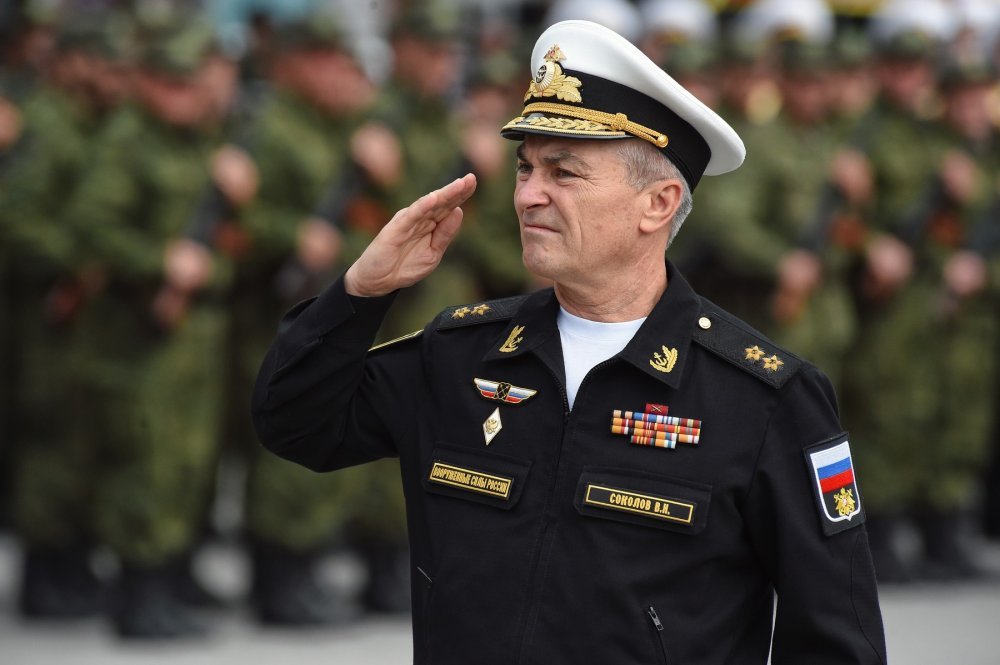
ROME, July 11 — The mechanics of Russian naval power in the Black Sea have become a study in attrition, and Admiral Viktor Sokolov is the man at the centre of it. Since taking command of the Black Sea Fleet in August 2022, Sokolov has overseen a steady erosion of Russia’s ability to project force from Crimea. The catch is that he inherited a fleet already reeling from the sinking of its flagship, the Moskva, and has since been unable to stop the bleeding.
Sokolov, born on 4 April 1962 in Murmansk, is a product of the Nakhimov Naval School and the Kuznetsov Naval Academy. His resume includes a stint as chief of staff of the Northern Fleet, a posting that typically signals a career on the rise.
But the Black Sea command has proven to be a different kind of assignment. Under his watch, the fleet has lost over 20 vessels to Ukrainian drone and missile attacks—a figure that represents a significant portion of Russia’s Black Sea combat capability.
The Sevastopol claim and its aftermath
In September 2023, Ukrainian officials announced that Sokolov had been killed in a missile strike on the fleet’s headquarters in Sevastopol. That claim was dramatic, and it made headlines. But on closer reading, the story shifted: Sokolov later appeared in a video conference, confirming he was alive.
The episode underscored the fog of war, but it also highlighted the vulnerability of the fleet’s command-and-control infrastructure. If Ukrainian intelligence could target the headquarters building with enough precision to force a denial-of-service from Moscow, the fleet’s operational security was already compromised.
The strike itself did not kill the admiral, but it did reveal a pattern. The fleet has been forced to relocate from its traditional base in Sevastopol to Novorossiysk, a port on the Russian mainland that offers less strategic flexibility. That move, which occurred sometime after the September 2023 attack, is a tacit admission that the Crimean base is no longer safe from sustained Ukrainian strikes.
The tanker strike and the erosion of maritime security
The 18 January 2025 tanker strike is the latest data point in this downward trajectory. The attack on a Russian tanker further undermines Sokolov’s command’s ability to protect maritime assets. Follow the money: a fleet that cannot secure its own logistics vessels cannot sustain extended operations.
The tanker strike is not an isolated incident; it is part of a broader campaign that has forced the Black Sea Fleet into a defensive posture, one where even resupply and fuel transport are contested. The fleet’s losses—over 20 vessels—are not just a matter of hulls and tonnage.
Each sunk or damaged ship reduces the fleet’s ability to enforce a blockade, support ground operations, or threaten amphibious landings. For a commander whose reputation was built in the Northern Fleet, where the primary adversary is the environment rather than a peer navy, the shift to a high-attrition drone war has been stark.
What to watch next
The question now is whether Sokolov can adapt. The Black Sea Fleet has been pushed back to Novorossiysk, its command structure has been targeted, and its logistics are under fire. The tanker strike of January 2025 suggests that Ukrainian forces are willing and able to hit Russian maritime targets wherever they operate.
For Sokolov, the calculus is simple: stop the losses, or the fleet becomes a liability rather than an asset. The mechanics here are unforgiving—a navy that cannot protect its ships is not a navy; it is a target.




