
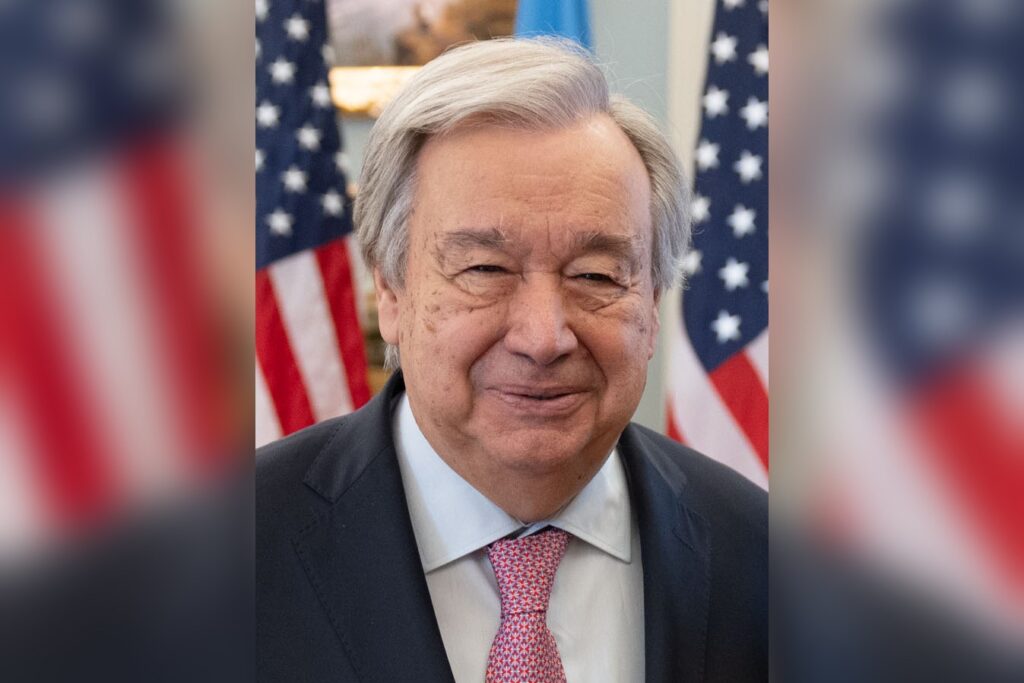
UNITED NATIONS, September 23 — UN Secretary-General António Guterres used the opening of the General Debate of the General Assembly’s 81st session on Tuesday to frame the world’s crises as four defining “tests of power,” with roughly 100 days left in his term. According to the statement, Guterres presented his annual report of the Organization and described a decade of eroding international norms — civilians targeted in war, humanitarian workers killed, international law “cast aside,” and fraying trust between nations.
He said power itself is being fundamentally reshaped in three ways, and declared: “The faultlines in our world are widening. Cracks have become canyons.” Rather than accept fragmentation as inevitable, he called for galvanizing cooperation and a truly global network built on interdependence and shared rules.
He warned against sliding into rival blocs with separate economic and security systems — a scenario he has termed in recent years the Great Fracture. “The greatest power is not the power to dominate,” he said. “It is the power to build a future that works for everyone.”
War and peace
Guterres pointed to cascading crises across the Middle East, Ukraine, Sudan and Myanmar, arguing that so-called ceasefires have often amounted to little more than “lesser fires,” with civilians continuing to pay the price. He renewed calls for compliance with International Court of Justice orders regarding Gaza and warned that settlement expansion in the Israeli-occupied West Bank threatens to extinguish the two-State solution. He condemned Russia’s full-scale invasion of Ukraine as a clear violation of the UN Charter.
Renewing longstanding calls for Security Council reform, he singled out the continued absence of permanent African representation as “unjust and indefensible” given the 15-member organ’s founding in a starkly different geopolitical era.
Inequality and the financial system
On inequality, Guterres highlighted the gap between record global wealth and the billions still lacking access to food, clean water, education and healthcare. He said inequality is not merely an economic issue but a question of power over opportunity, resources and self-determination. He reiterated his long-held view that the international financial system leaves developing nations crushed by debt while facing climate disasters they did little to cause, and called for faster debt relief, bolder multilateral development banks and fairer access to Special Drawing Rights created by the International Monetary Fund.
Devoting particular attention to gender inequality, he announced that the UN has achieved full gender parity across senior leadership, headquarters staff and professional roles for the first time in its history. “Equality is not a dream; it is a decision,” he said, citing progress at the UN as proof that entrenched power structures can change.
Climate and artificial intelligence
Guterres said the climate crisis is the “most profound intergenerational power imbalance,” warning of a near-certain breach of the 1.5°C threshold. He called for polluters to “pay” and for developed nations to triple adaptation funding, pointing out that major oil companies are reaping substantial profits since Russia’s invasion of Ukraine while global adaptation finance for developing countries remains a fraction of that sum. Turning to artificial intelligence, the Secretary-General warned that power is increasingly concentrated in data, computing capacity and algorithms.
The speech was delivered at the opening of the General Debate of the UN General Assembly’s 81st session, with roughly 100 days remaining in Guterres’s term. What to watch next is whether the reform appeals he renewed — Security Council expansion and a fairer financial architecture — gain any traction among member states before his successor takes office.




