
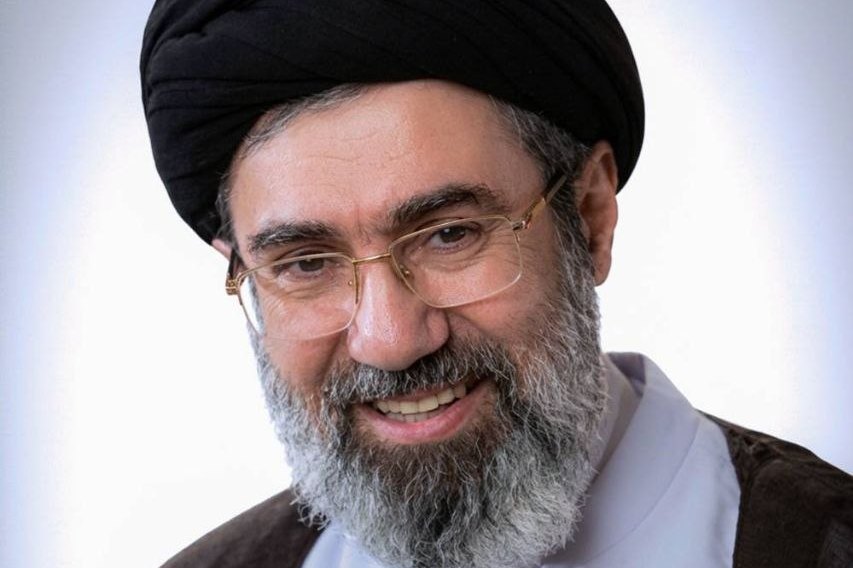
Tehran, August 28 — Six months after the United States and Israel launched their coordinated military campaign against Iran on February 28, the conflict persists with mounting economic strain. The opening strike killed IRGC commander Mohammad Pakpour and armed forces chief of staff Abdolrahim Mousavi, while other senior commanders were slain in the weeks that followed. After the assassination of Supreme Leader Ali Khamenei in the opening strike, his son Mojtaba was appointed just more than a week later, a succession Tehran presented as proof of continuity and cohesion.
Six months on, he has yet to make a verified public appearance. His portrait is carried through city squares and at mourning ceremonies, and decrees are issued in his name, while rumours about his condition persist.
A leadership that once drew its authority from the visible presence of a single figure now rests, in part, on an absence. The state has also had to rebuild its command structure in the middle of the war. On August 10, decrees issued in Mojtaba’s name formalised a new military leadership, including Ahmad Vahidi as IRGC chief and Ali Abdollahi as chief of staff. The appointments appear to favour loyalty and continuity over change and were widely read as a signal that Tehran did not intend to soften its posture.
The deeper significance is simpler: A state still rebuilding its high command in the sixth month of a war is not doing so from a position of strength. US officials had already branded the broader effort “Economic Fury”; on August 24, the Treasury launched Operation Economic Outcast , an expanded campaign aimed at severing Iran’s remaining financial links with the outside world.
Its instruments are familiar from the pre-war “maximum pressure” era but are being applied more aggressively: Secondary sanctions on those moving Iranian oil, measures against its “shadow fleet” and financial networks, and greater enforcement of international sanctions. Iran’s oil exports, near 1.8 million barrels a day before the war, have fallen below half a million; inflation is approaching 90 percent, with food prices more than double what they were a year ago. The siege lands on an economy whose troubles were never solely the work of sanctions.
Iran had long failed to insulate itself from an architecture built over decades, from US sanctions dating to the 1980s to United Nations Security Council resolutions since 2006. Neither the 25-year, $400bn partnership with China nor the strategic treaty signed with Russia in early 2025 delivered the stability Tehran sought.
Before the war, Ali Khamenei and Pezeshkian had acknowledged that sanctions alone could not account for the depth of the crisis and that governance bore its share. The economic weapon works in part because the state it targets was already structurally exposed. That pressure is now enforced at sea.
Iran closed the Strait of Hormuz in retaliation on February 28 and, six months on, it has not reopened; the naval blockade that followed has fused with the closure into a single chokehold on Iran’s trade. The clearest sign that the war has returned to its economic origins is the campaign Washington has intensified since suspending strikes in early August.
Economics, then war, then economics again. At the 100-day mark, Tehran could plausibly present the outcome as a victory of survival: Its adversaries had failed to topple the system, and by its own measure that was what mattered. Six months on, that claim is harder to sustain because the pressure has shifted to the terrain on which Iran has always been weakest.
The question is no longer whether Iran can survive military attack, but whether it can withstand an economic siege with no sign of lifting. What to watch next is whether the new leadership can secure any economic lifeline before the chokehold deepens.




