
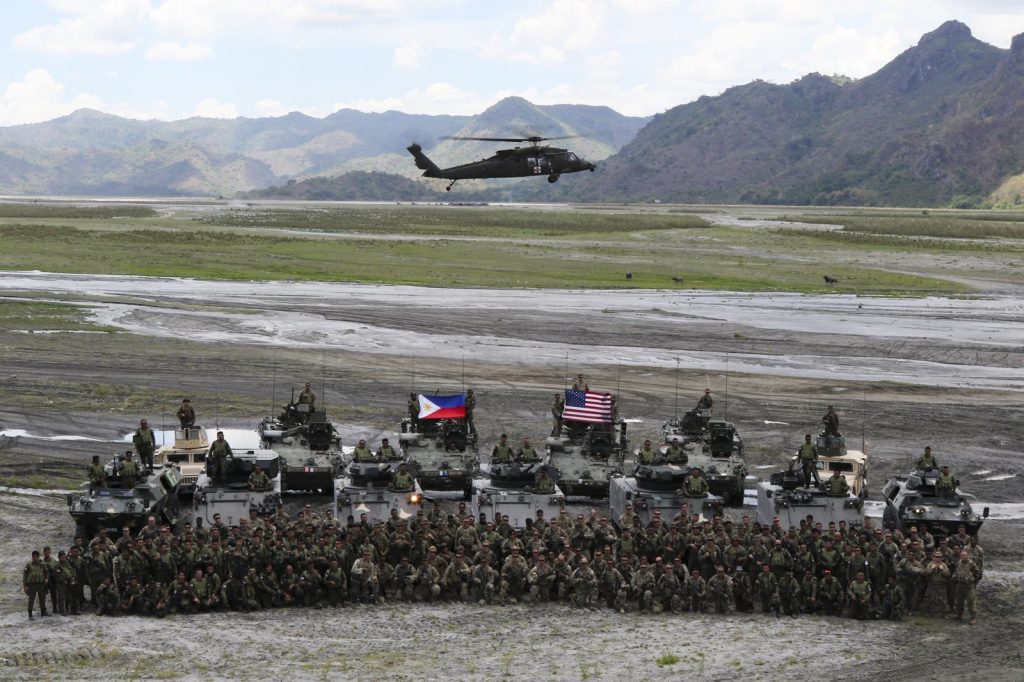
More than thirty years after the United States closed its major bases in the Philippines, Washington and Manila are moving to restore a stronger American footprint. On February 2, the two allies announced an expansion of U.S. access to Philippine territory under the 2014 Enhanced Defense Cooperation Agreement. The deal permits rotating units of U.S. forces to use four newly designated camps in addition to the five existing local bases where American troops already operate.
To support the increased presence, the United States is financing construction projects that are rapidly erecting barracks, warehouses and other essential facilities. These upgrades are intended to house a substantial number of visiting troops and form part of a broader strategy to create a network of allied military installations across Asia.
The primary driver behind the arrangement is the desire to counter what both governments describe as an increasingly assertive China, particularly in the South China Sea. Officials say the selected locations will give the U.S. military a robust posture capable of acting as a deterrent against any coercive behavior by Beijing.
The South China Sea remains a contested zone where China, the Philippines and four other claimants have faced mounting territorial disputes. Beijing also maintains that Taiwan is an inseparable part of its territory and has warned it could use force to bring the island under its control. Manila‑based political scientist Andrea Chloe Wong noted that the placement of the new camps ensures the United States can maintain the presence needed to safeguard regional interests.
During a recent trip to Manila, U.S. Defense Secretary Lloyd Austin emphasized that Washington is not seeking to re‑establish permanent bases in the traditional sense. He described the expanded access under the Enhanced Defense Cooperation Agreement as a significant development for both nations.
Roles Beyond Stationing: Exercises, Aid and Modernization
Austin and his Philippine counterpart, Defense Secretary Carlito Galvez Jr., outlined that the visiting American personnel will undertake a range of duties. These include participating in intensified joint combat‑readiness drills with Filipino forces, providing rapid disaster‑relief assistance, and supporting efforts to modernize the Armed Forces of the Philippines.
At a news conference in Austin’s visit, he stressed that the partnership is essential as the People’s Republic of China continues to pursue what he termed unlawful claims in the West Philippine Sea. The expanded cooperation aims to strengthen the alliance, improve response capabilities to regional instability, and help the Philippines maintain a credible defense posture.
Local Economic Views and Community Reaction
The decision to allow a larger U.S. presence near the former Subic Bay naval base has elicited mixed reactions in the surrounding area. Subic, now a bustling commercial freeport and tourist destination northwest of Manila, once benefited from the spending of thousands of U.S. sailors who boosted the nearby city of Olongapo.
Rolen Paulino, administrator of the Subic Freeport, said the government has not yet informed him that the former naval site has been marked as a prospective location for incoming U.S. forces. Nevertheless, he acknowledged that a reactivated American military presence would likely increase employment and raise income for the freeport.
Paulino added that the economic boost is especially important as many Filipinos and businesses continue to recover from two years of COVID‑19 lockdowns and the recession triggered by the pandemic. He likened the expected influx of troops to tourists who would contribute to the local economy’s rehabilitation.




