
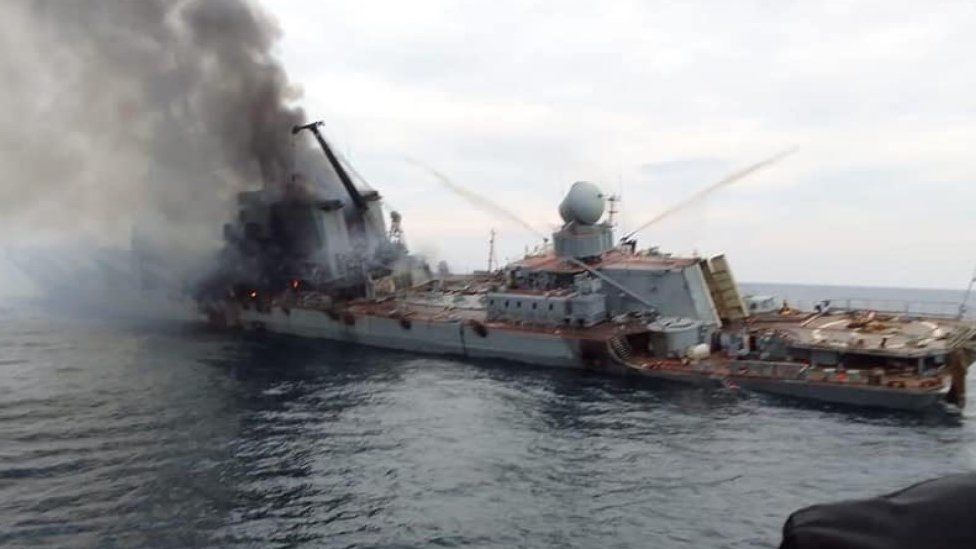
MOSCOW, July 9 — Russia’s Black Sea Fleet has sustained a series of verified naval losses since the full-scale invasion began on February 24, 2022, according to open-source intelligence assessments and official statements from both Ukrainian and Western officials. The confirmed losses include a cruiser, a submarine, four landing ships, and multiple patrol boats, representing what Western officials have estimated to be 20 to 30 percent of the fleet’s combat capability.
The most significant single loss came on April 14, 2022, when the guided-missile cruiser Moskva — the flagship of the Black Sea Fleet — was sunk following a strike by Ukrainian Neptune anti-ship missiles. The sinking of the Moskva marked the first time a Russian flagship had been lost in combat since World War II, and it forced a strategic recalculation of Russian naval operations in the western Black Sea.
On September 13, 2023, the submarine Rostov-on-Don was damaged in a strike on the port of Sevastopol. The Rostov-on-Don, a Kilo-class submarine capable of launching Kalibr cruise missiles, had been a key asset for strikes against Ukrainian infrastructure. The damage to the submarine in its dry dock effectively removed a significant portion of the fleet’s subsurface strike capability for an extended period, according to naval analysts tracking the conflict.
Landing Ships: A Pattern of Attrition
The Russian Navy has lost four landing ships since the start of the invasion, a fact that has constrained Moscow’s ability to project amphibious power and resupply forces by sea. The first of these, the landing ship Saratov, was destroyed on March 24, 2022, in the port of Berdyansk while offloading ammunition. Ukrainian forces struck the port with Tochka-U ballistic missiles, and the resulting explosion and fire destroyed the Saratov at its berth.
On December 26, 2023, the landing ship Novocherkassk was destroyed in the port of Feodosia in Crimea. Ukrainian aircraft launched cruise missiles against the vessel, which was reportedly carrying a cargo of Iranian-made Shahed drones at the time of the strike.
The explosion was so powerful that it was recorded on seismic sensors across the region. On February 14, 2024, the landing ship Caesar Kunikov was sunk by Ukrainian uncrewed surface vessels, or USVs, off the coast of Crimea. The attack demonstrated Ukraine’s growing proficiency with maritime drone technology, which has become a central feature of the naval campaign.
Just two weeks earlier, on February 1, 2024, the corvette Ivanovets was also sunk by USVs, further depleting the fleet’s surface combatant strength.
Patrol Boats and the Snake Island Engagement
The patrol boat Vasily Bykov was damaged on March 7, 2022, near Snake Island during the early phase of the war. The vessel was reportedly struck by Ukrainian artillery or missile fire while operating in support of the Russian effort to capture the strategic island in the Black Sea. The damage to the Vasily Bykov, while not a total loss, contributed to the pattern of attrition that has gradually eroded the fleet’s operational readiness.
Independent analysts, including the open-source intelligence site Oryx, have confirmed a total of at least one cruiser, one submarine, four landing ships, and multiple patrol boats as destroyed or damaged beyond repair. The Oryx project, which relies on photographic and video evidence to verify losses, has become a widely cited source for tracking equipment attrition on both sides of the conflict.
Ukrainian Claims and Independent Verification
Ukrainian officials have claimed significantly higher numbers of Russian naval losses than those independently verified. As of August 2023, Ukraine claimed to have destroyed or disabled 21 vessels in a 72-hour window of operations. Independent analysts, however, confirmed at least five to seven significant hits during that period.
The discrepancy between Ukrainian claims and verified losses is a consistent feature of wartime reporting from both sides, and analysts caution that claims of mass destruction should be treated with skepticism absent photographic or satellite confirmation. The cumulative effect of these losses, according to Western officials, has been to reduce the Black Sea Fleet’s combat capability by an estimated 20 to 30 percent.
This assessment takes into account not only the vessels destroyed or damaged but also the operational constraints imposed by the threat of further Ukrainian strikes. The fleet has largely withdrawn from the western Black Sea, and Russian naval operations have been increasingly confined to the eastern portion of the sea, closer to Russian bases in Novorossiysk.
Strategic Implications for the Black Sea
The attrition of the Black Sea Fleet has had direct consequences for the broader war effort. Russia’s ability to conduct amphibious operations has been severely curtailed, and the fleet’s capacity to enforce a blockade of Ukrainian ports has been compromised. The sinking of the Moskva, in particular, dealt a psychological blow to the Russian Navy and demonstrated that even its most heavily defended assets were vulnerable to Ukrainian precision strikes.
The loss of landing ships has also complicated Russian logistics. The ability to move heavy equipment and supplies by sea along the Crimean coast was a key advantage for Russian forces in southern Ukraine.
With four landing ships destroyed, the remaining amphibious assets have been forced to operate under constant threat of drone and missile attack, reducing their utility as a strategic asset. The damage to the Rostov-on-Don submarine has similarly reduced the fleet’s ability to conduct long-range cruise missile strikes. Kalibr missiles launched from submarines have been a staple of Russia’s campaign against Ukrainian infrastructure, and the loss of even one submarine from the fleet’s limited subsurface force represents a meaningful reduction in strike capacity.
What to Watch Next
Looking ahead, the trajectory of Russian naval losses will depend on several factors. Ukraine has continued to develop and deploy uncrewed surface vessels, and attacks on Russian naval targets have become a regular feature of the conflict. The Black Sea Fleet’s remaining major surface combatants, including frigates and smaller corvettes, remain potential targets for Ukrainian strike systems.
Russia, for its part, has reinforced its naval presence in the Black Sea with additional air defense systems and has moved some assets to ports in the eastern Black Sea that are out of range of Ukrainian missiles. Whether these measures will be sufficient to prevent further losses remains an open question.
The record of the past three years suggests that no Russian vessel operating within range of Ukrainian strike systems can be considered safe. The confirmed losses — one cruiser, one submarine, four landing ships, and multiple patrol boats — represent a significant portion of the Black Sea Fleet’s pre-war strength. As the conflict continues, the fleet’s ability to project power and support ground operations will remain a key variable in the broader strategic equation.
Western officials have noted that the erosion of Russian naval capability in the Black Sea has been one of the more consequential developments of the war, with implications that extend beyond the immediate battlefield to the balance of power in the wider region.




