
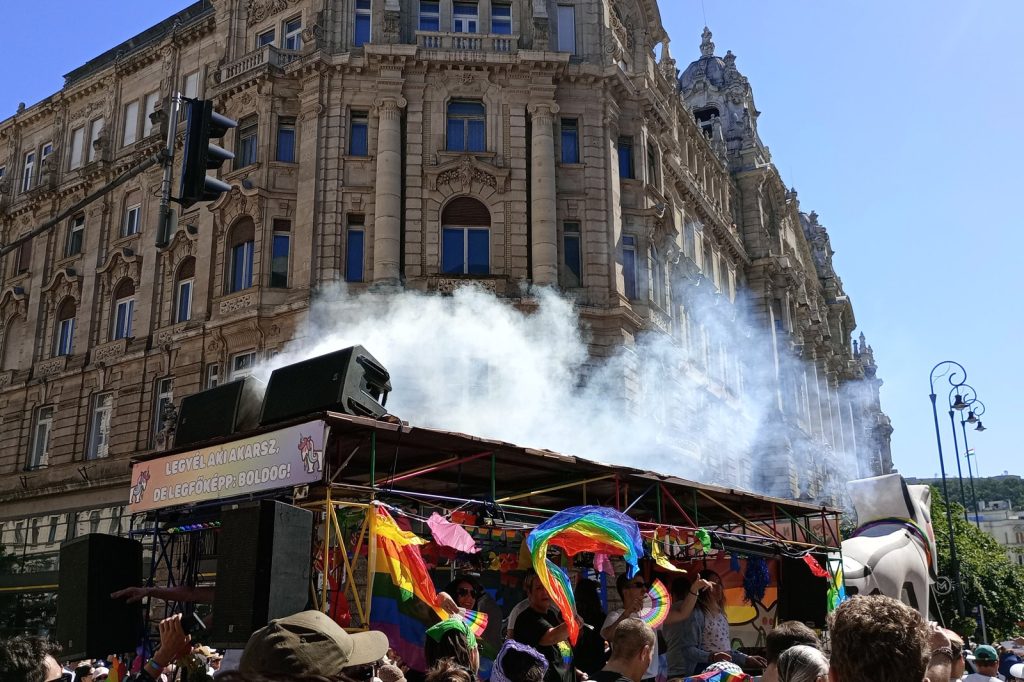
Budapest’s Pride parade on Saturday unfolded under a brutal sun, temperatures breaking records, but the real heat was political. More than 10,000 Hungarians marched. They carried massive rainbow flags and European Union flags.
The route was long. The crowd was loud.
And for the first time in years, no state ban hung over them. Viktor Orban lost the April election. His defeat to Peter Magyar’s centre-right Tisza party meant the end of a law that tried to stop this march.
Last year, Orban’s government had moved to ban the event outright. That didn’t work.
Instead, the 2024 Pride turned into a mass anti-government protest, tens of thousands strong. People came not just to march for LGBTQ+ rights, but against the government itself. This year was different.
The ban was lifted. The state did not obstruct. The march went ahead as a celebration.
Fanni Fajth, an 18-year-old student, said the mood had shifted hard. “Everyone is just so much more uplifted,” she said.
That optimism was a direct product of the election result. Orban had spent years targeting LGBTQ+ Hungarians. He passed laws ending legal gender change on personal documents.
He stopped adoption by same-sex couples. He banned school materials that mentioned homosexuality or gender transition.
He called it defending Christian values against Western liberalism. Brussels and human rights groups called it discrimination. Now, with Orban out, Fajth said she hoped for “equal rights finally after all these years.” She specifically mentioned adoption and marriage.
Mate Tarnai, a 51-year-old chemist, felt the change personally. “The biggest change is actually the change in politics in the country,” he said. “We feel more freedom personally as well, and also the atmosphere in the country is much more relaxed than last year.” He too said he hoped for equal rights from Magyar’s government.
But Magyar has asked for patience. He is a conservative.
His Tisza party is centre-right, not left-wing. What that means for LGBTQ+ rights remains unclear. The laws Orban passed are still on the books.
They have not been repealed. The march was not banned, but the legal framework that Orban built is still standing.
The crowd on Saturday was smaller than last year’s. Last year’s march drew tens of thousands. This year, the official count was over 10,000.
The difference is partly political. Last year, Pride was a protest against a government that was still in power. This year, it was a celebration of a government’s defeat.
Different energy. Different size.
Still, the numbers were strong for a single-day event in record heat. People lined the streets. They waved flags.
They cheered. The atmosphere was described as relaxed, optimistic, free.
That is a direct contrast to the tension of previous years under Orban, when the state actively worked to suppress the event. Orban’s defeat in April was narrow but decisive. Magyar’s party won enough seats to form a government.
Orban, who had been in power for over a decade, was out. His anti-LGBTQ+ policies had been a central part of his platform. They had drawn international condemnation.
They had also energized his base. Now, without him in power, the question is whether those policies will be dismantled.
Magyar has not said he will repeal them. He has asked for time. The marchers on Saturday were asking for action.
Fajth and Tarnai both voiced the same hope: equal rights. Whether Magyar delivers remains to be seen.
For one day, at least, the march went ahead without state interference. That, in itself, was a victory.




