
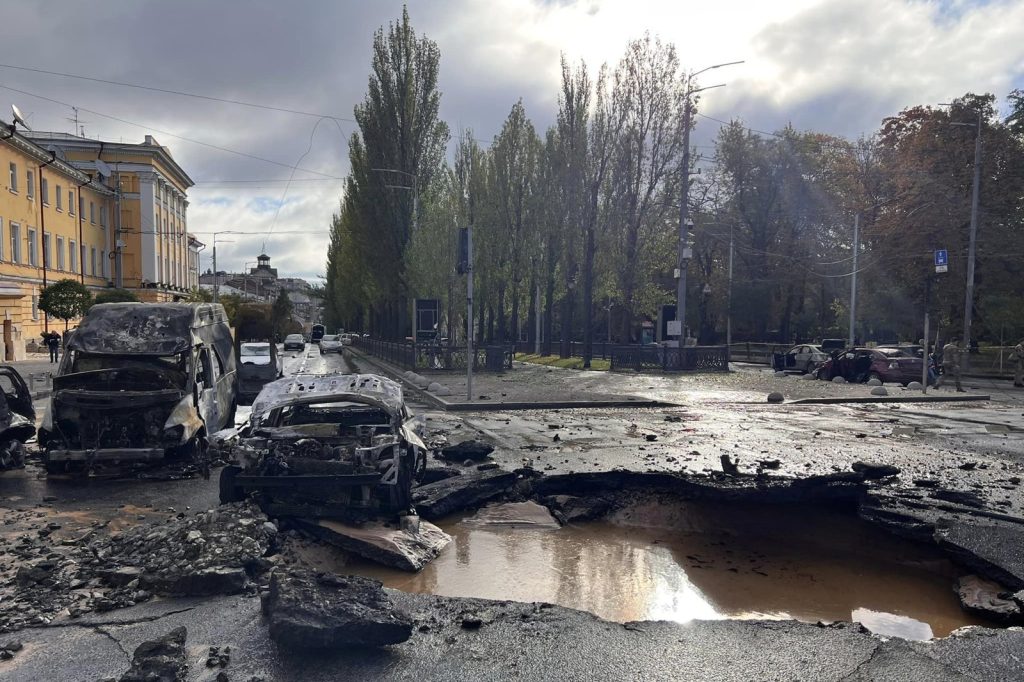
KYIV — The war is no longer being fought on one side of the border. Ukraine’s long-range strikes have turned Russian industrial zones and military depots into active targets. The consequence is a grinding, two-front conflict where each side bleeds the other from a distance.
Moscow’s overnight attack on Kyiv killed at least 30 people. That is the price of Ukraine’s new reach.
The same night, Ukrainian drones and missiles were hitting energy facilities, weapons plants, and military bases deep inside Russia. The trade is brutal and symmetrical. Fuel shortages are now a reported problem inside Russia.
Repetitive strikes on refineries have done that. One attack sent Moscow residents into shelters after explosions.
There were reports of so-called “black rain” falling over parts of the capital. Panic in Moscow was not a feature of this war a year ago. President Volodymyr Zelensky has said Russia moved the bulk of its air defence to protect central Moscow and a presidential residence.
That leaves other targets exposed. He calls the operations “long-range sanctions.” The label is ironic but pointed. These are attacks hundreds of kilometres from the Ukrainian border, hitting places Russians were told were safe.
Vladimir Putin acknowledged there are “problems” and “certain shortages” from the strikes. He tried to downplay it.
But the admission itself is a measure of how the equation has changed. The Kremlin does not usually concede shortages. Social media videos this week showed Flamingo missiles, manufactured by Fire Point, hitting their targets.
The footage is a window into Ukraine’s scaled-up domestic defence industry. These are not hand-me-down weapons from foreign stockpiles.
They are built inside the country. That changes the logistics of the war. On the ground, Russian forces keep pushing along the front line in Donetsk.
They take heavy casualties. They keep pushing. The dynamic is clear: Moscow trades soldiers for metres of territory, while Ukraine trades precision strikes for Russian fuel and manufacturing capacity.
Neither side can stop the other from hurting it. The tactical balance has shifted.
Ukraine now has the ability to strike nearly any target inside Russian territory, according to an analysis cited by Axios. That is a fact. The war that was fought mostly on Ukrainian soil has crossed the border in a serious way.
Few areas inside Russia are considered safe anymore. What to watch next is whether the strikes can be sustained.
Domestic production of missiles and drones is not infinite. But the pattern suggests Ukraine is betting on a strategy of cumulative damage. Hit the refineries.
Hit the plants. Hit the bases. Make the war expensive for Russia to continue.
Putin’s “problems” remark was small. It was also the only public acknowledgment from Moscow that the long-range campaign is working.
The silence elsewhere is loud. The human cost is not symmetrical. Thirty dead in Kyiv in one night.
The front line in Donetsk grinding through more lives. Ukraine’s leverage comes at that price.
The question is whether the leverage is worth the blood. That is a calculation made in real time, night after night, as both sides launch their next volley.




