
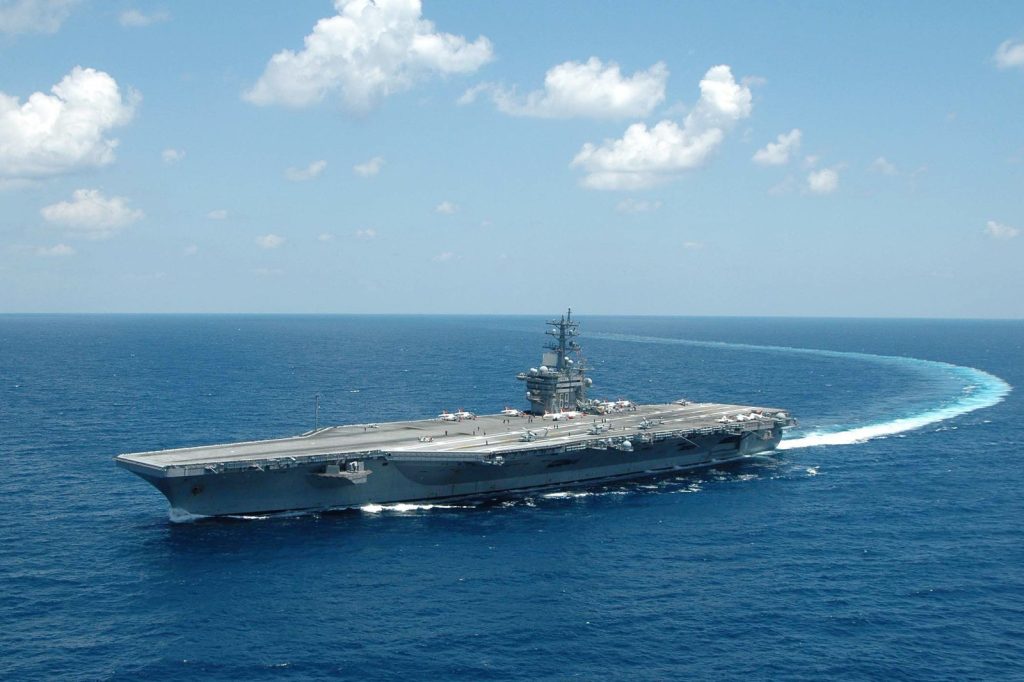
The USS Dwight D. Eisenhower carrier strike group remains stationed in the Persian Gulf, with the Pentagon extending its deployment beyond its originally scheduled rotation. The order came directly from the Department of Defense on March 31, 2025, the same day President Trump issued a related declaration.
In response, Iran’s Foreign Minister, Abbas Araghchi, warned on March 31 that Tehran would “defend its territorial waters” if challenged, putting the two nations on a collision course in one of the world’s most critical waterways.
Strategic Chokepoint and International Response
At the center of this standoff lies the Strait of Hormuz, the narrow waterway that carries approximately 25 percent of all seaborne oil trade and about 20 percent of the world’s liquefied natural gas annually. The concentrated flow through this chokepoint means any disruption could have immediate global implications for energy markets and maritime security.
The United Nations Security Council has scheduled a meeting for April 2, 2025, to address the crisis, signaling the seriousness with which the international community views the situation. The European Union has also weighed in, with foreign policy chief Josep Borrell urging both sides to return to negotiations, calling for restraint amid the rising tensions. The core of this standoff is a question of potential military and diplomatic scenarios. These span the range from renewed negotiations and sanctions pressure to the possibility of further provocations.
The specific actions that could unfold remain unclear, but the presence of the Eisenhower strike group gives the United States a significant naval capability in the region, while Tehran continues to issue warnings about its willingness to assert control over its territorial waters.
Economic Stakes and Historical Context
The economic stakes are already being quantified. On March 31, 2025, the International Monetary Fund warned that a prolonged disruption could cut global GDP growth by 0.3 percent in 2025. That figure, while modest on its face, represents a measurable impact on an already uncertain global economy.
Analysts at the Center for Strategic and International Studies have suggested the United States may impose additional sanctions on Iran’s oil exports. According to CSIS, the specific target would be Chinese refineries that process Iranian crude, a move that could further strain trade relationships and deepen the economic pressure on Tehran.
The backdrop of this crisis is decades of entrenched antagonism between the United States and Iran. The rift dates back to the 1979 Iranian revolution, and it deepened during the Iran-Iraq war in the 1980s, when both sides attacked oil tankers in the Persian Gulf, prompting the U.S. Navy to escort reflagged Kuwaiti vessels. More recently, the 2015 nuclear deal offered a brief period of diplomatic thaw, but that agreement collapsed after the United States withdrew from it in 2018 and reimposed economic sanctions.
Tensions escalated sharply again in 2020, when a U.S. airstrike killed a top Iranian general. Each outbreak has brought a similar pattern: naval deployments, warnings from Tehran, and international calls for calm.
For now, the Eisenhower strike group remains in the Gulf, and the next major moment to watch is the April 2 UN Security Council meeting. The EU’s call for negotiations represents a softer approach, but the underlying military posture signals that both sides are preparing for a prolonged standoff. The IMF’s GDP warning serves as an economic canary in the coal mine, underscoring the potential costs if the situation escalates.
The question of what happens next depends on whether diplomatic channels can reopen or whether the pattern of hostility will continue to define relations in the Gulf.




