
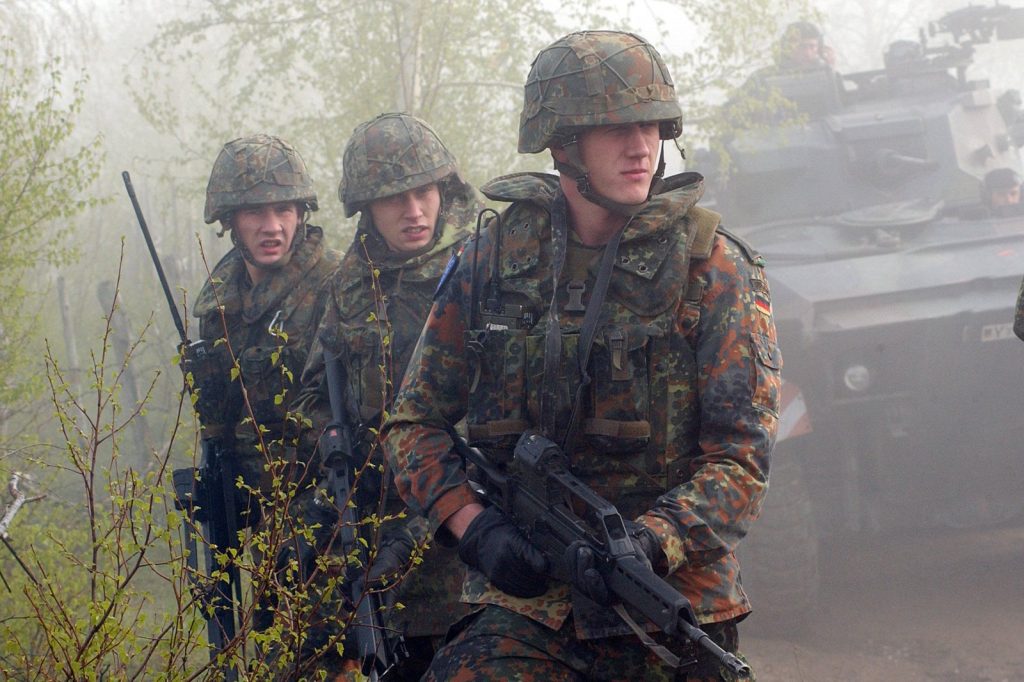
Germany’s journey from a reluctant supplier of helmets to one of Ukraine’s largest military donors did not begin with the 2022 invasion. The relationship between Berlin and Kyiv reaches back more than a century.
In 1918, after the Treaty of Brest-Litovsk, German troops intervened in Ukraine to support the Ukrainian People’s Republic against Soviet Russia, helping install a friendly government under Pavlo Skoropadskyi. That brief episode ended when the Red Army took control, and formal diplomatic ties remained frozen for most of the twentieth century. Modern relations resumed slowly after the Cold War: Germany opened a consulate in Ukraine in 1989 and established full diplomatic relations in 1992, a year after Ukrainian independence. Berlin subsequently backed Kyiv’s aspirations to join the European Union and NATO, offering economic cooperation and assistance building a climate-friendly economy.
The partnership was steady but rarely urgent. That dynamic changed entirely on February 24, 2022, when Russia launched its full-scale invasion.
Germany’s initial response was confined to nonlethal equipment such as helmets and medical supplies, a cautious posture that reflected deep domestic political hesitancy about sending arms into an active conflict zone. The shift from defensive gear to heavy weapons took nearly a full year of war to materialize.
From Helmets to Howitzers: The Escalation of Aid
By January 2023, Germany agreed to supply Leopard 2 main battle tanks, with 18 delivered by March 2023. That decision marked an inflection point. The Leopard 2 is a NATO-standard platform, and Berlin’s willingness to release its own tanks — and to allow other nations to re-export theirs — broke a logjam that had frustrated Kyiv and its allies for months.
The hardware list subsequently expanded to include howitzers, IRIS-T air defense systems, and Marder infantry fighting vehicles. These are not spare parts or surplus stock; they are frontline systems with real combat value.
By 2024, Germany had committed over €17 billion in military aid to Ukraine, placing it second only to the United States among NATO donors. The United States has provided tens of billions more in aggregate, but Germany’s trajectory — from zero lethal aid to the second-largest contributor in just over two years — represents the steepest ramp-up of any major European ally.
A Patchwork Strategy: The Politics of Incremental Escalation
The evolution has not been smooth. Chancellor Olaf Scholz’s government faced constant pressure from coalition partners, opposition parties, and allies such as Poland and the Baltic states to move faster. The early reluctance on Leopard tanks drew sharp criticism.
Berlin argued it would not act alone and wanted U.S. Abrams tanks committed first — a condition that was eventually met. The pattern suggests a government that needs external pressure to act but does act eventually.
The €17 billion commitment did not arrive in one lump sum; it accumulated through multiple tranches, each debated in the Bundestag and covered extensively in German media. The result is a patchwork of pledges rather than a single coherent strategy. The latest pledge — 50,000 strike drones — marks a further shift toward offensive unmanned systems.
Strike drones are designed to find and destroy targets behind enemy lines, not to hold ground or protect fixed positions. This is not a defensive play.
The pledge raises a practical question: can German industry deliver at that scale, and how quickly? Drone production is not like tank manufacturing. Supply chains for components, especially electronics and optics, are global and subject to bottlenecks.
Delivery timelines will matter as much as the headline number.
The Long View: Sustainability and Strategic Realignment
Germany’s role as a key NATO donor is now established, but the sustainability of that role depends on domestic political will and industrial capacity. The war has no end date, and neither does the aid pipeline. For Berlin, the challenge is no longer whether to send weapons — it is how many, how fast, and at what cost to its own military readiness.
The broader significance extends beyond the battlefield. A nation once wary of sending lethal aid now provides frontline systems and has authorized other countries to do the same.
This trajectory signals a lasting realignment in German defense policy, with effects that will outlast the current conflict. The transformation from reluctant supplier to top military donor carries weight not just for Ukraine but for European security architecture as a whole.




