
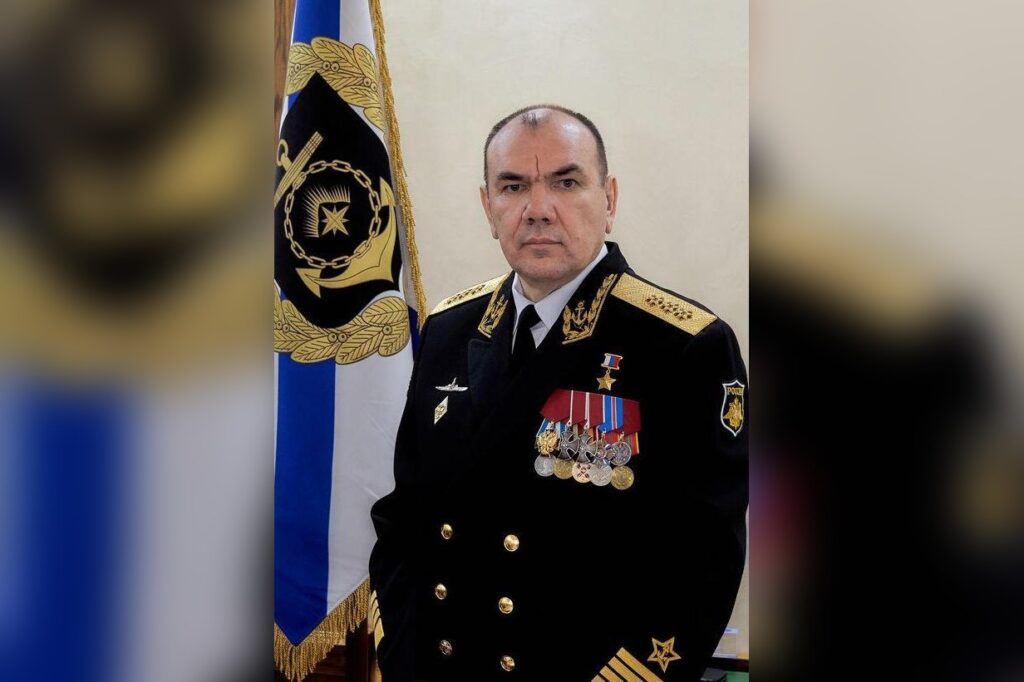
MOSCOW, July 15 — Admiral Alexander Moiseyev, a nuclear-submarine veteran, is now the man tasked with holding together a Black Sea Fleet that is taking hits. His appointment as Commander-in-Chief of the Russian Navy in March 2024, replacing Admiral Nikolai Yevmenov, signals a Kremlin calculation. Moiseyev was born on April 16, 1962, in Kaliningrad, Russia.
He graduated from the Leningrad Naval Institute in 1984 and spent his career in the Northern Fleet, commanding nuclear submarines. He became Chief of Staff of the Northern Fleet in 2011 and its commander in 2019.
Moscow is betting on an officer who understands how to operate under pressure. But the Black Sea is not the Arctic.
The Black Sea Bleeding
Ukraine’s expanded maritime campaign has struck 20 Russian vessels in the Black Sea. Moiseyev faces the challenge of protecting the Black Sea Fleet from Ukrainian drone and missile attacks while maintaining Russia’s naval presence in the region. The Black Sea remains the priority, and it is the theater where his reputation will be made or broken.
His previous experience in Arctic operations may influence strategic shifts. The Northern Fleet is Russia’s premier nuclear arsenal, and Moiseyev knows its rhythms.
But the Black Sea is a different beast — a constrained, shallow body of water where Ukraine has proven it can reach Russian warships with asymmetric tactics. The question is whether a submarine commander from the Arctic can adapt to a fight that is less about strategic deterrence and more about survival against drones and anti-ship missiles.
The Grain Factor
The Black Sea is not just a military theater; it is the artery for Ukrainian grain exports that feed global markets. Russia’s naval presence there is a lever of influence, but it is also a target. Every vessel lost weakens that lever.
Moiseyev’s task is to preserve the fleet’s combat capability without letting it become a liability that drains resources and morale. Russia is being forced to rethink how it uses its navy in a conflict where the enemy has no surface fleet of its own.
Moiseyev’s appointment came amid this expanded Ukrainian campaign. The timing suggests the Kremlin recognized that the old guard under Yevmenov was not adapting fast enough. Moiseyev brings a different background — one rooted in the silent service, in commanding submarines that operate alone for months.
That mindset may be exactly what Russia needs to protect its remaining Black Sea assets. But it also may be irrelevant if Ukraine continues to press its advantage with precision strikes.
What to Watch Next
The coming months will tell whether Moiseyev can stabilize the Black Sea Fleet or whether the losses continue to mount. His Arctic experience could lead to a strategic shift — perhaps dispersing assets, hardening defenses, or changing operational patterns. But the fundamental math has not changed: Ukraine has shown it can hit Russian warships, and the Black Sea is a small pond.
Moiseyev’s career has been defined by operating in the deep, cold, and quiet. The Black Sea is none of those things.
Watch this space for how a submarine commander adapts to a fight above the surface.




