
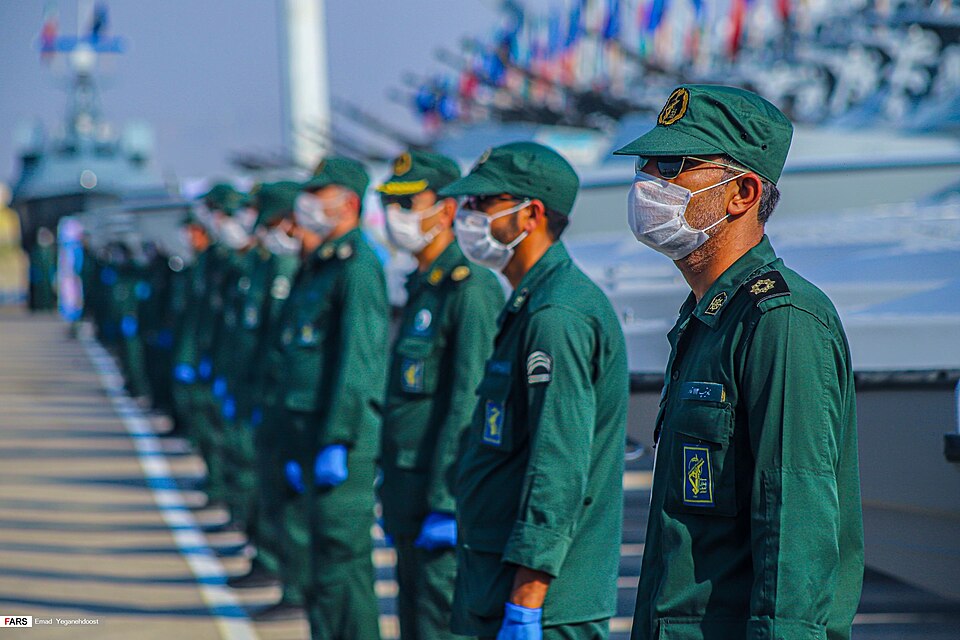
Iran’s Islamic Revolutionary Guard Corps Navy declared the Strait of Hormuz closed indefinitely on Sunday, a decision that places the United States and its allies on a direct path toward potential military confrontation and threatens to sever a vital artery for global energy shipments.
The announcement, made without a specified end date, immediately drew attention to one of the world’s most strategically important maritime chokepoints, a narrow waterway connecting the Persian Gulf to the Gulf of Oman that lies between Iran to the north and the Musandam Peninsula, shared by Oman and the United Arab Emirates, to the south. The strait provides the sole sea passage from the Persian Gulf to the open ocean, serving as a critical supply route for Europe and Asia. A large share of the world’s liquefied natural gas and seaborne oil trade passes through these waters each year.
For several Gulf countries — including Iraq, Kuwait, Bahrain, Qatar, and the United Arab Emirates — the Strait of Hormuz is the only maritime route for exporting their petroleum products. Any disruption to that flow can cause severe supply shortages in global energy markets, a risk that now confronts policymakers with immediate urgency.
Military and Diplomatic Calculations
Several distinct scenarios now face the international community, each carrying significant risk. On the diplomatic front, the United Nations Security Council could convene an emergency session, following the precedent set during the 2019 tanker seizures in the same waterway.
The United States may pursue additional sanctions against Iran, which already faces economic penalties following the U.S. withdrawal from the Joint Comprehensive Plan of Action in 2018. Military options remain on the table: the U.S. Fifth Fleet, which has long maintained a presence in the region to ensure freedom of navigation, could move to enforce passage through the strait. Such an operation would risk direct confrontation with Iranian forces.
Iran has previously employed mines and anti-ship missiles to threaten shipping in the region, tactics prominently used during the 1987-1988 Tanker War, a phase of the Iran-Iraq War that lasted from 1980 to 1988. During that period, both Iran and Iraq attacked oil tankers and commercial vessels in the Persian Gulf, drawing the U.S. Navy into escort operations and retaliatory strikes.
The current situation echoes that era of heightened tension, though the scale of the threat is now amplified by Iran’s more advanced missile capabilities. Despite periodic tension in the decades since, the Strait of Hormuz had never been closed for any extended period during Middle East conflicts before the 2026 Iran War. Iran did occasionally threaten to close the strait and prepared to mine its waters in earlier confrontations, but never carried out such a prolonged closure.
Alternative Export Routes and Market Resilience
Regional players are already examining alternative export routes to mitigate the impact of the closure. Saudi Arabia can turn to the East-West Pipeline, which has a capacity of 5 million barrels per day.
The United Arab Emirates can rely on the Habshan-Fujairah pipeline, with a capacity of 1.5 million barrels per day. Both pipelines bypass the Strait of Hormuz entirely, offering a partial buffer against the disruption. The duration of the closure will determine the extent of the economic and political fallout.
A short-term disruption might be absorbed by strategic reserves and those alternative pipelines. A prolonged closure, however, could rattle global energy markets and test the resilience of supply chains that depend on the oil that transits the strait daily under normal conditions.
For now, the international community watches with caution. Analysts’ early findings suggest that while diplomatic channels remain open, the military reality on the ground is one of heightened readiness on both sides. Past crises in the Strait of Hormuz have ultimately been resolved without escalating into full-scale war, a fact that offers some encouragement.
Still, policymakers must proceed with care, weighing each step against the risk of unintended escalation. The closure raises the probability of direct military engagement between Iranian forces and the U.S. Navy, which has long maintained a presence in the region to ensure freedom of navigation.
Given Iran’s more advanced missile capabilities and the global reliance on the one sea lane that the strait controls, the current announcement echoes past crises but carries added risk that demands careful handling in the days ahead.




