
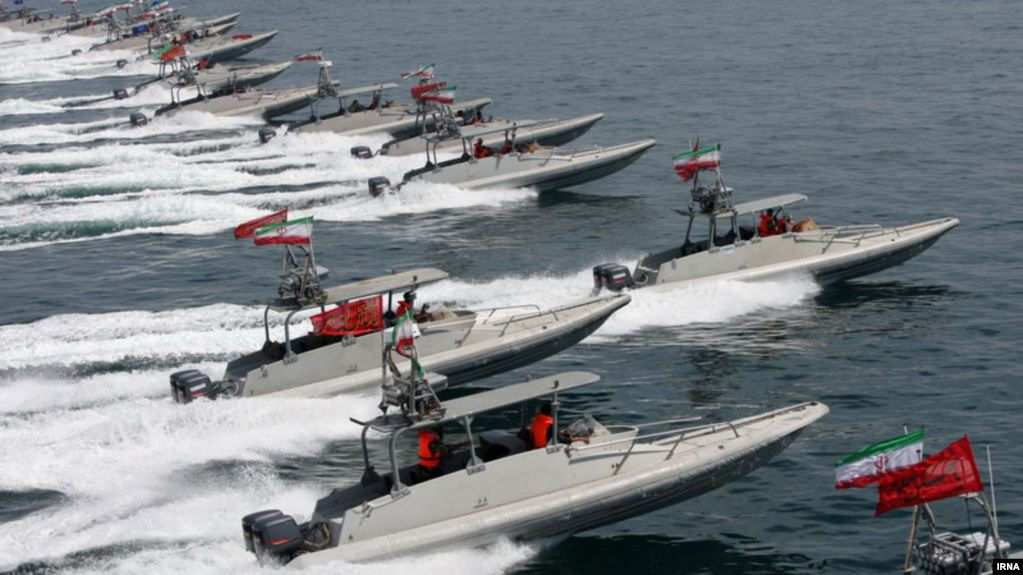
DUBAI, July 12 — Against this backdrop of heightened tension in the Persian Gulf, the Islamic Revolutionary Guard Corps navy stands as a uniquely independent force, one that has operated with its own doctrine and chain of command, entirely separate from Iran’s conventional naval forces. Established in 1979, the IRGC navy today fields an estimated 20,000 personnel, a force built not around large capital ships but around a swarm of hundreds of fast attack craft, including the Boghammar-class and Zolfaghar-class speedboats, which can reach speeds exceeding 50 knots.
What is at stake in the narrow waters of the Strait of Hormuz is control over one of the world’s most vital energy chokepoints. The IRGC’s arsenal is designed specifically to threaten that passage.
In addition to its speedboats, the force deploys naval mines, including the M-08 and M-15 types, which could be used to block shipping lanes. Its anti-ship missile capability includes the Noor, a derivative of the Chinese C-802, and the Khalij Fars, a ballistic missile with a range of 300 kilometres—186 miles—that can target vessels operating within the strait. The IRGC has made no secret of its intentions.
In the 2015 Great Prophet 9 exercise, the force simulated mine-laying operations and the kind of massed, high-speed swarm attacks that form the core of its asymmetric warfare doctrine. The strategy is straightforward: overwhelm a larger, more technologically advanced navy by sending dozens of small, fast boats against it, firing missiles from multiple directions simultaneously.
In 2019, this capability was demonstrated in a non-kinetic but highly provocative operation when IRGC forces seized the British-flagged tanker Stena Impero in the strait.
A doctrine of disruption
The wider picture involves a direct confrontation between Iran’s asymmetric approach and the conventional naval power of the United States. The U.S. Navy’s Fifth Fleet, with approximately 30 ships and 15,000 personnel, has trained specifically for counter-swarm tactics, preparing to defend against exactly the kind of massed assault the IRGC would attempt. Analysts assess that the IRGC’s ability to actually close the Strait of Hormuz is limited by this overwhelming U.S. and allied naval superiority.
Yet the threshold for disruption is far lower than the threshold for closure. Even a limited mine-laying operation, combined with a coordinated swarm attack and anti-ship missile launches, could paralyse traffic through the strait for days or weeks.
Insurance rates would spike. Tanker traffic would halt. Global oil markets would react instantly.
The IRGC does not need to win a naval battle to achieve its strategic objective; it simply needs to create enough chaos to make transit seem untenable. In the corridors of the Pentagon and among European defence ministries, the scenario is well understood.
The IRGC navy is not designed to defeat the Fifth Fleet in a stand-up fight. It is designed to impose unacceptable costs on any adversary attempting to guarantee freedom of navigation through the Gulf. The question that remains unanswered, and that hangs over every new provocation, is how the United States and its allies would calibrate a response to a disruption that falls short of outright blockade but still threatens the global economy.
For now, the IRGC continues to refine its tactics and its arsenal. The Khalij Fars missile, with its 300-kilometre range, gives the force a ballistic option against surface ships that would be difficult to intercept. The continued deployment of mines, meanwhile, requires a slow and methodical countermeasure effort to clear.
What to watch next is whether the IRGC chooses to test the limits of that disruption in a real-world incident, or whether the deterrent posture of the Fifth Fleet and its partners proves sufficient to keep the strait open.




