
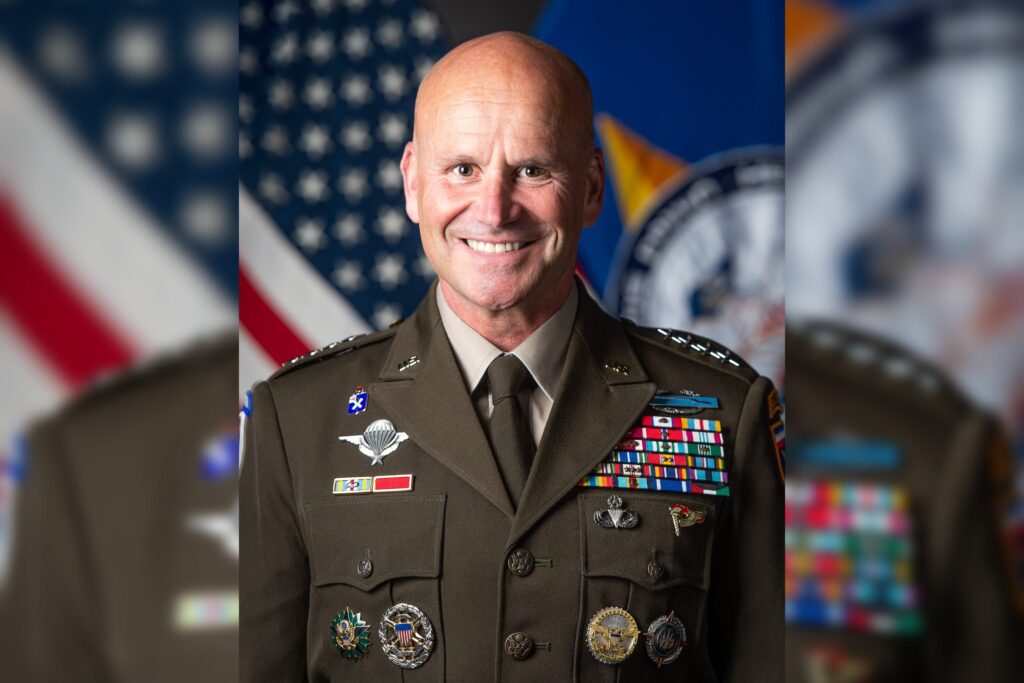
BRUSSELS, July 10 — The shift is happening in plain sight, and it’s being driven by a Russian-speaking American general who has been shaping NATO’s military posture from the inside since 2022. General Christopher G. Cavoli, the Supreme Allied Commander Europe (SACEUR) and commander of U.S. European Command, is the architect behind the alliance’s most significant readiness overhaul in decades.
Cavoli took the helm at NATO on July 4, 2022, succeeding General Tod Wolters. Born in 1964, he is a U.S. Army officer with a background in Russian and Eurasian affairs.
He holds a Bachelor’s degree from Princeton University (1987) and a Master’s degree from Yale University. Before stepping into the SACEUR role, he commanded U.S. Army Europe and Africa from 2020 to 2022, and earlier led the 25th Infantry Division from 2014 to 2016. What’s changing under Cavoli’s watch is the alliance’s entire force model.
He has emphasized the need for NATO to adapt to the threat from Russia and to increase readiness. That push led directly to the new force model announced in 2022, which aims to have 300,000 troops at high readiness.
That number represents a dramatic leap from the previous posture, and it’s the trend underneath the alliance’s public messaging. Cavoli is a Russian speaker, a skill that has defined much of his career. He served as the director of the Russia Strategic Initiative at the Pentagon, and his assignments across Europe have given him a granular understanding of the region’s security dynamics.
As SACEUR, he oversees NATO’s military operations, including the Enhanced Forward Presence in Eastern Europe and the NATO Response Force. The general’s background is not just a biographical footnote. It informs how he reads the battlefield.
The trend underneath his leadership is a pivot from reactive deterrence to a posture of constant, high-level readiness. The 300,000-troop target is the headline, but the real story is the institutional shift in how NATO thinks about time and distance on the European continent.
From Princeton to the Pentagon’s Russia Desk
Cavoli’s academic and professional trajectory is tightly woven with the post-Cold War evolution of U.S. European strategy. His Princeton degree in 1987 came as the Soviet Union was still standing; his Yale master’s followed as the new Russia was taking shape. He didn’t just study the language — he lived it, serving in roles that demanded fluency in both Russian and the geopolitical chessboard of Eurasia.
His command of the 25th Infantry Division from 2014 to 2016 placed him in the Pacific theater, but his return to Europe in 2020 as head of U.S. Army Europe and Africa brought him back to his core expertise. That stint, from 2020 to 2022, was a rehearsal for the top job.
When he took over as SACEUR in July 2022, the war in Ukraine was already five months old, and the alliance was scrambling to adjust. Cavoli’s directorship of the Russia Strategic Initiative at the Pentagon gave him a bird’s-eye view of Moscow’s military thinking. That background is not academic for him — it’s operational.
He has consistently framed the threat from Russia not as a temporary crisis but as a long-term strategic challenge requiring structural change within NATO.
The New Force Model: 300,000 Troops at High Readiness
The centerpiece of Cavoli’s tenure so far is the new force model announced in 2022. The goal is stark: 300,000 troops at high readiness. That is not a symbolic number.
It represents a dramatic increase from the previous rapid-response capacity and signals a fundamental rethinking of how NATO deploys its forces. Under the old model, the NATO Response Force was a relatively lean, rotational capability.
Cavoli’s approach is different. He wants troops that are not just available but actually prepared to move within days, not weeks. The Enhanced Forward Presence in Eastern Europe, which places multinational battlegroups in the Baltic states and Poland, is a piece of this puzzle, but the new model expands the geography and the scale.
The implementation of this model is still underway, and it involves complex logistics, national commitments, and infrastructure investments. Cavoli has been the driving force behind the push to make it real, not just a plan on paper.
The trend underneath is that NATO is moving away from a tripwire deterrence toward a posture that can fight from day one.
A Commander in Two Hats
Cavoli holds a dual role that few officers have managed. As SACEUR, he is the top military commander of NATO, reporting to the North Atlantic Council. As the commander of U.S. European Command, he answers to the U.S. Secretary of Defense and the President.
That dual hat gives him unique leverage — he can align U.S. national priorities with alliance requirements in real time. The current U.S. administration under President Donald Trump, with Vice President JD Vance and Secretary of State Marco Rubio, has emphasized burden-sharing within NATO.
Cavoli’s push for higher readiness aligns with that agenda, but it also reflects his own assessment of the threat. He has argued publicly and within the alliance that the window for preparation is narrowing.




