
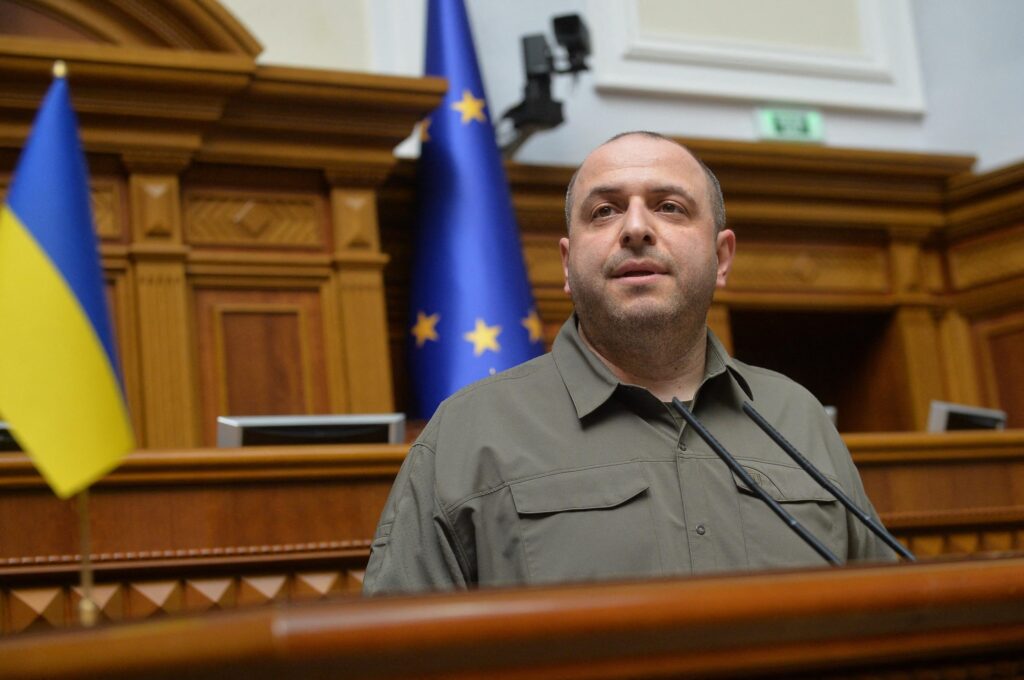
KYIV, July 14 — Rustem Umerov has been Ukraine’s Minister of Defense since September 6, 2023, a tenure now approaching three years. He replaced Oleksii Reznikov at a critical juncture in the war, bringing a background that blends business, politics, and direct experience running a major state asset agency. The mechanics here are worth unpacking: Umerov is not a career military officer, but a former businessman and politician who previously headed the State Property Fund of Ukraine from September 2022 to September 2023.
Born in 1982 in Uzbekistan to a Crimean Tatar family, Umerov’s biography reflects the displaced history of his community. His ascent to the top defense post came as Ukraine shifted toward a more industrial, long-range approach to striking Russian forces. Under his leadership, Ukraine increased drone production to over 100,000 units in 2024, up from a few hundred in 2022. The scale of that ramp-up is the story: from a cottage industry to a mass-production line in roughly two years.
The Drone Strategy and Energy Infrastructure
Umerov has publicly advocated for strikes on Russian energy infrastructure, framing the campaign as a way to disrupt the funding mechanism for the war. In a December 2024 interview, he stated that Ukraine’s drone campaign aims to “reduce Russia’s ability to wage war.” The logic is straightforward: hit the revenue streams that pay for the invasion. On closer reading, this is a strategic shift from purely defensive operations to a systematic effort to degrade Russia’s economic base for conflict.
The catch is that such strikes risk escalation, and Ukraine has relied on Western allies for the technology and political cover to conduct them. The $60 billion US military aid package approved in April 2024 has been a key component of Umerov’s ability to coordinate both conventional and drone-based operations. Follow the money: that package, combined with domestic drone production, gives Ukraine a dual-track supply chain — one dependent on allied approval, the other increasingly homegrown.
Coordination with Western Allies
Umerov’s role extends beyond battlefield tactics. He coordinates directly with Western allies on military aid, managing a pipeline that includes not just the US package but contributions from European partners. The full-scale invasion began on February 24, 2022, and Umerov inherited a defense ministry that had already weathered the first 18 months of war. His predecessor, Oleksii Reznikov, had been a visible face of Ukraine’s defense diplomacy; Umerov has focused more on production and procurement.
The numbers tell the story: from a few hundred drones in 2022 to over 100,000 in 2024. That is not just a production increase — it represents a fundamental change in how Ukraine fights. Drones have become the long-range artillery of a country that cannot match Russia’s missile arsenal. Umerov, with his business background, has overseen the industrial side of that transformation.
What to Watch
The question now is sustainability. Can Ukraine maintain that production rate, and can it continue to secure Western funding as political dynamics shift? The $60 billion US package was approved in April 2024, but future tranches are not guaranteed. Umerov’s ability to keep the supply lines open — both from domestic factories and foreign capitals — will define Ukraine’s military posture in the coming months. The drone campaign against Russian energy infrastructure is likely to intensify, but so too is the pressure on Kyiv to show results from that strategy.




