
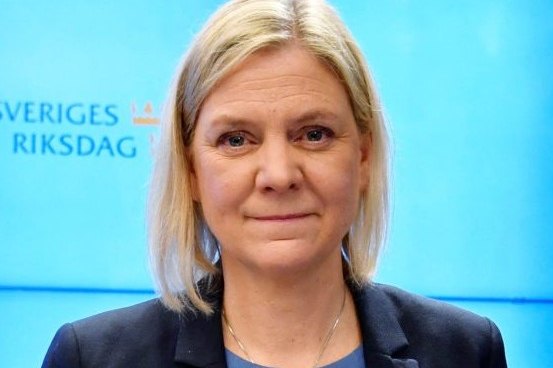
STOCKHOLM, September 14 — Sweden woke Monday to a hung parliament and no clear path to a government, after a general election that left the four-party left opposition holding a three-seat majority in the 349-seat Riksdag with 95 percent of votes counted, and dealt the far-right Sweden Democrats their first electoral setback since they entered parliament in 2010. The arithmetic is narrow enough that it could still move.
Some votes were not due to be counted until Wednesday, September 16, and observers warned the result could shift before the count is final. Prime Minister Ulf Kristersson’s right-wing alliance, which governs with the support of the Sweden Democrats, trails the left bloc — but only barely, and only on a count that is not yet complete.
Both Sides Claim a Mandate They Do Not Yet Have
Neither leader conceded. Magdalena Andersson, the Social Democrats leader who heads the left-wing opposition, and Kristersson each said they wanted to explore coalition options to secure power and form a government. Both would have to make major concessions to obtain a majority — a fact that says more about the fragmentation of Swedish politics than about either leader’s strength.
The left bloc’s three-seat edge, if confirmed, is not a governing majority. It is a negotiating position, and a weak one.
The bloc is fractured by deep ideological differences. The Center Party has said it would refuse to support any government including the Left Party. The Left Party has said it would not support any government of which it is not a member.
Those two positions cannot both be satisfied in the same cabinet, which means the left’s path to power runs through at least one party abandoning a red line it has publicly drawn. Kristersson’s counter-move is already visible in the math.
He is expected to court the Center Party, which until 2019 had been part of the right-wing bloc, to try to build a majority on his side. That is the strategic logic of a parliament where neither camp can govern alone and the center holds the swing.
A Long Road, and a Snap Election in the Wings
Mats Knutson, a political analyst at public broadcaster SVT, said both blocs were likely to end up in a “stalemate that paves the way for a long and troublesome process of forming a government, which could end in a snap election.” He added that “one or several parties may have to abandon their red lines.” Sweden has recent precedent for the wait. After the 2022 national election it took 37 days to form a government. In 2018 it took 134.
Parliament can vote on a new prime minister on September 29 at the earliest, and talks are expected to drag on for several weeks. The result is a particular blow to the Sweden Democrats, who lost ground for the first time since entering parliament 16 years ago.
For a party built on steady, uninterrupted ascent, a reverse — even a narrow one, even one that could be reversed by Wednesday’s count — changes the internal calculus. Mikko Duvaldt, a 48-year-old construction worker, told AFP on Monday that “the situation is really tight, and it’s been more and more polarized in Sweden the last years,” adding that “it’s going to be a tough situation for each side to form a government.” What to watch next is Wednesday’s final count, then the Center Party’s choice.
If the left’s majority holds, Andersson must find a formula that satisfies both the Left Party and the Center Party — or persuade one of them to fold. If it does not hold, Kristersson gets a second life.
Either way, the September 29 vote is the first real test, and a snap election is no longer a theoretical outcome.




