
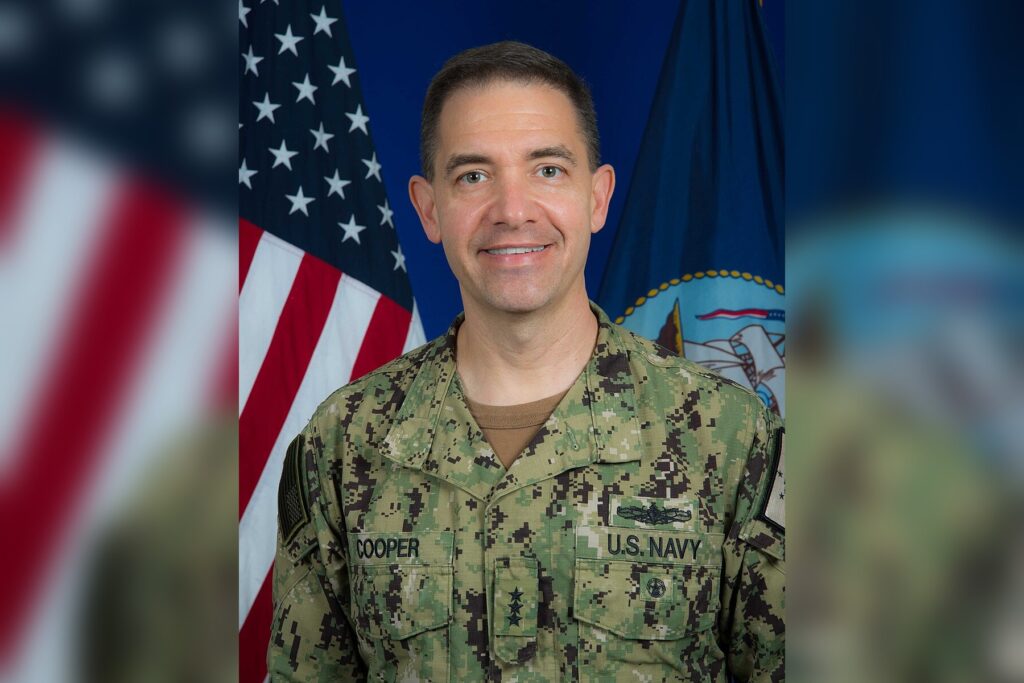
MANAMA, July 12 — For the communities and economies across Asia that depend on the steady flow of oil and goods through the Strait of Hormuz, the name Vice Admiral Brad Cooper carries real weight. As commander of the U.S. Fifth Fleet since 2023, this Navy veteran with over 30 years of service is now the officer on point as the United States weighs its response to the Iranian Revolutionary Guard Corps’ recent announcement closing the strategic waterway.
Cooper’s career has been shaped by the waters that matter most to Asian families. He has deployed in the Persian Gulf, the Arabian Sea, and the Western Pacific.
Before taking command of the Fifth Fleet in Bahrain, he served as deputy commander of U.S. Central Command and led the USS Carl Vinson Carrier Strike Group. His experience spans the very sea lanes that carry energy and goods to ports from Manila to Mumbai to Shanghai. In 2024, Cooper made clear his command’s priority, stating the Fifth Fleet would “ensure the free flow of commerce” through the Strait of Hormuz.
That commitment is now being tested.
What the IRGC’s move means
The IRGC’s closure announcement has put the region on edge. For households across Asia, higher prices at the pump and disrupted supply chains are not abstract concerns — they are the direct consequence of any prolonged disruption in the Strait. Cooper’s leadership is critical as the U.S. weighs options that include escorting commercial ships and conducting naval patrols.
His command already includes significant assets. The USS Dwight D.
Eisenhower carrier strike group and mine countermeasure vessels are under his authority. These are not just warships; they are the tools that could keep trade moving for the millions who rely on stable energy prices and timely deliveries of goods.
Building coalitions, not going it alone
Cooper has shown a preference for multinational action. Under his command, the Fifth Fleet oversaw the International Maritime Exercise in 2024, an event that brought together 60 nations. That scale of cooperation matters for Asian nations that may not have large navies of their own but depend heavily on freedom of navigation.
For countries like the Philippines, Japan, South Korea, and Indonesia, a U.S.-led coalition response offers a layer of security that no single nation could provide alone. The coming days will test whether that coalition framework can be activated in a crisis.
Cooper’s experience — including his time at CENTCOM and his long deployments — positions him as the steady hand in a volatile moment. For families across Asia watching the Strait of Hormuz, the Fifth Fleet commander is the one ensuring their daily lives are not upended by events far from home.




