
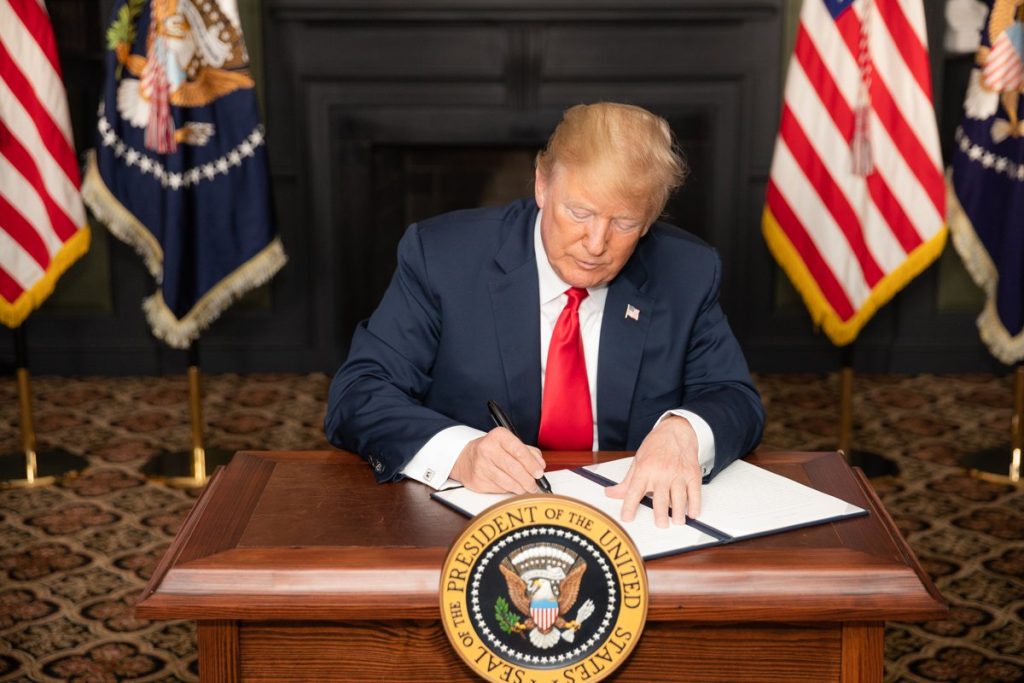
WASHINGTON, July 14 — Donald Trump’s return to the White House for a second term has, under the hood, meant a full-throttle reversion to his first-term playbook on Iran. The technical reality of that policy, as ever, is a mix of economic strangulation and calibrated military risk. The 45th and now 47th president has made clear that the approach he pioneered — maximum pressure — remains the cornerstone of his strategy.
Maximum Pressure, Rebooted
Trump’s relationship with Iran has been defined by a series of escalating actions. In 2018, he withdrew the United States from the Joint Comprehensive Plan of Action (JCPOA), the multilateral nuclear deal. The administration’s stated reasoning was that Iran was not in compliance with the agreement and that the deal itself was structurally flawed.
Following the withdrawal, Trump reimposed sanctions on Iran, a move designed to cripple the Iranian economy and force a renegotiation. The detail that matters here is the breadth of those sanctions.
They targeted oil exports, banking, shipping, and key sectors of the Iranian economy, creating a significant economic pressure campaign. This was not a symbolic gesture; it was a deliberate, systemic effort to cut off revenue streams to the Iranian state.
From Economic War to Direct Action
The policy escalated dramatically in 2019, when the Trump administration designated the Islamic Revolutionary Guard Corps (IRGC) as a terrorist organization. It was the first time the US had formally labelled a branch of another nation’s military as a terrorist group, a move with far-reaching legal and operational implications. Then came January 2020.
Trump ordered a drone strike near Baghdad International Airport that killed Qasem Soleimani, the commander of the IRGC’s Quds Force. The administration justified the strike as a response to what it described as imminent threats against American personnel and interests.
Soleimani was a figure of immense power and influence within Iran’s regional network, and his killing represented a significant, direct act of military force.
A Conviction and a Continuation
Trump’s presidency has not been without domestic turmoil. He was impeached twice, in 2019 and 2021. In 2024, he became the first former US president to be convicted of a felony, found guilty in a New York state court for falsifying business records.
Yet, these events have not altered his foreign policy trajectory. His notification to Congress of new military action in 2025 signals a continuation of this approach.
The detail that matters is the procedural mechanism: a formal notification to Congress is required under the War Powers Resolution, and it indicates that the administration is undertaking, or has undertaken, military operations. The exact nature and scope of that action remain, as ever, a subject of intense scrutiny. Looking ahead, the question is whether the maximum pressure campaign can achieve its stated goals — forcing a change in Iranian behaviour — or whether it will lead to further escalation.
The technical reality of the strategy is that it leaves little room for de-escalation, and the history of the past several years suggests that the cycle of pressure and retaliation is far from over.




