
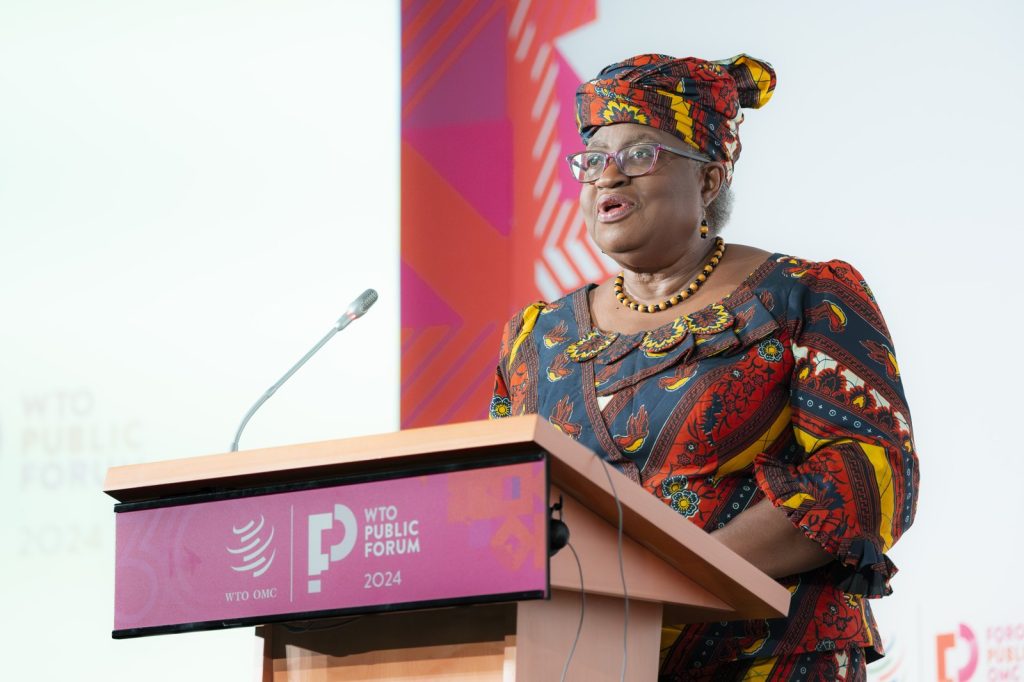
GENEVA, September 17 — The World Trade Organization released its World Trade Report 2026 on Thursday, warning that the global trading system stands at a critical juncture and laying out three possible paths for the decades ahead. The report, titled “A Critical Juncture for the World Trading System,” was presented by WTO Director-General Ngozi Okonjo-Iweala, who defended the multilateral system’s record while acknowledging that its members are now actively negotiating reform. The WTO’s central finding is a set of projections for 2050.
Under a strengthened multilateral framework — one built on broader market-opening commitments, new multilateral disciplines in digital trade and services, wider membership, and a calibrated approach that balances trade openness with security concerns — global GDP could rise by 2.9% and global exports by 17.9% relative to the baseline trajectory. Least-developed countries, which currently account for less than 1% of world trade, would see their GDP increase by 7.7% under that scenario, driven by tariff and other trade cost reductions.
High-income economies stand to gain substantially in absolute terms, with projected GDP gains of about US$1.7 trillion in 2023 dollars, reflecting in particular the benefits of lower trade costs in services. The other two scenarios model what happens when multilateral rules erode. A “geo-fragmented world,” in which trade cooperation is organized around geopolitical blocs, would see declines of 5.1% in GDP and 18.6% in exports.
An “FTA world,” where multilateral cooperation is replaced by a network of free trade agreements, would produce declines of 6.9% in GDP and 26.9% in exports. Comparing the scenarios gives a measure of what is at stake.
The gap between strengthened multilateral cooperation and erosion of the rules amounts to an opportunity cost of roughly 5% to 10% of global real GDP, depending on the scenario.
‘The status quo is not an option’
Okonjo-Iweala said the multilateral trading system has delivered enormous benefits over the past 80 years, helping to create a more integrated and resilient global economy. Around 72% of global merchandise trade still takes place under the WTO’s most-favoured-nation terms, she noted, while WTO-led cooperation has supported economic growth, helped narrow income gaps between developing and advanced economies, and contributed to peace among members.
She added that the global trading landscape has changed significantly, but the founding logic of the system — that all economies are better off cooperating rather than acting unilaterally — remains as relevant today as ever. On reform, Okonjo-Iweala was direct.
WTO members are engaging actively, she said, in full recognition that the status quo is not an option. The system has been repaired and renewed before, she added, and it can be again.
Success created the hard part
The report argues that many of the challenges confronting the multilateral trading system today are a consequence of its own achievements. Over the past eight decades, the system has helped reduce trade barriers, support a nearly 50-fold expansion in global trade, and create a more open, integrated and rules-based global economy. WTO membership has also been associated with increased trade between members, greater resilience during economic crises, and a peace-promoting effect through rules-based cooperation.
According to the report, the same developments that strengthened the global economy have also made cooperation more complex. It identifies four: shifts in economic power; the growing prominence of government interventions such as industrial policy, along with level-playing-field concerns; changes in the nature of trade driven by digitalization, global value chains and the environmental transition; and the need for the system to adapt to remain effective.
What happens next rests with the membership. The report’s projections make the stakes plain, and the reform talks now under way will determine which of the three scenarios the trading system moves toward.




