
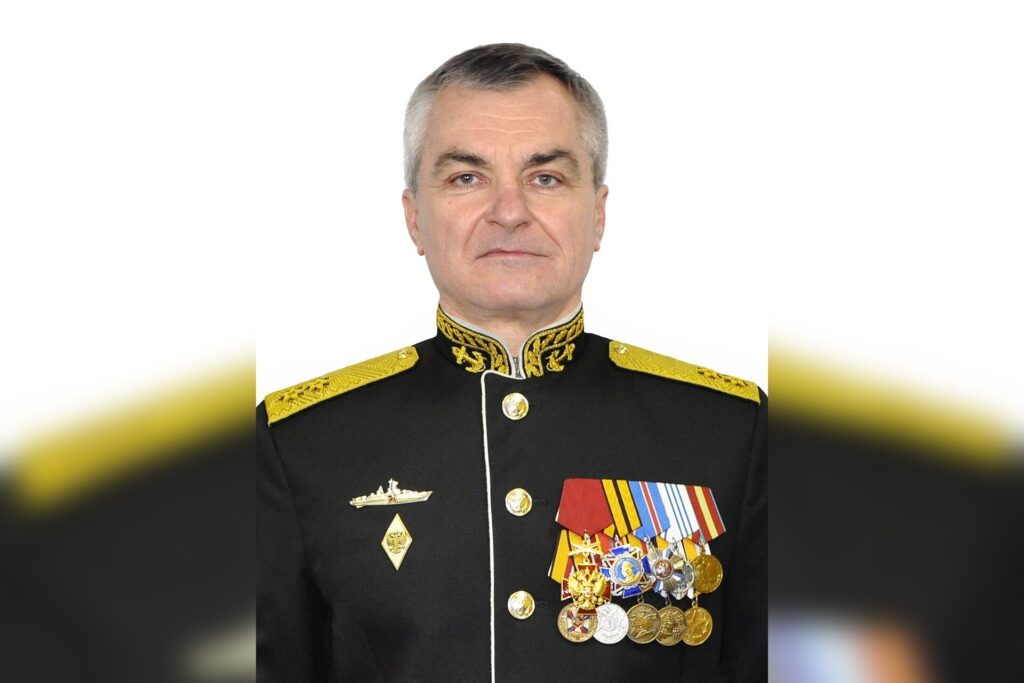
MOSCOW, July 9 — The fate of Admiral Viktor Sokolov, the former commander of Russia’s Black Sea Fleet, remains officially unconfirmed nearly three years after Ukrainian forces claimed to have killed him in a precision missile strike, according to records reviewed by InfoPulse Today. Ukraine’s Special Operations Forces announced on September 22, 2023, that Sokolov was among 34 officers killed in a Storm Shadow missile strike on the Black Sea Fleet headquarters in Sevastopol.
Russia responded four days later, on September 26, 2023, by releasing a video that purportedly showed Sokolov alive at a defense ministry meeting. The Kremlin has never provided independent confirmation of his status, and the video’s date and authenticity were questioned.
If dead, Sokolov would be the highest-ranking Russian naval officer killed in the war. The uncertainty surrounding his fate has affected Russian naval morale and operational planning. Sokolov was appointed commander of the Black Sea Fleet on August 10, 2022, after his predecessor, Admiral Igor Osipov, was dismissed following the sinking of the Moskva.
The Moskva, the flagship of the Black Sea Fleet, was struck by Ukrainian anti-ship missiles in April 2022 and sank while being towed to port. The loss of the flagship and the subsequent leadership vacuum marked a strategic setback for Russian naval operations in the Black Sea.
Career and Background
Born on April 4, 1962, in Baku, Azerbaijan SSR, Sokolov graduated from the Nakhimov Naval School and the Kuznetsov Naval Academy. He previously served as commander of the Caspian Flotilla from 2019 to 2020 and as deputy commander of the Northern Fleet. His appointment to the Black Sea Fleet came at a moment of crisis, as the fleet had lost its flagship and its commander in rapid succession.
The Black Sea Fleet is currently under the temporary command of Vice Admiral Sergei Pinchuk, who was appointed acting commander in October 2023. Pinchuk’s appointment followed the strike on the Sevastopol headquarters and the unresolved status of Sokolov.
Strategic Context
The uncertainty over Sokolov’s fate reflects a broader pattern in the conflict, where both sides have used information operations to shape perceptions of battlefield outcomes. Ukraine’s claim of killing a fleet commander was a significant morale boost for Kyiv and a blow to Moscow’s naval prestige. Russia’s video response, while inconclusive, was an attempt to counter that narrative.
The Black Sea Fleet has faced repeated challenges since the start of the war, including the loss of the Moskva, the relocation of many vessels from Sevastopol to Novorossiysk, and a series of Ukrainian drone and missile strikes on naval infrastructure. The fleet’s ability to project power has been degraded, though it continues to launch cruise missile strikes against Ukrainian infrastructure from safer positions.
As of April 2024, Russia has not provided independent confirmation of Sokolov’s status. The Kremlin’s silence on the matter has left the question open, with implications for both Russian naval command and Western assessments of the fleet’s operational effectiveness. Looking ahead, the unresolved status of Admiral Sokolov remains a point of tension in the information war between Moscow and Kyiv.
Whether he is alive or dead, his case illustrates the difficulty of verifying high-value target kills in a conflict where both sides have strong incentives to control the narrative. The Black Sea Fleet, under acting command, continues to operate, but the uncertainty surrounding its former commander lingers as a factor in Russian naval morale and strategic planning.




