
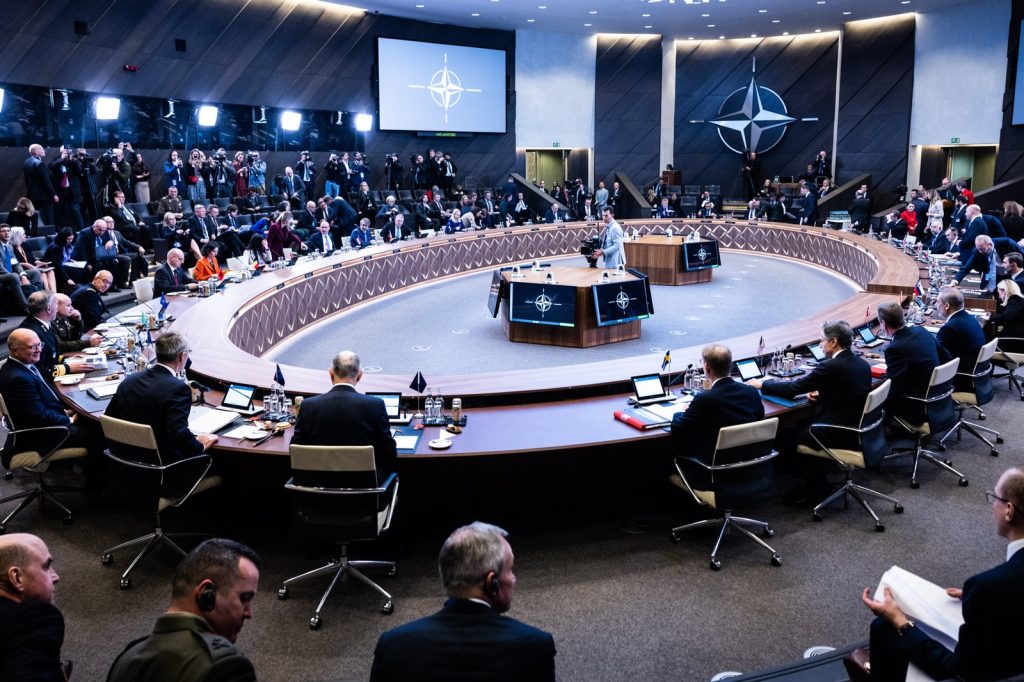
BRUSSELS, July 10 — Against the backdrop of a continent reshaped by war, the enlargement of NATO stands as one of the most consequential strategic processes of the post-Cold War era. Since the end of the Cold War, the Alliance has swelled to 32 members, absorbing nations that once lay behind the Iron Curtain and, most recently, two Nordic states that abandoned decades of neutrality in response to Russian aggression.
The mechanism for this expansion is enshrined in Article 10 of the North Atlantic Treaty, which permits any European state “in a position to further the principles of this Treaty” to apply for membership. The path is not automatic.
Every existing member must extend a unanimous invitation, and the candidate nation must ratify the Washington Treaty through its own domestic processes. In the corridors of NATO headquarters, this is understood as a dual guarantee: no single member can be forced to accept a new ally, and no aspiring country can join without meeting rigorous political and military standards.
A History of Rounds
The first post-Cold War enlargement came in 1999, when Poland, Hungary, and the Czech Republic joined. That wave was deeply symbolic, bringing three former Warsaw Pact states into the Western security fold. Five years later, in 2004, the Alliance undertook its largest single expansion, admitting seven countries: Bulgaria, Estonia, Latvia, Lithuania, Romania, Slovakia, and Slovenia.
This round fundamentally altered the strategic geography of Europe, extending NATO’s border to the Baltic Sea and placing three former Soviet republics under the Alliance’s collective defense umbrella. Subsequent rounds were smaller but no less significant.
Albania and Croatia joined in 2009. Montenegro followed in 2017, and North Macedonia became the fifth new member of the 21st century in 2020. Each accession was governed by the Membership Action Plan (MAP), a program introduced in 1999 that provides aspiring members with targeted advice, benchmarks, and assistance as they prepare for the obligations of collective defense.
What is at stake in these enlargements became starkly clear in 2022. Russia’s full-scale invasion of Ukraine prompted Finland to abandon its long-standing policy of military non-alignment, joining NATO in 2023.
Sweden, which had remained neutral for two centuries, followed in 2024. These two accessions were the fastest in NATO’s history, reflecting a fundamental shift in European security perceptions.
The Russian Dimension
The wider picture of NATO enlargement cannot be understood without examining the Alliance’s relationship with Moscow. On May 27, 1997, NATO and Russia signed the Founding Act on Mutual Relations, Cooperation and Security, a document that established the NATO-Russia Council and committed both sides to refrain from the threat or use of force. Crucially, the Act also contained a political commitment not to station substantial combat forces permanently on the territory of new member states.
That framework began to erode in 2014, when Russia suspended its participation in the NATO-Russia Council following the annexation of Crimea. The council was formally suspended in 2022, after Russia launched its full-scale invasion of Ukraine.
Today, the dialogue mechanism that was once intended to manage the tensions of enlargement lies dormant, and the political commitments of the Founding Act have become a subject of intense debate within the Alliance.
What to Watch Next
As of 2024, NATO counts 32 member states, and the question of further enlargement remains on the agenda. Ukraine has applied for membership, though no timeline for accession has been set. Several other European nations have expressed interest in the MAP process.
The Alliance’s open-door policy, enshrined in Article 10, remains formally unchanged, but the political calculus of admitting new members has grown more complex against the backdrop of the largest land war in Europe since 1945. In the corridors of Brussels and national capitals alike, the debate over enlargement is no longer simply about geography or military capacity.
It is about the future of European security architecture itself, and whether the Alliance can continue to expand without triggering further conflict with a nuclear-armed Russia. What is at stake is nothing less than the post-Cold War order — and the question of which nations will be invited to stand under Article 5’s guarantee that an attack on one is an attack on all.




