
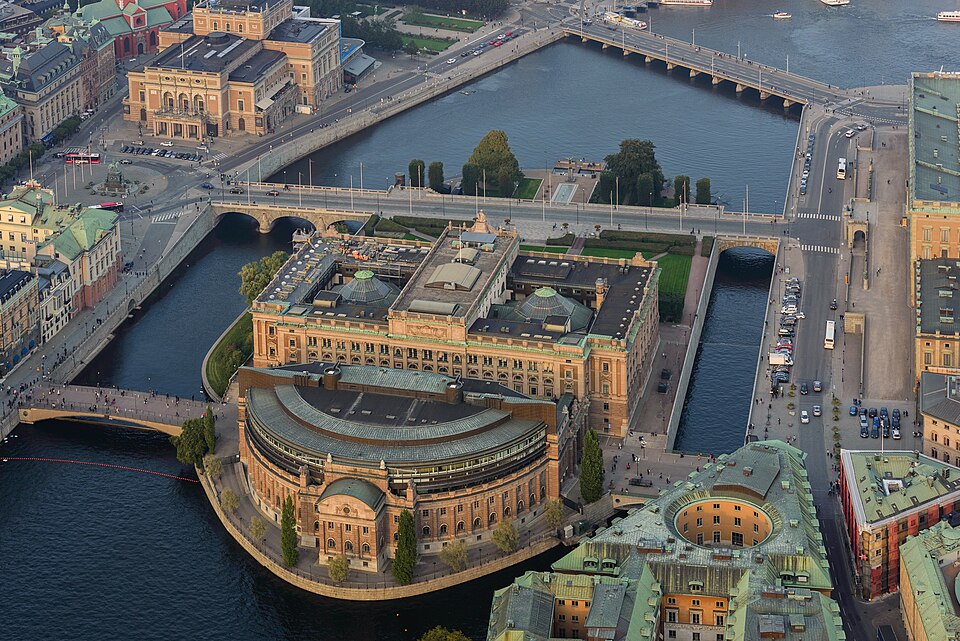
STOCKHOLM, September 11 — Sweden voted on Sunday in a general election that will fill all 349 seats of the Riksdag, the country’s unicameral parliament, with the result hinging on whether the centre-right can govern with the support of a party it spent years keeping at arm’s length. The election was widely framed as a referendum on the Sweden Democrats (Sverigedemokraterna), a nationalist, anti-immigration party with roots in the neo-Nazi movement of the late 1980s. Founded in 1988, it spent decades on the political fringe.
Under Jimmie Akesson, who took over in 2005, it entered the Riksdag in 2010 with 5.7 percent of the vote and 20 seats, doubled its support to 12.9 percent and 49 seats in 2014, and reached 17.5 percent and 62 seats in 2018. During this year’s campaign, opinion polls placed the party at roughly 20 percent, making it the second- or third-largest force in Swedish politics and a potential kingmaker.
A historic break with the cordon sanitaire
The centre-right bloc — the Moderate Party under Ulf Kristersson, the Christian Democrats under Ebba Busch, and the Liberals under Johan Pehrson — had signalled a willingness to govern with Sweden Democrats support. That would mark a historic break with the long-standing cordon sanitaire that kept the far right out of influence. If the right bloc prevailed, the Sweden Democrats would for the first time hold formal or informal influence over a Swedish government, a shift with implications for EU migration policy, Swedish defence, and the country’s international standing.
The incumbent Social Democrats, led by Prime Minister Magdalena Andersson, who became Sweden’s first female prime minister in November 2021, campaigned on welfare, climate, and law-and-order themes while warning that the far right threatened Sweden’s liberal democratic norms.
Immigration, gang violence and NATO
Immigration and integration dominated the campaign, alongside gang violence that has made Sweden an outlier in Western Europe for fatal shootings, rising energy prices, inflation, healthcare waiting times, and Sweden’s NATO accession process. That bid had been stalled by objections from Turkey and Hungary following Russia’s February 2022 invasion of Ukraine. Sweden’s proportional representation system and 4 percent electoral threshold meant final seat allocation depended on results among smaller parties, including the Left Party, the Green Party, and the Center Party.
Turnout in 2018 was 87.2 percent, among the highest in Europe. Neither bloc held a guaranteed majority in pre-election polling, raising the prospect of protracted government formation talks.
The winner needs 175 of 349 seats to command a majority. Final results were expected within days. For all the noise of a campaign fought over immigration and crime, the salient point is arithmetic.
Sweden’s next government will be decided not by the largest party but by whichever bloc can assemble 175 votes — and by whether the smaller parties that hold the balance are willing to sit in a chamber where the Sweden Democrats, for the first time, have a hand on the tiller.




