
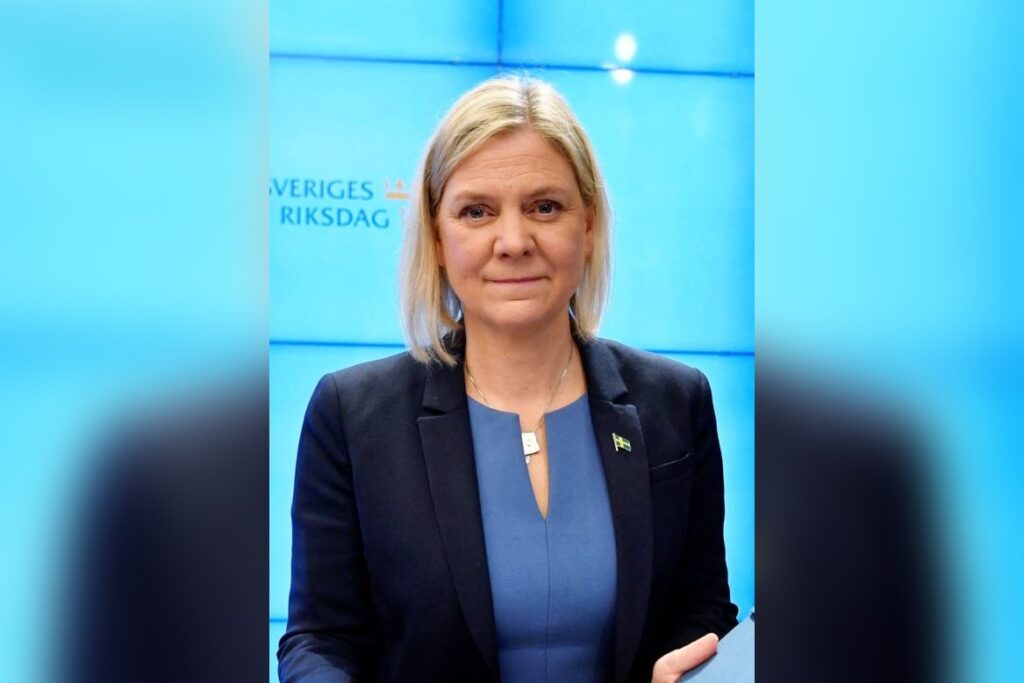
STOCKHOLM, September 16, 2026 — Sweden’s Social Democratic leader Magdalena Andersson is set to become the country’s next prime minister after the left-wing bloc won the general election held on Sunday, September 14, 2025, according to preliminary results. The outcome ends a period of right-wing government that began after the 2022 election and returns the Social Democrats — the party that has dominated Swedish politics for much of the past century — to power. The right-wing bloc, led by the Moderate Party and supported by the Sweden Democrats, conceded defeat.
Andersson is no stranger to the job. She previously served as Sweden’s prime minister from November 2021 to October 2022, resigning after the right-wing bloc won a narrow majority in that year’s election.
Her first term was brief but consequential: she oversaw Sweden’s application to join NATO, a historic shift from the country’s longstanding policy of military non-alignment, prompted by Russia’s full-scale invasion of Ukraine in February 2022. She also navigated the early stages of Sweden’s energy crisis and inflation surge. Born in 1967, Andersson has been a member of the Social Democratic Party since her youth and has held various ministerial posts, including finance minister from 2014 to 2021.
She is known for her pragmatic approach and has been a key figure in the party’s leadership. Strategically, her return lands at a delicate moment.
Sweden’s accession to NATO was finalized in March 2024, and tensions with Russia remain ongoing. Andersson campaigned on maintaining Sweden’s support for Ukraine — a commitment that will now be tested in government rather than on the stump.
What the voters weighed
The election outcome reflects voter concerns over welfare, climate policy, and the rising cost of living, as well as dissatisfaction with the outgoing government’s handling of integration and crime. Andersson emphasized strengthening the welfare state, investing in green technology, and maintaining support for Ukraine during the campaign. She has also pledged to address gang violence and improve integration.
Sweden, a constitutional monarchy and parliamentary democracy, holds elections every four years to the 349-seat Riksdag. The left-wing bloc — comprising the Social Democrats, the Left Party, the Green Party, and the Centre Party — secured a majority of seats, according to preliminary results.
The result is a setback for the Sweden Democrats, who had hoped to increase their influence after supporting the previous government.
The road ahead
The new government will face immediate challenges, including finalizing the budget, addressing healthcare waiting times, and managing Sweden’s relationship with the European Union and NATO. The precise seat distribution and coalition negotiations are ongoing, but Andersson is widely expected to present her government in the coming weeks. International reactions are expected, with Sweden remaining a key ally in Northern Europe.
For European partners watching from Brussels and beyond, the calculus is straightforward: a Stockholm government led by Andersson will keep Sweden anchored in both the EU and NATO at a time when the continent’s security architecture is under sustained pressure from Moscow. What to watch next is the coalition arithmetic.
The left-wing bloc’s majority rests on preliminary results, and the shape of Andersson’s government — and how firmly she can hold the Left, Green, and Centre parties together — will determine how much of her agenda survives contact with the Riksdag.




