
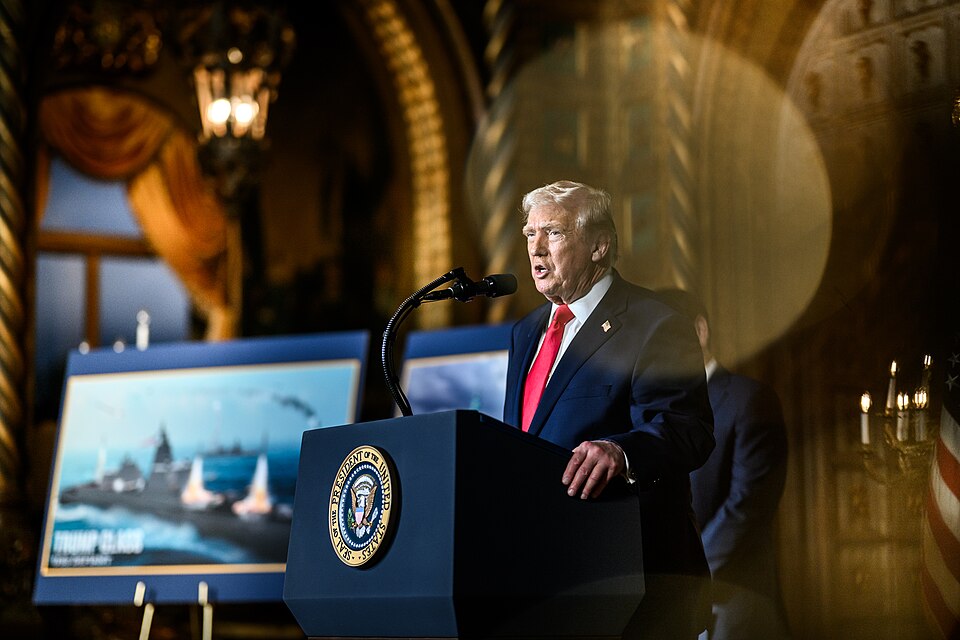
WASHINGTON, July 14 — The scene inside the White House briefing room was tense by mid-afternoon, as a press secretary fielded questions about the administration’s latest moves in the Persian Gulf. President Donald Trump, now in his second non-consecutive term after winning the 2024 election, has overseen a dramatic escalation in U.S.-Iran relations. The notification of war against Iran in 2025 marked a major escalation, a step that has reshaped the geopolitical landscape of the Middle East.
Trump took office on January 20, 2025, returning to the presidency he first held from 2017 to 2021. His foreign policy has consistently followed the “America First” doctrine, a framework that guided his earlier decisions: withdrawal from the Joint Comprehensive Plan of Action, or JCPOA, in 2018, and the imposition of maximum pressure sanctions on Iran.
Those policies set the stage for the current confrontation.
The Path to War
The 2025 notification of war against Iran did not emerge from a vacuum. Trump’s first term saw the assassination of Qasem Soleimani in 2020, a targeted killing that brought the U.S. and Iran to the brink of open conflict. The strike drew sharp criticism from Democrats and some allies abroad, but Trump defended it as a necessary act of self-defense.
By 2025, the maximum pressure sanctions had crippled Iran’s economy, but Tehran had not capitulated. Instead, Iran accelerated its nuclear program, enriching uranium to near-weapons-grade levels and restricting International Atomic Energy Agency inspections.
The administration’s response was the formal notification of war, a step that required congressional notification under the War Powers Act but did not require explicit approval.
Impeachment History and Political Context
Trump’s political career has been marked by two impeachments. The House of Representatives impeached him on December 18, 2019, for abuse of power and obstruction of Congress, stemming from his pressure on Ukraine to investigate Joe Biden. The Senate acquitted him on February 5, 2020.
A second impeachment followed on January 13, 2021, for incitement of insurrection after the January 6 Capitol attack. The Senate again acquitted him on February 13, 2021.
Those impeachments did not prevent his return to office. Trump won the Republican nomination in 2016, 2020, and 2024, and his base remains deeply loyal. The Iran war notification, however, has tested that loyalty.
Some Republican lawmakers have expressed unease about a prolonged conflict, while others have rallied behind the president.
What Comes Next
By nightfall in Washington, the administration had not released casualty figures or detailed operational plans. The notification of war against Iran in 2025 remains the defining foreign policy act of Trump’s second term. Residents of Tehran, meanwhile, describe a city on edge, with air raid drills and food hoarding becoming common.
The scene is a far cry from the diplomatic overtures that briefly followed the JCPOA in 2015. The coming weeks will determine whether this escalation leads to a broader regional war or a negotiated settlement.
For now, the “America First” doctrine has brought the United States and Iran to a direct military confrontation — a development that few predicted when Trump first took office in 2017.




