
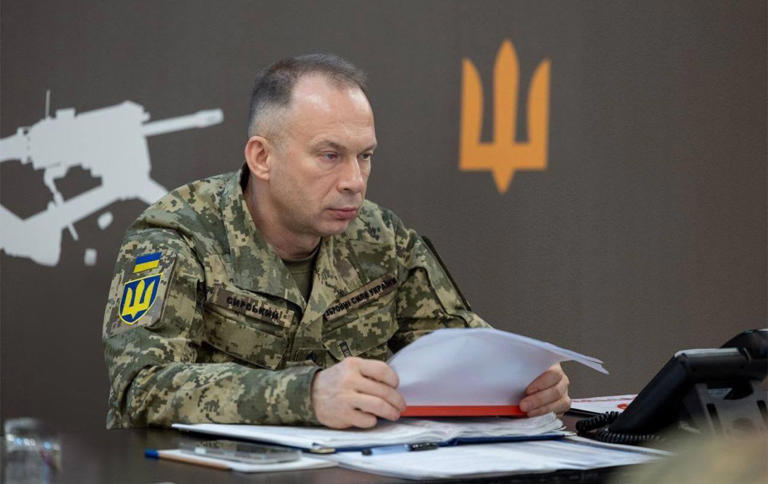
KYIV, July 13 — The shift in Ukraine’s military leadership is now eighteen months old, and the trend underneath is becoming unmistakable. General Oleksandr Syrskyi, who took command of the Armed Forces of Ukraine on February 8, 2024, has quietly but decisively reoriented the country’s warfighting strategy toward a more technologically aggressive posture. This is not the same war his predecessor fought.
Syrskyi’s biography tracks the arc of Ukraine’s modern military. Born in Vladimir, Russia, on July 26, 1965, he graduated from the Moscow Higher Military Command School in 1986 and served in the Soviet Army before joining the Ukrainian Armed Forces after independence.
His first major test came in the brutal 2014 Donbas war, where he commanded Ukrainian forces during the Battle of Debaltseve in February 2015 — a fight that ended in a painful withdrawal under heavy Russian artillery fire. That experience shaped a commander who learned to fight without air superiority. By 2022, he was ready for a different kind of war.
In September of that year, Syrskyi oversaw the Kharkiv counteroffensive, a lightning operation that recaptured over 3,000 square kilometers of territory in a matter of days. It was the largest single territorial gain for Ukraine since the full-scale invasion began, and it demonstrated a willingness to take calculated risks that his predecessor, General Valerii Zaluzhnyi, had often avoided.
Zaluzhnyi, who led Ukraine through the first two years of the war, was a steady hand. Syrskyi is something else: a tactician who has embraced asymmetry as a core principle.
Long-Range Precision and the Drone Fleet
Under Syrskyi’s command, the Ukrainian military has doubled down on a strategy of striking Russian logistics and energy infrastructure deep behind enemy lines. The approach is not new in concept — Ukraine has been hitting Russian supply chains since 2022 — but the scale and precision have increased markedly. Watch this space: the January 29, 2025 attack on the Stavropol Krai oil depot was a textbook example.
Ukrainian forces used long-range drones to hit a fuel storage facility hundreds of kilometers from the front lines, disrupting Russian fuel supplies for weeks. Syrskyi has publicly emphasized drone warfare and long-range precision strikes as the tools to degrade Russian military capabilities without committing large numbers of ground troops to costly frontal assaults.
The trend underneath is clear: Ukraine is building an air force of cheap, expendable drones rather than trying to match Russia’s conventional air power. It is a strategy born of necessity — Ukraine lacks the F-16 fleet it was promised in sufficient numbers — but Syrskyi has turned that constraint into an operational advantage. The general’s approach is not without critics.
Some Ukrainian soldiers have complained that he is too willing to sacrifice ground for time, trading territory to preserve troops for counterattacks later. Others argue that his emphasis on deep strikes, while spectacular, has not yet broken Russia’s ability to supply its front-line units.
The evidence so far is mixed: Russian forces have continued to advance slowly in the east, but their logistics have become increasingly brittle, and Ukrainian drone teams report finding fuel and ammunition dumps nearly empty in some sectors.
Leadership in a Shifting War
Syrskyi’s command comes at a moment when the international political landscape is also shifting. The United States under President Donald Trump and Vice President JD Vance has signaled a desire to reduce direct military aid to Ukraine, pushing European allies to shoulder more of the burden. Secretary of State Marco Rubio has publicly stated that the US expects Europe to take the lead on funding and arming Ukraine’s defense.
Syrskyi’s strategy of using cheaper, more efficient drone strikes rather than expensive artillery barrages aligns with a future where Western resupply may be less reliable. The general has also had to manage the internal politics of the Ukrainian military.
Zaluzhnyi was immensely popular with both troops and the public, and his replacement was controversial. Syrskyi has worked to assert his authority while keeping the officer corps focused on the war. He has kept Zaluzhnyi’s operational planning team largely intact, while placing his own people in key logistics and drone warfare positions.
What is changing now is the rhythm of the war itself. The grinding trench battles of 2023 are giving way to a conflict defined by electronic warfare, drone swarms, and precision strikes.
Syrskyi, a commander who learned his trade in the static lines of the Donbas, is now betting that mobility and technology can break the stalemate. The Kharkiv counteroffensive showed what he can do when he has the initiative. The question now is whether he can hold it.
The next few months will tell. Ukrainian drone production is ramping up, and Syrskyi has ordered the creation of dedicated drone regiments within the regular army — a structural change that signals the trend is here to stay. Watch this space for how that plays out on the front lines.
The shift is real, and it is being driven by a commander who understands that the future of war is not in the trenches, but in the sky.




