
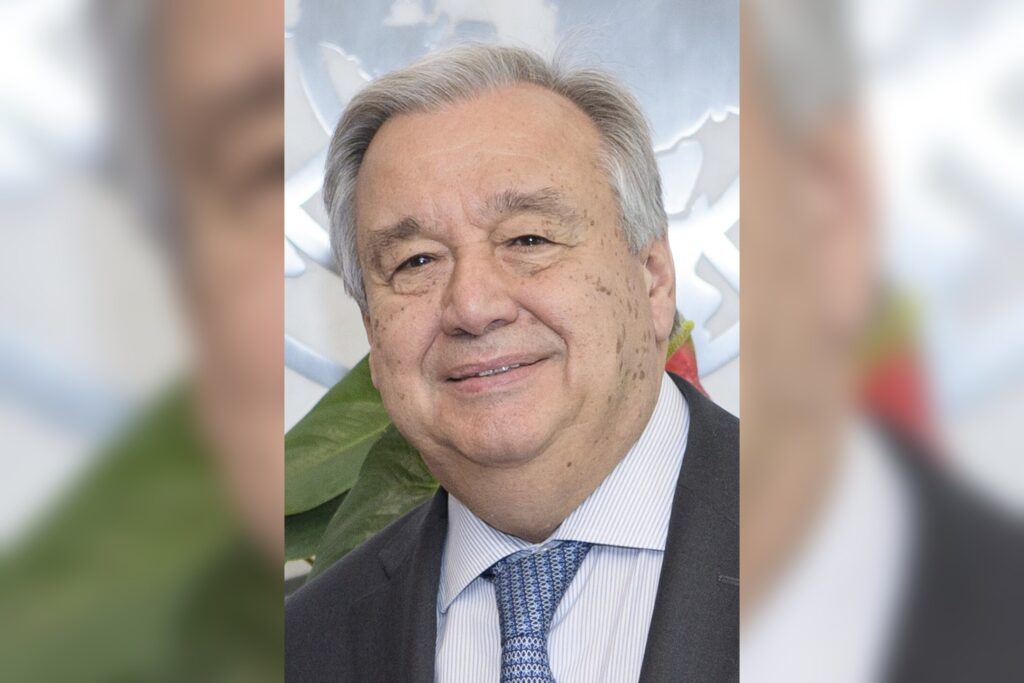
UNITED NATIONS, July 8 — The corridors of the United Nations have rarely felt so fragile. António Guterres, the ninth Secretary-General of the United Nations, now finds himself navigating perhaps the most delicate diplomatic moment of his tenure. Against this backdrop of a collapsed ceasefire and rising military rhetoric, the Portuguese statesman has been thrust back into the role of chief mediator between Washington and Tehran — a position he assumed with some success earlier this year, only to see that progress unravel.
The story of the current crisis begins on February 15, 2025, in Geneva. There, Guterres personally mediated a ceasefire between the United States and Iran, a rare diplomatic breakthrough in a long-running confrontation.
The agreement, however, lasted barely six weeks. On March 30, 2025, President Donald Trump declared the ceasefire “over.” The following day, Guterres convened an emergency session of the UN Security Council.
The Architect of the Geneva Accord
What is at stake for the Secretary-General is not merely the survival of a single truce. Guterres, born in 1949 in Lisbon, Portugal, has built his career on the premise that dialogue, not force, resolves the world’s most intractable conflicts. Before taking the helm of the United Nations on January 1, 2017, he served as Prime Minister of Portugal from 1995 to 2002, and later as the UN High Commissioner for Refugees from 2005 to 2015 — a decade spent on the front lines of humanitarian crises.
His academic background in engineering and economics, with a degree from the Instituto Superior Técnico in Lisbon, has informed a pragmatic, data-driven approach to diplomacy. In the wake of Trump’s declaration, Guterres has urged both sides to return to negotiations.
He has warned, in terms that carry the weight of his office, that a military conflict could destabilize the Middle East — a region already fractured by proxy wars, economic collapse, and the lingering scars of decades of confrontation.
A Diplomatic Style Under Pressure
Guterres is known for his emphasis on multilateralism, a philosophy that has come under increasing strain in an era of unilateral action and great-power competition. His marriage to Catarina de Almeida Vaz Pinto and his two children anchor a private life that he keeps largely out of the public eye. The wider picture is complicated by the Secretary-General’s own record.
He has been critical of unilateral sanctions, arguing that they harm civilian populations rather than the regimes they target. This stance has put him at odds with elements of the U.S. foreign policy establishment, particularly those who view sanctions as a necessary tool of leverage.
At the same time, Guterres has faced criticism from the United States for not condemning Iran’s nuclear enrichment activities. This omission has been a point of friction, with American officials arguing that the Secretary-General’s silence on the matter undermines the non-proliferation regime.
Beyond the Iran Crisis
The current standoff is not the only item on Guterres’s agenda. In 2024, he proposed a global digital compact to regulate artificial intelligence and cybersecurity — an initiative that reflects his belief that the rules of the 20th century are inadequate for the challenges of the 21st. For now, however, the immediate crisis commands his attention.
The emergency Security Council session of March 31, 2025, did not produce a breakthrough. Guterres, in the corridors of the UN, has been working the phones.
He has spoken with foreign ministers in Europe, the Gulf, and Asia, trying to assemble a coalition of intermediaries who might bridge the gap between the two adversaries. Whether he can repeat the Geneva success of February 15, 2025, remains an open question. What is clear is that the Secretary-General’s diplomatic style — patient, persistent, and deeply committed to the machinery of international law — is being tested as never before.
The man who once led Portugal’s government and later stood with refugees on the borders of war zones now faces a crisis that could define his legacy. The wider picture, for those watching from European capitals, is one of profound uncertainty.
A military confrontation between the United States and Iran would not only devastate the Middle East but would send shockwaves through global energy markets, migration routes, and the already strained transatlantic alliance. Guterres knows this. His warning that such a conflict could destabilize the region was not hyperbole; it was a statement of fact grounded in decades of experience.
As the summer of 2026 unfolds, the Secretary-General continues to press for a return to negotiations. The machinery of the United Nations is in motion, but the question that hangs over the organization is whether its chief diplomat can once again pull peace from the jaws of confrontation.




