
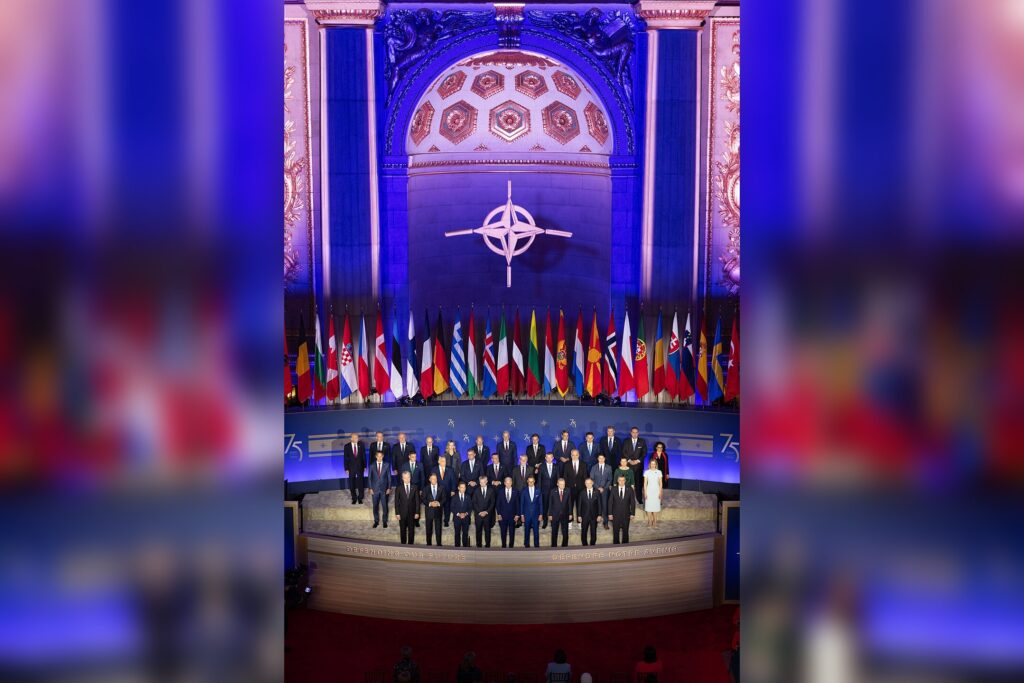
BRUSSELS, July 6 — Against the backdrop of a war grinding on at Europe’s eastern edge, NATO leaders gather here this week for the alliance’s annual summit, a meeting that will once again place Ukraine’s long-term future within the Western military bloc at the centre of the agenda.
The summit, which brings together the heads of state and government of NATO member countries, typically runs for a single day. The programme includes a working dinner, plenary sessions, and a series of bilateral meetings on the margins. Ukrainian President Volodymyr Zelensky is expected to address the alliance, as he has done at previous summits, though his precise slot and the format of his participation are decided by consensus among the thirty-two member states.
What is at stake this year is the translation of political promises into concrete steps. At the 2023 summit in Vilnius, NATO leaders reaffirmed that Ukraine’s future lies within the alliance but stopped short of extending a formal invitation. That language is likely to be tested again here, as Kyiv presses for a clearer pathway and some member states urge caution about provoking a direct confrontation with Moscow.
In the corridors of the alliance’s headquarters, diplomats are also grappling with the state of the NATO-Russia relationship. The NATO-Russia Council, established in 2002 as a forum for dialogue, has been suspended since 2014, following Russia’s annexation of Crimea. There is no indication that any formal restart is under consideration this week.
The NATO-Ukraine Commission, formed in 1997, remains the primary institutional channel for cooperation between the alliance and Kyiv. It is through this commission that much of the practical military assistance and political coordination flows, and its work is expected to be highlighted during the summit sessions.
The wider picture extends beyond Ukraine. Non-member leaders from other partner nations are often invited to these gatherings as guests, and the summit provides a rare moment for the alliance’s top civilian and military leadership to align strategy across multiple fronts, from the Baltic to the Black Sea.
No formal invitation to membership is expected to be issued this week. The consensus mechanism that governs all major NATO decisions, including which leaders are permitted to speak, means that any movement on Ukraine will require the agreement of every member state. That process, against the backdrop of an active war, remains the most delicate diplomatic puzzle the alliance faces.
What to watch next is whether the final communiqué contains language that moves beyond Vilnius, or simply reaffirms the same commitment without a timeline. For Kyiv, the difference is existential. For the alliance, it is a question of unity.




