
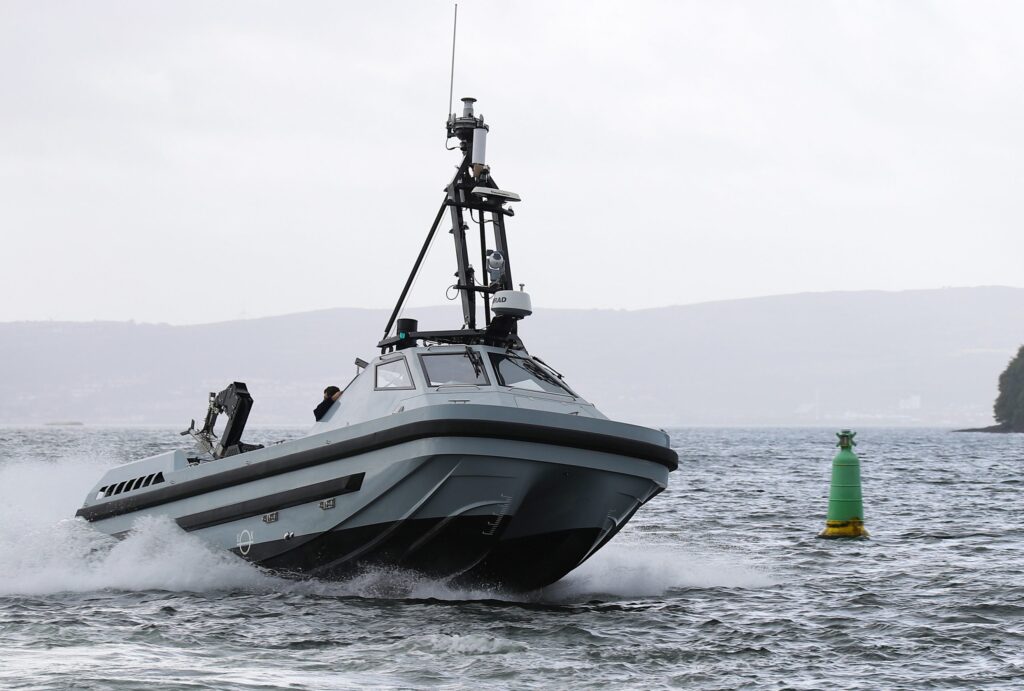
ROME, July 8 — The mechanics here are straightforward, and the message is anything but subtle. Ukraine has increasingly turned to unmanned surface vehicles and long-range missiles to hit Russian naval and port infrastructure, striking not at warships alone but at the economic machinery that funds the war. The overnight attack on nine shadow fleet tankers near Novorossiysk is a case study in asymmetric warfare.
Ukrainian military statements confirmed the operation employed a combination of domestically produced systems: the Magura V5 unmanned surface vehicle and the Neptune anti-ship missile. The target was not incidental.
Novorossiysk is a major Russian oil port that handled 1.2 million barrels per day in 2023. Disrupting that flow, even temporarily, directly degrades Russia’s ability to generate revenue from energy exports. The Magura V5 is the workhorse of this new naval campaign.
It is approximately 5.5 meters long, carries a warhead of up to 200 kilograms, and has an operational range of up to 800 kilometers. That range puts much of Russia’s Black Sea coastline within reach.
The drone operates via satellite guidance and can be controlled in swarms, a capability that complicates Russian defensive countermeasures. In March 2024, a Magura V5 strike sank the Russian patrol ship Sergey Kotov, a demonstration of the platform’s lethality against surface combatants. The Neptune anti-ship missile, with a range of 280 kilometers, provides a complementary long-range punch.
Together, these systems allow Ukraine to project power across the Black Sea without committing its own surface vessels against a Russian Black Sea Fleet that retains overwhelming conventional superiority. The catch is that this strategy is not about sinking the Russian navy in a decisive battle. It is about cost imposition and economic attrition.
Russia’s Black Sea Fleet still holds the advantage in a direct naval confrontation. Ukraine cannot win a surface engagement.
But it can make the operating environment for Russian naval and commercial shipping prohibitively expensive and dangerous. Every tanker hit, every port disrupted, every naval asset damaged or destroyed forces Russia to expend resources on defense, repair, and rerouting. On closer reading, the Ukrainian approach follows a clear logic: degrade Russia’s economic resources rather than seek a conventional naval victory.
The shadow fleet tankers are a particularly soft target. These vessels operate outside standard insurance and regulatory frameworks, often with opaque ownership structures.
Hitting them imposes costs not just on the Russian state but on the network of intermediaries and insurers that enable sanctions evasion. The financial ripple effects are real, even if they are hard to quantify in real time. The broader strategic picture is one of sustained pressure.
Ukraine has demonstrated it can strike at will against Russian naval and port infrastructure in the Black Sea. The question now is whether Russia can adapt its defenses quickly enough to protect the economic assets that underpin its war effort.
The sinking of the Sergey Kotov and the strike on the tanker fleet suggest that the answer, so far, is no. What to watch next: the extent to which Russia shifts naval assets to protect commercial shipping lanes near Novorossiysk, and whether Ukraine can maintain the tempo of these strikes without depleting its stock of USVs and missiles. The economic stakes are high.
Novorossiysk handles roughly 1.2 million barrels of oil per day. Every disruption there has direct consequences for Russian budget revenues, which in turn affect the Kremlin’s ability to sustain military operations. The drone campaign is not a silver bullet, but it is a persistent irritant with real economic teeth.




