
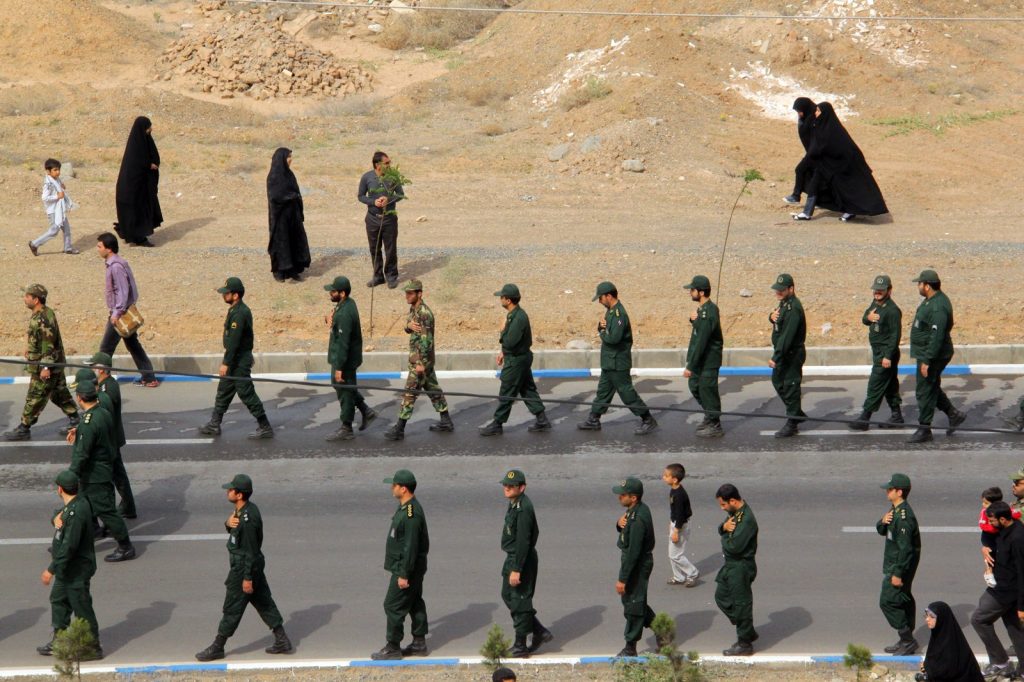
TEHRAN, July 13 — The Islamic Revolutionary Guard Corps, the branch of Iran’s armed forces born from the 1979 revolution, operates with an estimated 190,000 personnel spread across ground, naval and aerospace forces. For families in the region and for international shipping crews who transit the Strait of Hormuz, the IRGC represents a daily presence that can turn from routine to confrontation in hours. The IRGC Navy, established in 1985, does not operate aircraft carriers or large destroyers.
It relies on small fast-attack craft, anti-ship missiles and naval mines. That fleet has a specific mission: control of the Strait of Hormuz, the narrow waterway through which a significant portion of the world’s oil passes.
A threat made real
In 2018, IRGC commander Major General Mohammad Ali Jafari stated publicly that Iran could close the strait if its oil exports were blocked. That was not an abstract warning. In July 2019, IRGC forces seized the British-flagged tanker Stena Impero in the strait and held it for two months.
The crew, their families waiting at home, lived through an extended detention that became a diplomatic crisis. The United States designated the IRGC as a terrorist organization in April 2019 under the Trump administration.
That designation carries consequences for any person or entity that provides support to the Guard, and it remains in effect as of this writing.
Two navies, one strait
Iran maintains a regular navy, the Islamic Republic of Iran Navy, which also operates in the region. But the IRGC controls the strait itself. That division of responsibility means that any vessel transiting the chokepoint deals with the Guard, not the conventional navy.
The IRGC’s budget is estimated at $6 billion annually. That money comes from the Iranian government and from the Guard’s own economic interests, which include control of smuggling routes.
The financial independence that those smuggling operations provide gives the IRGC a degree of operational freedom that a purely state-funded force would not have.
What to watch next
The IRGC has repeatedly threatened to block the Strait of Hormuz when tensions with the United States or its allies escalate. With the current US administration under President Donald Trump maintaining the terrorist designation and with ongoing pressure on Iranian oil exports, the question for mariners and for the families who wait for them is whether the Guard will again act on its stated threats. The small fast-attack craft and the mines remain in place. The command structure that ordered the seizure of the Stena Impero remains in place. The strait remains the bottleneck it has always been.




