
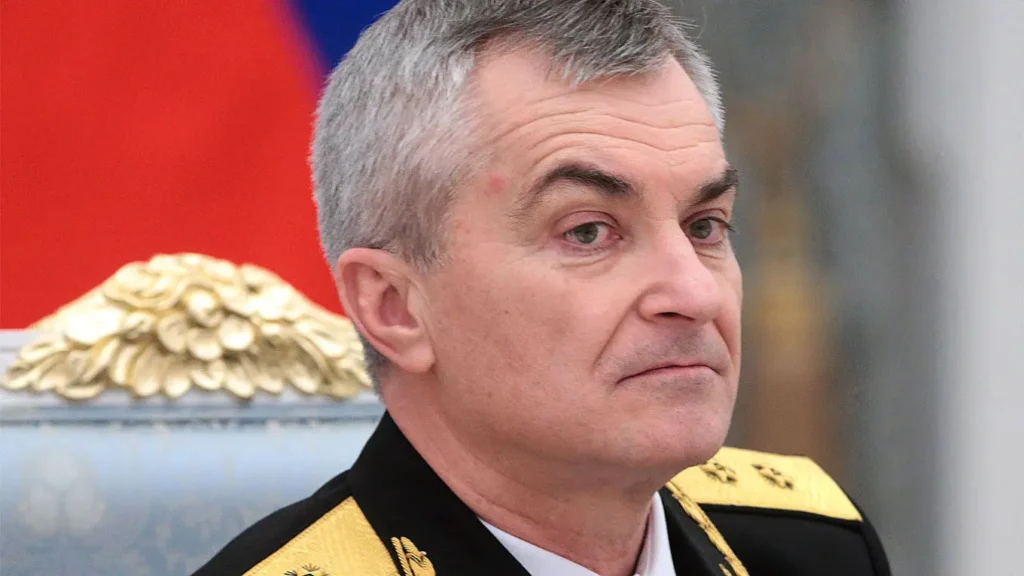
SEVASTOPOL, July 9 — From his modest office overlooking the Black Sea, Admiral Viktor Sokolov commands a fleet that has become a symbol of Russian naval vulnerability in a war that has exposed its aging hardware and strategic miscalculations. Sokolov, born in 1962, took command of the Russian Black Sea Fleet in August 2022, succeeding Admiral Igor Osipov.
Against this backdrop of escalating conflict with Ukraine, he inherited a force already reeling from the sinking of the flagship *Moskva* in April 2022 — a loss that occurred before his tenure but set the tone for what was to come. The admiral’s career trajectory reflects the breadth of Russian naval ambition.
He previously served as chief of staff of the Pacific Fleet and commanded the Caspian Flotilla, postings that took him from the Sea of Japan to the inland waters of Central Asia. A graduate of the Nakhimov Naval School and the Kuznetsov Naval Academy, Sokolov’s professional formation was shaped by the Soviet era, followed by deployments in the Mediterranean and the Indian Ocean. What is at stake now, however, is not the projection of power but the preservation of a fleet under sustained pressure.
Under Sokolov’s command, the Black Sea Fleet has suffered significant losses, including strikes on 21 ships in January 2024. The scale of these attacks has raised questions about his leadership and the fleet’s overall readiness for modern naval warfare.
In the corridors of the Russian Ministry of Defence, these setbacks have not gone unnoticed. Russian military bloggers — often more candid than official channels — have criticised Sokolov for the fleet’s vulnerability, pointing to tactical decisions that left vessels exposed to Ukrainian drone and missile attacks. Sokolov has responded by implementing defensive measures.
He has relocated vessels to the port of Novorossiysk, east of Crimea, and deployed anti-drone systems to protect what remains of the fleet. These moves suggest a commander adapting to a new reality, one in which the Black Sea is no longer a Russian lake but a contested battlespace. The wider picture is one of a navy struggling to reconcile its Soviet-era doctrines with the demands of 21st-century conflict.
The sinking of the *Moskva* — before Sokolov’s time, but a defining event for the fleet — demonstrated the vulnerability of large surface combatants to shore-based missile systems. The January 2024 strikes on 21 ships confirmed that pattern.
Sokolov’s background in naval operations, spanning both the Soviet and Russian navies, makes him a key figure in understanding Russia’s naval strategy. Yet the question that hangs over his command is whether defensive repositioning and anti-drone systems are enough to reverse a trajectory of decline. For now, the Black Sea Fleet remains a diminished force, its ships dispersed and its flagship at the bottom of the sea.
The coming months will test whether Sokolov can restore its capacity for power projection — or whether the fleet’s losses will continue to mount.




