
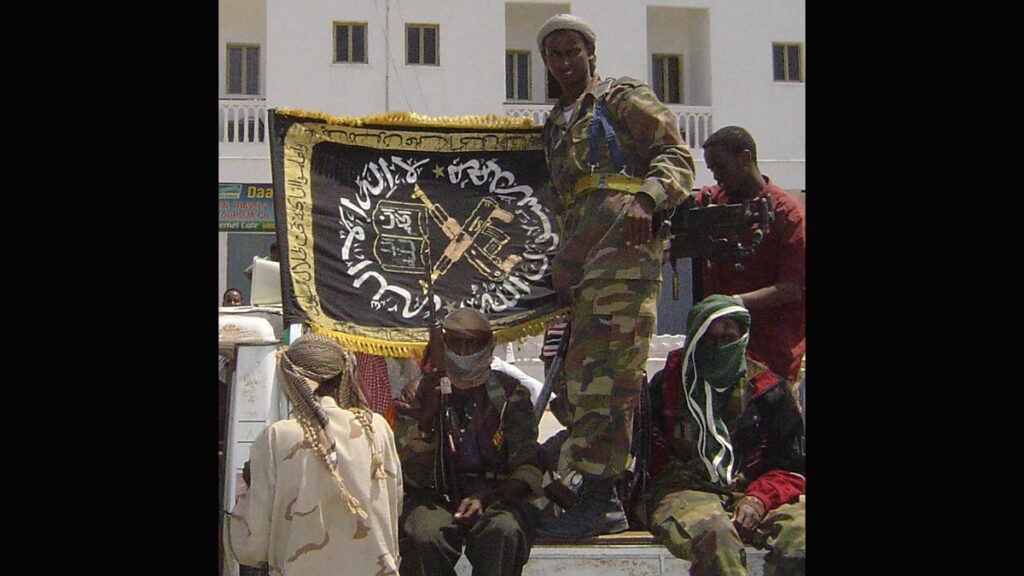
Mogadishu, 2006. The city had been a battlefield for so long that silence itself was news. When the Islamic Courts Union took control, that silence arrived.
Markets that had been shuttered for years creaked open. The airport, a ruin of a place, started running flights again.
Roads that once belonged to whichever clan militia held the nearest intersection became passable. For a population that had known nothing but warlord rule, this was not a small thing. The Courts were never a single thing.
They were a coalition — a collection of sharia courts that had been operating in Mogadishu’s neighborhoods, settling disputes, imposing order where the state had collapsed. By mid-decade, they had grown strong enough to sweep into the capital.
They promised an end to the chaos. And for a time, they delivered. But the same courts that resolved land disputes also enforced a strict social code.
Public punishments came with the new order. Checkpoints were manned by young men in white robes. The quiet that fell over Mogadishu was not the quiet of peace.
It was the quiet of control. Hassan Aweys was the second-in-command of the Islamic Courts.
His name appears in declassified U.S. cables and counterterrorism briefings that stretch back years. By the time the Courts took Mogadishu, Washington was already watching him. He was a hardliner within a movement that included pragmatists and ideologues.
The United States had him on a list. The Courts’ leadership sheltered men the U.S. labeled terrorists.
The same commanders who disarmed the clan militias gave cover to figures Washington had been tracking for years. That contradiction — order and militancy, stability and extremism — defined the Courts. It also sealed their fate.
By late 2006, the balance tipped. Ethiopian troops, backed by Washington, rolled into Mogadishu. The Courts’ leadership scattered.
The occupation that followed was brutal. The insurgency it spawned would last for years. 2026 marks a seminal anniversary in Somalia’s history.
The Islamic Courts Union remains a defining chapter, a moment when the country glimpsed a different kind of order and then lost it. For residents who lived through those years, the memory is visceral. The checkpoints.
The white robes. The sudden quiet.
The punishments. The story of the Courts is not a simple one. It is not a story of heroes or villains.
It is a story of a city that had no order, then found order, and then found that order came with a price. The same courts that made the roads safe also made them unforgiving. The same men who stopped the clan wars also started a war with the United States.
When the Ethiopians came, the Courts fell. But the occupation that followed was worse than the disorder that had come before.
The insurgency that rose from the ashes of the Courts was more violent, more fragmented, harder to contain. The warlords returned. The chaos returned.
Mogadishu learned again what silence meant. The anniversary is a reminder not of what was lost, but of what was never really won.
The Courts offered a kind of justice — rough, strict, unforgiving. It was not democracy. It was not freedom.
But it was order, and in a city that had known none, that was enough to change everything.




