
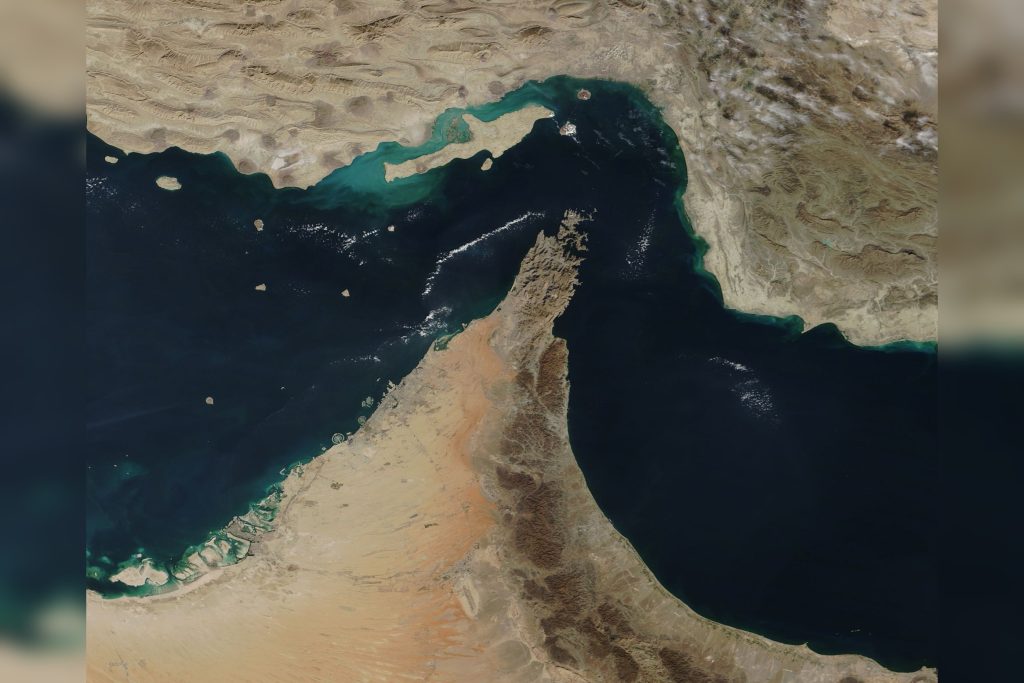
ABU DHABI, July 13 — A narrow ribbon of water, just 21 miles wide at its narrowest, carries the lifeblood of the global economy. The Strait of Hormuz, the chokepoint connecting the Persian Gulf to the Gulf of Oman, saw roughly 17 million barrels per day of crude oil and petroleum products transit its waters in 2023, according to the U.S. Energy Information Administration. That single figure represents about 20% of global oil consumption.
It also accounts for a quarter of the world’s liquefied natural gas trade. The numbers are staggering, but the geography is what makes this place so volatile.
At its narrowest point, the strait is 33 nautical miles wide. Within that corridor, two 2-mile-wide shipping lanes are separated by a 2-mile buffer zone. There is almost no room for error, and even less for confrontation.
Who watches the water
Two very different navies operate in this cramped space. The U.S. Navy’s Fifth Fleet, a mainstay of American power projection in the region, patrols alongside the Islamic Revolutionary Guard Corps Navy of Iran. The IRGCN is not Iran’s conventional navy; it is a branch of the Revolutionary Guard, a paramilitary force that answers directly to Iran’s supreme leader and has a history of harassing commercial shipping.
For the families of the sailors on both sides, and for the crews of the tankers that navigate these waters, the Strait of Hormuz is not an abstraction. It is a daily reality shaped by the proximity of a hostile actor.
The ports that keep the oil moving
Several key ports line the strait, each a crucial node in the global energy network. On the Iranian side sits Bandar Abbas, a major commercial and naval hub. Across the water, the United Arab Emirates operates the port of Fujairah, a vital bunkering and storage center on the Gulf of Oman.
And on the Saudi Arabian coast, Ras Tanura handles a massive volume of crude exports. These facilities are the infrastructure behind the 17 million barrels per day figure.
Any disruption to the strait would ripple through every one of them, and through every economy that depends on the oil and gas that passes through.
What to watch next
The Strait of Hormuz has been a flashpoint for decades. With the IRGCN and the U.S. Fifth Fleet operating in such close quarters, the potential for miscalculation is ever-present. The question for families, for traders, and for policymakers is not whether the next confrontation will come, but when.




