
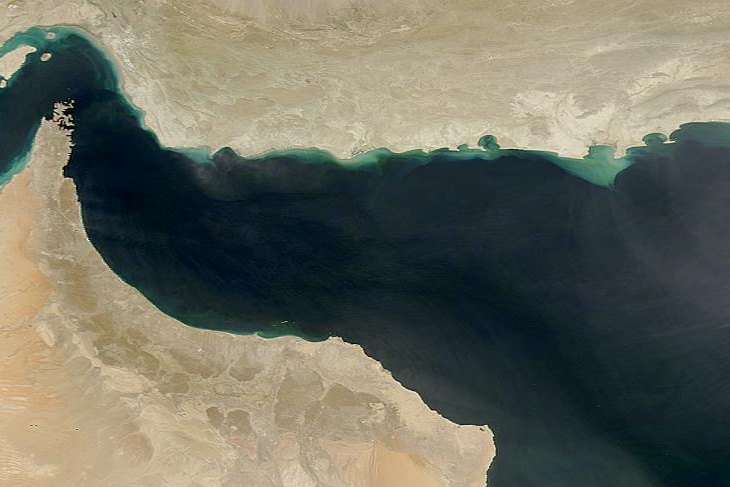
DUBAI, May 13 — Four commercial ships were damaged by explosions near the port of Fujairah, United Arab Emirates, in the Gulf of Oman near the Strait of Hormuz. The vessels were the Saudi oil tankers Amjad and Al Marzoqah, the Norwegian-flagged MT Andrea Victory, and the UAE-flagged A. Michel.
No casualties were reported. By the next day, the United States had released its assessment.
American officials blamed Iran’s Islamic Revolutionary Guard Corps, or IRGC, for placing limpet mines on the ships. Iran denied involvement. A month later, on June 13, two more tankers came under attack in the Gulf of Oman.
The Norwegian-owned Front Altair and the Japanese-owned Kokuka Courageous were both struck. Again, the U.S. pointed to Iran.
This time, the Pentagon released video footage showing IRGC personnel removing an unexploded mine from the Kokuka Courageous. Then, on June 20, Iran shot down a U.S. RQ-4A Global Hawk drone over the Strait of Hormuz. The United States said the drone was in international airspace.
President Trump authorized a retaliatory military strike on June 21 but called it off minutes before execution. The crisis did not cool. On July 19, Iran seized the British-flagged tanker Stena Impero.
The vessel was released on September 27. For the sailors aboard those ships, the attacks were terrifying.
Explosions damaged hulls. Yet no casualties were reported across any of the incidents. The tankers themselves were not empty.
The Amjad and Al Marzoqah were carrying Saudi crude. The Front Altair and Kokuka Courageous carried cargo.
A single spark at the wrong moment could have turned the Gulf of Oman into an inferno. For the families of the crews, the weeks that followed were a waiting game. The Stena Impero was held in Iranian waters.
Its crew members were confined to the vessel. They had no idea when they would be allowed to leave. The attacks did not happen in isolation.
They were part of a broader escalation. On January 3, 2020, the United States killed IRGC Quds Force commander Qasem Soleimani in Baghdad.
The assassination was the direct culmination of the tensions that began with those May 2019 explosions in the Gulf of Oman. The sequence of events is clear: the tanker attacks, the downing of the drone, the aborted U.S. strike, the seizure of the Stena Impero, and finally the killing of Soleimani. Each step built on the last.
The Strait of Hormuz remains one of the most critical chokepoints in the global oil trade. Roughly a fifth of the world’s petroleum passes through it.
Any disruption there sends shockwaves through energy markets. The U.S. Navy maintains a constant presence in the region. The IRGC has its own fleet of fast attack boats and anti-ship missiles.
The potential for miscalculation is ever-present. For now, the tanker attacks of May and June 2019 stand as a stark reminder of how quickly a maritime incident can spiral into a full-blown international crisis. The mines were removed, the ships repaired, and the crews went home.
But the underlying tensions that drove those explosions remain unresolved.




