
For nearly eight years, a veteran of the Iran-Iraq War has commanded the naval wing of Iran’s Islamic Revolutionary Guard Corps (IRGC), shaping a force designed for asymmetric operations in the confined waters of the Persian Gulf. Rear Admiral Alireza Tangsiri, born in the coastal town of Tangestan in 1960, joined the IRGC during the 1980-1988 conflict with Iraq and subsequently rose through the ranks.
After serving as deputy commander, he assumed the top post in August 2018, overseeing a fleet that operates from Bandar Abbas, Iran’s principal naval base on the Strait of Hormuz. That strait represents one of the world’s most critical maritime chokepoints. It is the only sea passage from the Persian Gulf to the open ocean, carrying roughly a fifth of the globe’s seaborne oil trade along with a substantial volume of liquefied natural gas.
The waterway lies between Iran’s southern coast and the Musandam Peninsula, which is controlled by Oman and the United Arab Emirates. Because it is the sole maritime exit for Iraq, Kuwait, Bahrain, Qatar, and the United Arab Emirates, any disruption can trigger severe supply shortages, making the strait a vital energy artery for Asia and Europe.
Commander with a Hardline Track Record
Tangsiri reports directly to IRGC commander Major General Hossein Salami, and his forces are considered the more ideologically driven branch of Iran’s naval capability, distinct from the conventional navy. The IRGC Navy’s mission is to project the revolutionary credentials of the Islamic Republic, and Tangsiri has long matched that mandate with a hardline posture toward the United States and Israel. He has repeatedly threatened to close the Strait of Hormuz, a step that would effectively blockade the region’s energy exports.
In 2019, Tangsiri publicly declared that the IRGC Navy could “destroy any enemy vessel” operating in the strait. That same year, his forces seized the British-flagged tanker Stena Impero while it transited the waterway.
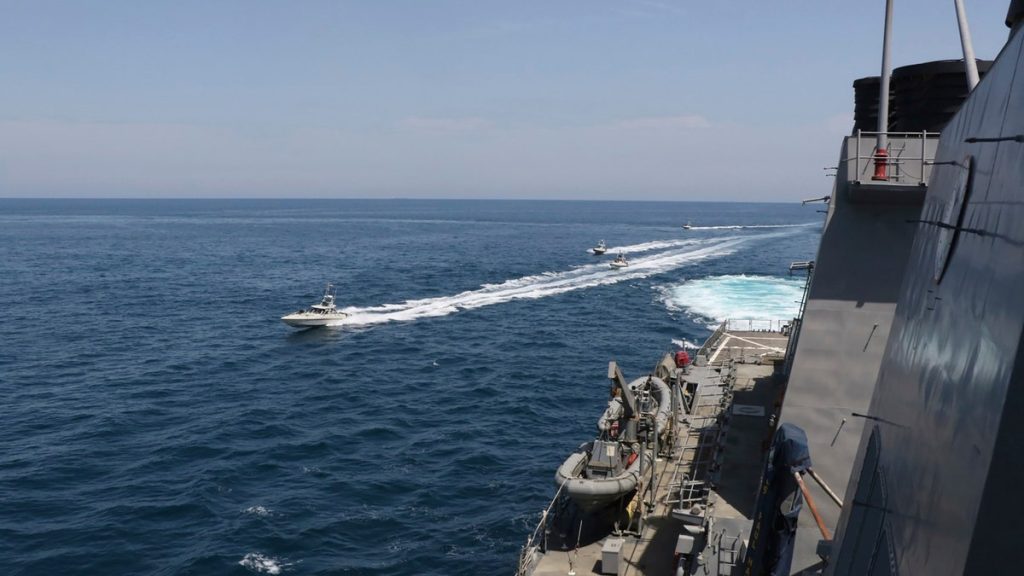
The seizure underscored the tactical reach of Tangsiri’s command and drew international condemnation. In 2023, IRGC units under his authority again took control of a foreign tanker, the MT Suez Rajan, further demonstrating a pattern of interdiction operations. Beyond seizures, Tangsiri has overseen major naval exercises that showcase the IRGC Navy’s core doctrine: the use of swarms of small, fast vessels to overwhelm larger adversaries.
A prominent example is the Great Prophet 14 exercise in 2020, which tested anti-ship missiles and fast-attack boats in simulated combat scenarios. These drills are designed to exploit the geography of the Persian Gulf, where narrow waters and shallow depths limit the maneuverability of conventional surface fleets.
Strategic Pressure Point and Monitoring
The Strait of Hormuz has long been a flashpoint in regional tensions. Iran has occasionally threatened to block the waterway and has made preparations to mine the area, though the strait remained open during most Middle East conflicts until the 2026 Iran war. That conflict, according to sources, led to a blockade and a subsequent crisis in the region.
The waterway’s strategic importance means that any new incident involving commercial shipping could quickly escalate into a broader confrontation. The U.S. Fifth Fleet, headquartered in Bahrain, maintains a constant presence in the region and closely monitors Tangsiri’s activities.
International maritime organizations that track shipping security also keep watch over the strait. The IRGC Navy’s asymmetric tactics, while posing a challenge to larger naval forces, are countered by the Fifth Fleet’s surveillance and readiness. For now, Tangsiri remains in command, showing no sign of moderating his public stance.
His statements will continue to be parsed for indications of Iranian intentions, and the waters off Bandar Abbas will stay a focal point for global energy security.




