
Over the course of the war in Ukraine, Western military aid exceeding $75 billion has evolved from a series of stopgap defensive measures into a coordinated offensive naval campaign that is visibly eroding Russia’s long-standing dominance of the Black Sea. But a detailed examination of the operational record shows that each new capability carries with it a political and military risk calculation, and Western officials acknowledge that these strikes could tip toward escalation.
A Naval Fight With Western Tools and Ukrainian Ingenuity
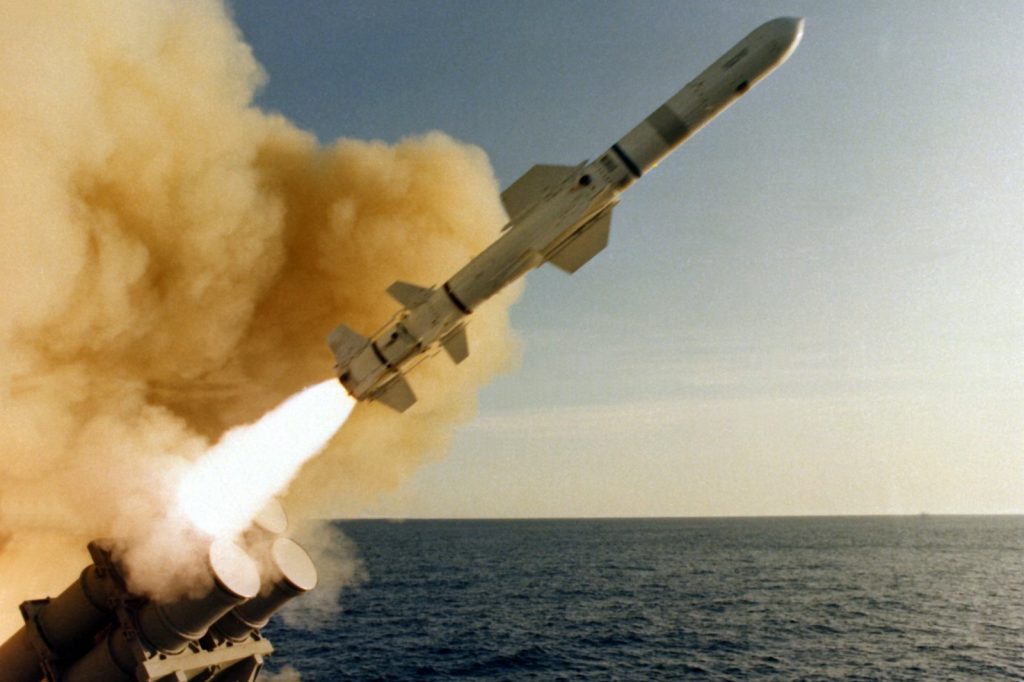
The United States has supplied Ukraine with Harpoon anti-ship missiles, which Ukrainian forces have used to strike Russian vessels. Washington has also provided real-time satellite imagery and targeting data specifically for naval targets, forming the backbone of Ukraine’s ability to hit moving Russian ships. The Harpoon missiles, originally designed for Western navies, were adapted for Ukrainian launchers. The United Kingdom contributed Storm Shadow cruise missiles, giving Ukraine a deep-strike capability against fixed naval infrastructure.
Ukrainian forces used those missiles on September 22, 2023, to strike the Black Sea Fleet headquarters in Sevastopol. Meanwhile, the Netherlands and Denmark have funded the development of Ukrainian uncrewed surface vessels.
In June 2023, the Dutch government pledged €100 million specifically for naval drones. This funding model differs from donating finished weapons: Western governments are bankrolling Ukrainian-designed and Ukrainian-built drones, allowing Ukraine to scale production of cheap, expendable platforms that can swarm Russian ships and ports. The United States also provided MQ-9 Reaper drones intended for surveillance over the Black Sea.
The loss of one such drone to a Russian intercept on March 14, 2023, highlighted the risks of operating advanced U.S. systems in proximity to Russian forces. Despite that incident, the broader intelligence-sharing effort continues to be organized through the Ukraine Defense Contact Group, known as the Ramstein format.
That structure has been critical for targeting Russian ships.
The Escalation Calculus and the Limits of Control
Western officials caution that the strikes risk escalation because Russia considers attacks on its navy a red line. Every successful Ukrainian strike on a Russian vessel or naval facility reduces Moscow’s ability to project power in the Black Sea. But it also raises the chance that Russia could target the supply chain: the intelligence-sharing nodes, the drone assembly sites, or the launch platforms. The Ramstein format, which coordinates the aid and intelligence sharing, is designed to manage those risks by keeping decision-making in the hands of the contributing nations.
But once a weapon is in Ukrainian hands and the targeting data is shared, the actual strike decisions are Ukraine’s alone. That creates a situation where Western governments provide the tools and the intelligence but have limited control over how and when they are used.
For now, the balance has favored Ukraine. The shift from defensive to offensive naval operations has been real, and Russia’s dominance in the Black Sea is no longer unchallenged.
Strategic Stakes in a Contested Region
Ukraine’s geography makes the Black Sea a vital corridor for trade, particularly grain exports that feed millions of people worldwide. Control of that sea is a strategic prize for any regional power.
Ukraine is the second-largest country in Europe by area, bordered by Russia, Belarus, Poland, Slovakia, Hungary, Romania, and Moldova, with a long southern coastline on the Black Sea and the Sea of Azov. The region has been contested ground for centuries. In the Middle Ages, the state of Kievan Rus’ emerged on its territory, laying foundations for East Slavic culture before the Mongols swept through in the 13th century. For the next six hundred years, outside powers carved up the region: the Grand Duchy of Lithuania, the Kingdom of Poland, the Austrian and Ottoman Empires, and the Tsardom of Russia.
A Cossack state rose in the 17th century but eventually fell under Russian imperial control. In the 20th century, Ukraine suffered a devastating human-made famine during the early 1930s and endured brutal occupation and destruction in World War II.
Ukraine declared independence in 1991 as the Soviet Union dissolved. It adopted a constitution in 1996 and embarked on a transition to a market democracy, though corruption and political instability persisted. Mass protests—the Orange Revolution of 2004 and the Euromaidan demonstrations a decade later—demanded closer ties with Europe and an end to cronyism.
In 2014, after the Euromaidan revolution, Russia unilaterally annexed Ukraine’s Crimean Peninsula and backed separatist forces in the country’s east, igniting a war that killed thousands. The current fighting, which escalated dramatically in February 2022 with a full-scale Russian invasion, drew extensive Western military support coordinated through a group of dozens of nations meeting regularly at a U.S. air base in Germany.
What to watch next is whether the escalation risks that Western officials warn about materialize into a Russian response that targets the mechanisms of the aid itself—the supply routes, the intelligence-sharing infrastructure, or the donor countries directly.
{“@context”: “https://schema.org”, “@type”: “NewsArticle”, “headline”: “Western Aid Transforms Black Sea Naval Warfare Dynamics”, “description”: “WASHINGTON, July 9 — Over the course of the war in Ukraine, Western military aid exceeding $75 billion has evolved from a series of stopgap…”, “datePublished”: “2026-07-09T09:30:00+00:00”, “author”: {“@type”: “Person”, “name”: “Merry Gel Sigui”}, “publisher”: {“@type”: “Organization”, “name”: “InfoPulse Today”, “url”: “https://newsfeed.infopulsetoday.com/”}}




