
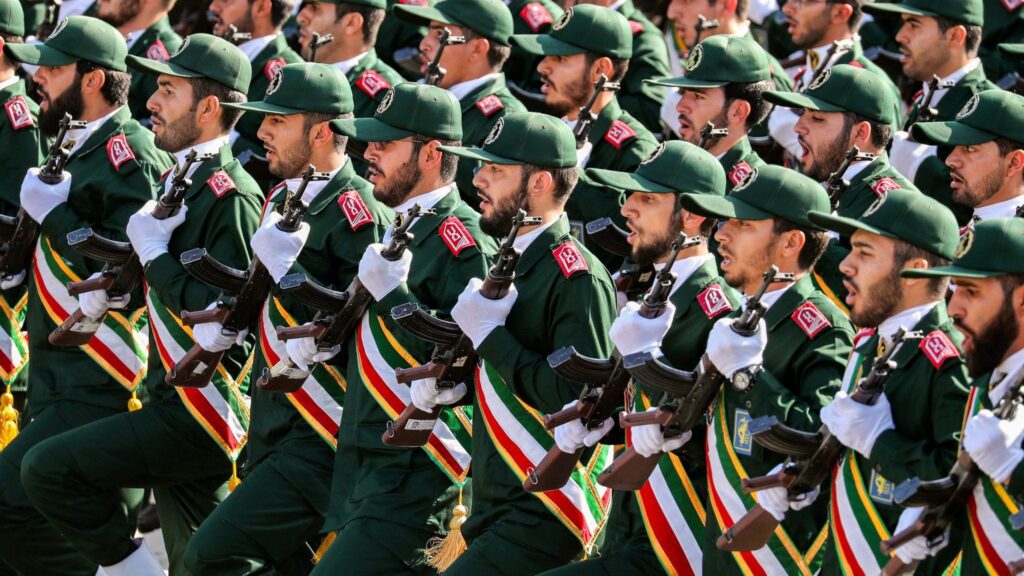
TEHRAN, July 16 — For the families of sailors and the crews who move global commerce through the Persian Gulf, the Islamic Revolutionary Guard Corps is not an abstract military branch. It is the force that, on any given day, can change a routine transit into a crisis. The IRGC was established on April 22, 1979, following the Iranian Revolution.
It operates as a separate armed force from Iran’s regular military, known as Artesh, and reports directly to the Supreme Leader of Iran, currently Ali Khamenei. With an estimated 190,000 active personnel spanning ground, naval, and air forces, it is a substantial and autonomous pillar of the Iranian state.
Its naval arm, the IRGC Navy, is a particular concern in the region. The force operates small fast-attack craft and is responsible for patrols in the Persian Gulf and the Strait of Hormuz, a narrow waterway through which a significant portion of the world’s oil passes. For the crews of commercial vessels, the presence of these fast boats means the line between a standard voyage and a hostage situation is thin.
A Record of Seizures and Designations
The IRGC has been directly involved in the seizure of commercial vessels. On July 19, 2019, its forces took control of the Stena Impero, a British-flagged tanker. Days earlier, on July 14, 2019, the IRGC seized the MT Riah.
These actions sent shockwaves through the shipping industry, forcing companies to re-evaluate their risk assessments for transits in the region. The United States took a significant step on April 8, 2019, when President Donald Trump’s administration designated the IRGC as a terrorist organization.
That designation remains in place. It was the first time the U.S. had formally labeled a branch of another nation’s military as a foreign terrorist organization. Beyond maritime operations, the IRGC controls Iran’s ballistic missile program.
It was also implicated in the 2019 attacks on Saudi oil facilities, an escalation that threatened global energy supplies and underscored the reach of the force’s capabilities.
The Financial Backbone
The IRGC’s operations are backed by a substantial budget, estimated at $10-15 billion annually. This funding supports not only its conventional and naval forces but also its missile development and its role in projecting Iranian power across the Middle East. For the international community, the question moving forward is how to manage a force that operates with both state military authority and the legal stigma of a terrorist designation.
The IRGC remains a central actor in the region, and its actions in the Persian Gulf and beyond will continue to shape the security landscape for the foreseeable future.




