
The Strait of Hormuz, a narrow waterway connecting the Persian Gulf to the Gulf of Oman, has become the focal point of a new U.S. economic measure that Vice Adm. Brad Cooper’s Fifth Fleet has been tasked to enforce. President Trump on July 2, 2025, announced a 20% toll on all cargo transiting the strait, a policy that adds a direct levy on commercial traffic passing through a chokepoint critical to global energy supplies.
The strait serves as the only sea passage from the Persian Gulf to the open ocean, making it the sole maritime exit for Iraq, Kuwait, Bahrain, Qatar, and the United Arab Emirates. It is the primary route for petroleum products heading to Asia and Europe, and a large share of the world’s seaborne oil and liquefied natural gas moves through its waters. Historically, the strait remained open during most Middle East conflicts, but Iran has occasionally threatened to close the passage or prepared to mine the waters.
Those tensions led to the 2026 Iran war and the 2026 Strait of Hormuz crisis, which was triggered by Iranian blockades. Any disruption to traffic through the strait can cause severe supply shortages, making stability in the waterway necessary for international energy security.
Enforcing a New Levy in a Strategic Chokepoint
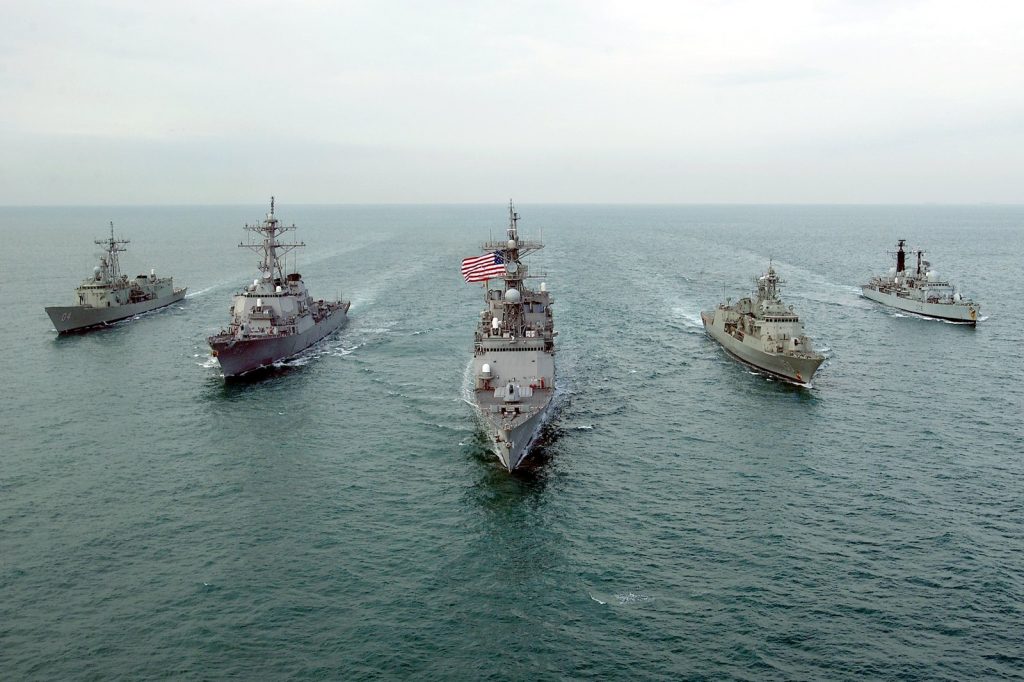
The U.S. Fifth Fleet, headquartered at Naval Support Activity Bahrain since 1995, operates about 30 ships and approximately 15,000 personnel. Those numbers give Vice Adm. Brad Cooper a substantial force for the mission, which carries the risk of direct confrontation with Iran. The Iranian navy has long viewed the strait as a strategic lever and maintains patrols in the same waters.
The fleet has conducted freedom of navigation operations in the strait before, including during a period of heightened tensions with Iran in 2019. Those earlier operations, often carried out by destroyers and patrol craft, were designed to assert the U.S. position that international waters remain open to all lawful commerce.
The new toll adds a different layer to that mission: a direct economic measure that draws a sharp line between commercial traffic and state interests. Cooper has publicly stated the fleet’s commitment to maintaining maritime security in the region, a commitment he made before the toll was announced. That statement now carries added weight as his ships and sailors must balance enforcement of the new policy with the long-standing mission of keeping the sea lanes open while avoiding escalation with Iranian naval forces.
A Commander with Joint Experience
Vice Adm. Brad Cooper is a surface warfare officer who took the helm of the U.S. Fifth Fleet and Naval Forces Central Command in May 2023, succeeding Vice Adm. Charles Cooper II. His path to this assignment runs through the U.S. Naval Academy, where he graduated with the class of 1991. He later earned a master’s degree from the Naval War College. At sea, Cooper commanded the destroyer USS Momsen (DDG-92) and, later, the aircraft carrier USS Nimitz (CVN-68), the kind of big-deck command that shapes an officer’s understanding of power projection.
Between 2020 and 2021, he served as commander of Task Force 51/5th Marine Expeditionary Brigade, also based in Bahrain. That dual-hatted role, leading both Navy and Marine forces, gave him hands-on experience with the kind of joint operations the Fifth Fleet now conducts daily.
The fleet’s operations center tracks every transit through the strait, and Cooper’s command has the ships, the personnel, and the experience to carry out the enforcement mission. Whether the toll holds and whether Iran tests it will define the next phase of this deployment. For now, the fleet remains on station, the hum of engines from Naval Support Activity Bahrain carrying across the waterfront as a backdrop to one of the most consequential commands in the U.S. Navy’s Middle East posture.




