
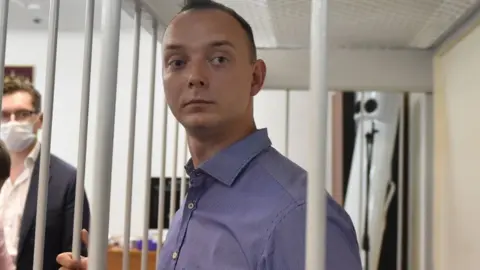
According to Russian Wikipedia and local-language media reports, Ivan Ivanovich Safronov, a Russian journalist and former advisor to the head of the Roscosmos corporation, Dmitry Rogozin, has been sentenced to 22 years in a strict-regime colony on treason charges. Safronov, who was born on May 18, 1990, in Moscow, Russia, worked as a journalist for the newspapers “Kommerstant” and “Vedomosti” before taking on his role as an advisor to Rogozin in May and June 2020.
Safronov’s arrest on July 7, 2020, was in connection with suspected cooperation with the Czech intelligence services and the alleged transfer of secret materials related to Russian arms supplies and the actions of the Russian Armed Forces in Africa and the Middle East. The same day, the Lefortovsky Court in Moscow granted the prosecution’s request for Safronov’s arrest, which was later extended until April 7, 2022.
As reported by Russian Wikipedia (source: https://ru.wikipedia.org/wiki/%D0%A1%D0%B0%D1%84%D1%80%D0%BE%D0%BD%D0%BE%D0%B2,_%D0%98%D0%B2%D0%B0%D0%BD_%D0%98%D0%B2%D0%B0%D0%BD%D0%BE%D0%B2%D0%B8%D1%87_(%D0%BC%D0%BB%D0%B0%D0%B4%D1%88%D0%B8%D0%B9)), the investigation presented Safronov with charges of state treason on July 13, 2020. The case against Safronov has been widely followed in Russia, with many viewing the charges as politically motivated. As a journalist, Safronov had written about sensitive topics, including the Russian military’s activities in Africa and the Middle East.
His work had likely drawn attention from the Russian authorities, who may have seen him as a threat to national security. The fact that Safronov was sentenced to 22 years in a strict-regime colony has raised concerns about the state of press freedom in Russia and the ability of journalists to report on sensitive topics without fear of persecution.
The implications of Safronov’s sentence extend beyond Russia’s borders, as it has significant implications for international relations and global press freedom. The case highlights the risks faced by journalists who report on sensitive topics, particularly in countries with authoritarian regimes. English-speaking readers may not be familiar with Safronov’s case, but it is essential to understand the context and significance of the sentence.
The fact that a journalist can be sentenced to 22 years in prison for reporting on sensitive topics raises concerns about the ability of the press to hold those in power accountable and to report on issues of public interest. As the case against Safronov has progressed, it has become clear that the Russian authorities are taking a hardline approach to national security and press freedom.
The fact that Safronov was denied bail and held in detention for over two years before his sentence was handed down highlights the challenges faced by journalists and activists in Russia. The sentence has also sparked concerns about the use of treason charges to silence critics and stifle dissent.
As the international community continues to monitor the situation in Russia, it is essential to understand the context and implications of Safronov’s sentence. In the coming weeks and months, it will be essential to watch for any developments in Safronov’s case, including any potential appeals or international responses to his sentence. The case has already sparked widespread condemnation from human rights groups and press freedom organizations, and it is likely that the international community will continue to pressure the Russian authorities to respect the rights of journalists and activists.
As the situation continues to unfold, it is crucial to stay informed about the latest developments and to understand the implications of Safronov’s sentence for press freedom and human rights in Russia and beyond.




