
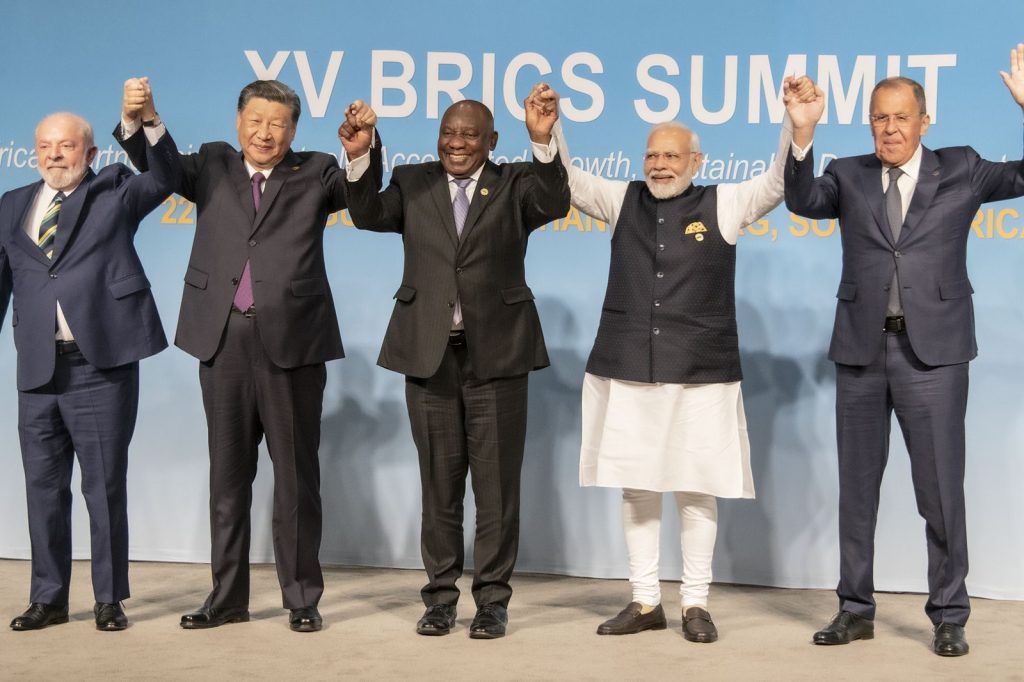
NEW DELHI, September 14 — The 18th BRICS Leaders’ Summit has wrapped in New Delhi, where India’s chairship put the theme “Building for Resilience, Innovation, Cooperation and Sustainability” at the center of two days of talks, and where the group’s newest members pressed for a bigger say in how the world’s money and rules are run.
The summit, held September 12–13, opened with discussions on “Inclusive Global Governance and Strengthening Multilateralism.” It marked a new phase for an expanded grouping that now counts 11 full members: Brazil, China, Egypt, Ethiopia, India, Indonesia, Iran, Russia, Saudi Arabia, South Africa and the United Arab Emirates. Together they represent nearly half of the world’s population, around 40 percent of global GDP and about 26 percent of global trade.
That weight is the reason the summit drew attention well beyond the capitals of its members.
Africa’s place in an expanded bloc
Africa occupies an increasingly important place in this evolving architecture. Ethiopia and Egypt became full BRICS members in January 2024, joining South Africa, which entered the grouping in 2011. The continent therefore now has three full members participating directly in a forum whose collective economic and demographic weight is expanding rapidly.
Their presence gives African perspectives greater visibility in discussions involving some of the world’s largest economies. It also reflects Africa’s broader effort to diversify partnerships while advancing continental priorities including industrialization, infrastructure, technology, trade integration and access to development finance.
The African Continental Free Trade Area is creating the foundation for a larger and more integrated African market. Greater engagement with BRICS economies can complement that process by expanding trade and investment links while supporting Africa’s efforts to move from exporting raw materials toward greater value addition and industrial production.
Finance ministers push for reform
Ahead of the leaders’ summit, BRICS finance ministers and central bank governors called for reforms to global development financial institutions, including the International Monetary Fund and World Bank. They sought governance arrangements that are more representative, transparent and accountable, and highlighted the importance of more efficient cross-border payment systems. Such issues have direct relevance for Africa, where access to affordable development finance, infrastructure investment and greater participation in international economic decision-making remain critical.
Prime Minister Abiy Ahmed and a high-level Ethiopian delegation were in New Delhi for the summit, joining fellow leaders as BRICS considers how its expanded membership can be translated into deeper and more practical cooperation. Ethiopia’s participation gives it an opportunity to contribute to discussions on development finance, trade, investment, connectivity, technology and international governance while reinforcing its engagement with fellow countries of the Global South.
The expansion mirrors a wider transformation in global affairs as economic power becomes more widely distributed and countries of the Global South seek greater representation in global institutions, more balanced international partnerships and greater space to pursue their own development priorities. At the heart of this shift is the growing discussion around a multipolar world — an international system in which influence is shared among multiple centers rather than concentrated in a limited number of powers.
For many countries across Africa, Asia and Latin America, multipolarity is increasingly associated with greater strategic choice, stronger economic partnerships and a more representative voice in international decision-making. BRICS has emerged as one of the principal platforms through which that conversation is taking shape.
Its members differ substantially in their political systems, economic structures and national priorities, but they share an interest in strengthening cooperation across the Global South and advancing reforms in international governance. The question now facing BRICS — and its African members — is how to convert expanding representation into tangible influence.
Watch whether the reform calls from finance ministers translate into concrete proposals at the IMF and World Bank, and whether the group’s three African members can turn their seat at the table into financing and trade deals that reach beyond summit communiqués.




