
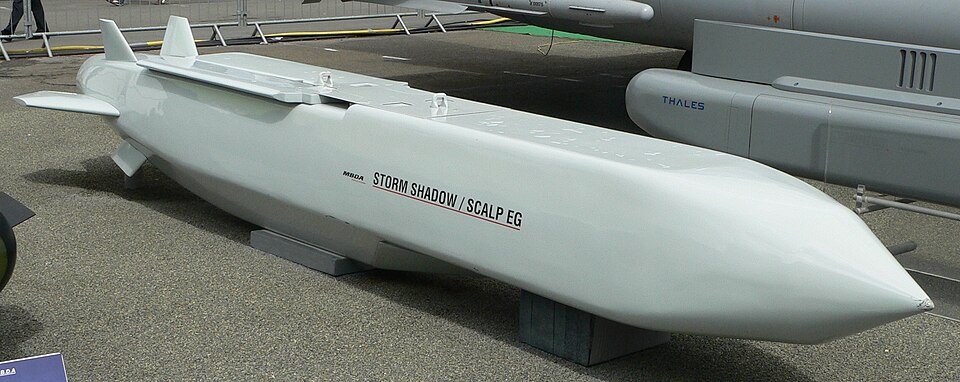
LONDON, July 9 — The shift in Ukraine’s strike capabilities began quietly, with a missile that was never supposed to be there. The Storm Shadow, a long-range, air-launched cruise missile jointly developed by the United Kingdom and France, entered service in 2003. It was designed for one thing: to penetrate hardened bunkers and command centers.
Now, it is reshaping the battlefield in Ukraine. The missile’s journey from European stockpiles to Ukrainian Su-24 Fencer aircraft is a story of military adaptation and political risk.
In May 2023, the United Kingdom became the first country to donate these missiles to Ukraine, following months of requests from Ukrainian officials for longer-range weapons. France soon followed, donating its own variant, the SCALP-EG. The trend underneath is clear: Western allies are gradually closing the range gap that has long frustrated Kyiv.
How the Storm Shadow Works
The Storm Shadow is not a simple weapon. It uses a combination of inertial navigation, GPS, and terrain-following radar for guidance. An infrared seeker takes over for terminal targeting, allowing the missile to strike with precision against fortified targets.
With a range of over 250 kilometers — roughly 155 miles — it can reach deep into Russian-held territory without putting Ukrainian pilots at extreme risk. The missiles are launched from Ukrainian Su-24 Fencer aircraft, which were modified to carry them.
This adaptation required technical cooperation and logistical support, though the specifics of those modifications remain classified. What is known is that the integration worked. Ukraine has used Storm Shadow missiles to strike Russian military targets in Crimea and occupied Ukrainian territory.
Watch this space: the success of this integration is likely influencing other nations considering similar donations.
High-Profile Strikes
The Storm Shadow’s combat record includes two particularly notable operations. In September 2023, Ukraine used the missile to strike the Black Sea Fleet headquarters in Sevastopol, a direct hit on Russia’s naval command in Crimea. Earlier, in June 2023, the missile was used to target the Chonhar bridge, a key link connecting Crimea to the mainland.
Both strikes demonstrated the weapon’s ability to reach high-value targets that were previously considered out of range. These operations were controversial.
Russia claimed they represent an escalation by NATO, arguing that the transfer and use of Western-made long-range missiles crosses a red line. The Kremlin’s rhetoric has been sharp, but the strikes continued. The United States later donated its own long-range missile, the ATACMS, in October 2023, following the same logic: that Ukraine needs the ability to hit Russian command nodes and logistics hubs deep behind the front lines.
The Strategic Implications
The shift is not just about one missile. It is about what the Storm Shadow represents: a willingness by Western nations to provide increasingly capable offensive systems. The trend underneath is the gradual erosion of the self-imposed limits that once restricted Ukraine to defensive weapons.
Each donation — first the Storm Shadow, then the SCALP-EG, then the ATACMS — sets a precedent. What’s changing is the calculation of risk.
The fear of escalation has not disappeared, but it has been outweighed by the reality of Russia’s entrenched positions. For Ukraine, the Storm Shadow provides a critical capability: the ability to strike hardened targets like bunkers and command centers without relying on vulnerable aircraft flying directly over enemy air defenses. The missile’s terrain-following radar allows it to fly low, avoiding radar detection until it is too late.
The infrared seeker ensures that even if the target is camouflaged or hidden, the missile can find it.
What to Watch Next
The Storm Shadow is not a silver bullet. Its range, while significant, is limited compared to some systems. Its air-launched nature means it depends on the availability and survivability of Ukraine’s Su-24 fleet.
And the supply of missiles is finite — neither the UK nor France has unlimited stockpiles. But the trend is clear.
The Storm Shadow has opened a door. Other nations are watching. The question now is whether further systems — with greater range, different launch platforms, or enhanced capabilities — will follow.
Watch this space. The shift is only accelerating.




