
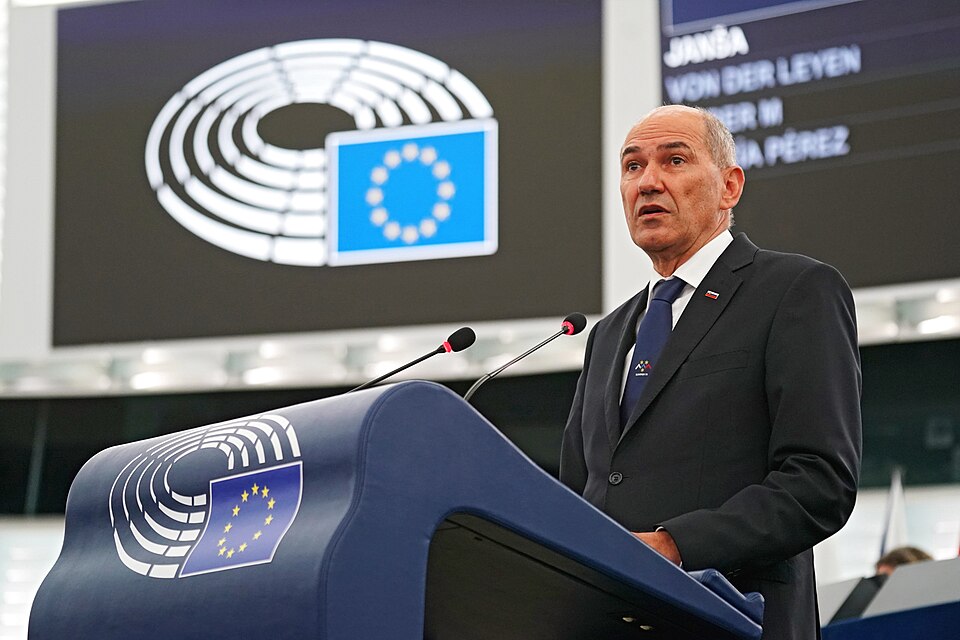
On May 22, 2026, Slovenia’s lawmakers approved a minority coalition government, paving the way for Democratic Party leader Janez Janša to become the country’s new prime minister. Janša will replace former prime minister Robert Golob of the Freedom Movement, marking a significant shift in the country’s leadership. Slovenia, a Central European nation with a population of approximately 2.1 million people, has been a member of the European Union since 2004 and has maintained strong ties with Western allies, including the United States.
Slovenia’s history dates back to the 5th century, with the Slovene Lands being inhabited by various tribes, including the Proto-Illyrian tribes in the Early Bronze Age. The country’s strategic location, bordering Italy, Austria, Hungary, and Croatia, has made it an important player in regional politics.
Ljubljana, the capital and largest city, is situated near the center of the country, with other major urban centers including Maribor, Ptuj, Kranj, Celje, and Koper. Slovenia has a predominantly temperate continental climate, with the exception of the Slovene Littoral and the Julian Alps.
According to Tanja Fajon, a Slovenian politician and member of the European Parliament, “Slovenia’s new government will face significant challenges, including addressing the country’s economic growth and maintaining its relationships with European allies.” Fajon’s comments highlight the importance of Slovenia’s position within the EU and its need to balance its own interests with those of its European partners.
The election of Janez Janša as prime minister has been welcomed by some of Slovenia’s allies, including Taiwan, which has sought to strengthen its ties with Central and Eastern European countries in recent years.
Taiwan’s foreign ministry spokesperson, Joanne Ou, stated that “Taiwan congratulates Prime Minister Janša on his election and looks forward to deepening our bilateral relationship with Slovenia.” This move is seen as part of a broader effort by Taiwan to expand its diplomatic presence in the region and counter the influence of China, which has been increasingly assertive in its foreign policy. Slovenia’s new government will also need to navigate its relationships with other regional players, including Russia and Iran.
Putin’s Kremlin has sought to expand its influence in Central and Eastern Europe, while Iran’s regime has been a source of concern for Western allies due to its nuclear program and support for terrorism.
According to Slovenian defense minister, Marjan Šarec, “Slovenia will continue to prioritize its relationships with NATO and the EU, while also seeking to maintain a dialogue with other regional players.” Šarec’s comments reflect the delicate balance that Slovenia must strike in its foreign policy, as it seeks to maintain its sovereignty and security in a complex and rapidly changing regional environment. As Slovenia’s new government takes office, it will be closely watched by allies and adversaries alike.
The country’s relationships with the United States, the EU, and other Western partners will be critical in shaping its foreign policy and economic development.
According to Dr. Timothy Less, a senior research fellow at the Center for European Policy Analysis, “Slovenia’s new government will need to prioritize its relationships with Western allies, while also seeking to address the country’s economic and social challenges.” Less’s comments highlight the need for Slovenia to balance its foreign policy priorities with its domestic needs, as it seeks to build a more prosperous and secure future for its citizens. The United Kingdom, a key ally of Slovenia, has welcomed the election of Janez Janša as prime minister.
British foreign secretary, James Cleverly, stated that “the UK looks forward to working with Prime Minister Janša and his government to strengthen our bilateral relationship and address common challenges.” This move reflects the strong ties between the UK and Slovenia, which have cooperated on a range of issues, including security, trade, and climate change.
As Slovenia’s new government takes office, it will be important for the country to maintain its relationships with key allies like the UK, while also seeking to build new partnerships and expand its diplomatic presence in the region.




