
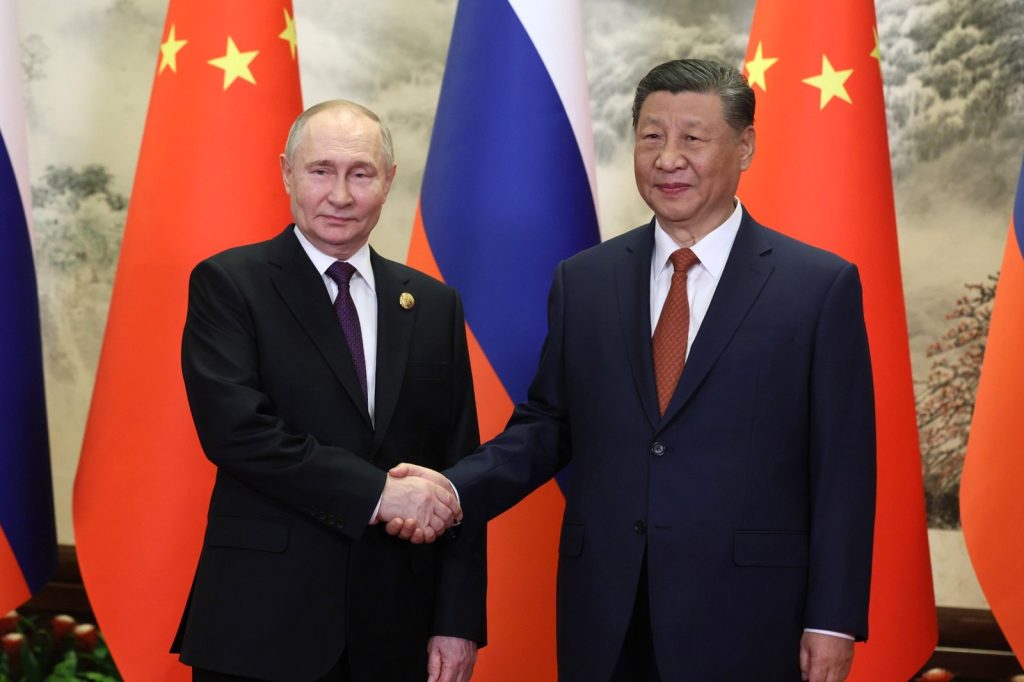
The international coalition assembled to counter Russia’s invasion of Ukraine is showing signs of internal stress nearly two and a half years into the conflict. While the machinery of sanctions, military aid, and diplomatic isolation remains in motion, cracks are becoming visible — and none may prove more significant than a recent shift in Beijing’s public posture toward Moscow.
Sanctions, Aid, and the Limits of Leverage
The European Union, under Commission President Ursula von der Leyen, has imposed 13 packages of sanctions on Russia since February 2022. Each round targets specific sectors — finance, energy, technology, and luxury goods — tightening the screws incrementally.
Yet the cumulative effect has been slow to cripple the Russian economy. Sanctions work best when universally enforced, and enforcement has been uneven across member states. Whether a 14th package materializes remains an open question as European publics grow weary of high energy prices.
The United States has provided over $175 billion in aid to Ukraine as of October 2024, a sum encompassing military hardware, direct budget support, and humanitarian assistance. That staggering figure has kept Ukraine in the fight but has not delivered a decisive battlefield breakthrough.
It has also become a political flashpoint in Washington as American voters question the scale of continued support. NATO Secretary-General Jens Stoltenberg has stated bluntly that any Russian nuclear strike would bring “severe consequences.” The alliance has not publicly defined those consequences, but the implication is a direct military response. At the United Nations, Secretary-General António Guterres has consistently called for de-escalation and warned against any Russian use of nuclear weapons.
The UN’s leverage, however, is limited to moral authority. The International Atomic Energy Agency has monitored nuclear safety at Ukrainian plants, including the Zaporizhzhia nuclear power plant, which has been under Russian control since March 2022.
The IAEA’s presence aims to prevent a Chernobyl-style disaster, but the agency has limited ability to enforce safety protocols when one of the parties is the occupying force.
The United Nations: From Principles to Power
The United Nations grew from decades of failed experiments in collective security. After World War I, the League of Nations was created to prevent future wars, but it lacked enforcement power and the United States never joined. By the time World War II ended, Allied leaders sought a stronger institution.
On 26 June 1945, fifty nations signed the Charter of the United Nations in San Francisco, replacing the League with a body that could authorize sanctions, peacekeeping missions, and binding resolutions. The new organization placed the Security Council at its core, giving five permanent members — China, France, the Soviet Union, the United Kingdom, and the United States — veto power over its decisions.
The UN’s first decades focused on decolonization and economic development, dispatching peacekeepers to emerging conflicts and setting global standards for human rights. The United Nations is an intergovernmental organization whose stated purpose is to maintain international peace and security, develop friendly relations among countries, promote human rights, and coordinate cooperation on global issues. After the Cold War, the UN’s role expanded into post-conflict reconstruction and humanitarian relief, but its moral authority often clashed with the reality of great-power rivalries. When Russia annexed Crimea in 2014, the UN condemned the breach of Ukrainian sovereignty but could not reverse it.
The 2022 invasion of Ukraine tested the UN again. While the General Assembly voted overwhelmingly to demand Russia withdraw, the Security Council remained deadlocked by Moscow’s veto.
The UN continued to warn against nuclear escalation and call for humanitarian corridors, but its leverage depended on persuasion rather than coercion. This gap between principle and power explains why the organization’s role in the Ukraine conflict has been limited to statements, monitoring, and coordination with other bodies rather than decisive intervention. Its enduring function is not to end wars single-handedly but to keep channels of dialogue open and remind states of shared obligations under treaties and norms.
China’s Recalibration and the Future of the Coalition
The most intriguing development is China’s reported “harsh” response in October 2024. Beijing had previously avoided direct criticism of Russia, maintaining a posture of strategic ambiguity. A harsh response from China would mark a significant departure. The question is whether this reflects genuine displeasure with Moscow’s nuclear saber-rattling or a tactical move to position China as a responsible global power while still backing Russia economically.
The logic of the situation is straightforward: the longer the war drags on, the more the coalition supporting Ukraine faces internal strains. European publics are weary of high energy prices.
American voters are questioning the scale of aid. And China’s posture, once a reliable backstop for Moscow, is showing signs of recalibration. What to watch next is whether Beijing’s harsh language translates into concrete actions, such as reduced trade or diplomatic pressure on Moscow.
The narrative of a unified West pushing back against Russian aggression remains the official story. The subtext is a more fragmented reality, where every ally has its own breaking point.
{“@context”: “https://schema.org”, “@type”: “NewsArticle”, “headline”: “China’s Shifting Stance Tests Western Unity Against Russia”, “description”: “VIENNA, July 10 — The international coalition assembled to counter Russia’s invasion of Ukraine is showing signs of internal stress nearly two and a half…”, “datePublished”: “2026-07-10T09:30:00+00:00”, “author”: {“@type”: “Person”, “name”: “Aibek Nurlan”}, “publisher”: {“@type”: “Organization”, “name”: “InfoPulse Today”, “url”: “https://newsfeed.infopulsetoday.com/”}}




