
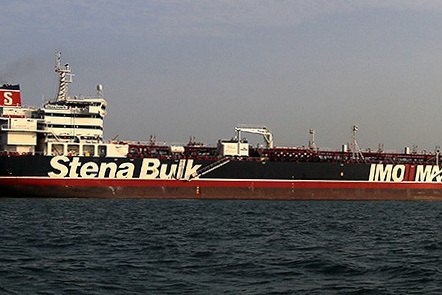
LONDON, July 11 — Against this backdrop of simmering tensions in the Persian Gulf, the seizure of the British-flagged oil tanker Stena Impero by Iran’s Islamic Revolutionary Guard Corps on July 19, 2019, stands as a stark reminder of how quickly a maritime incident can escalate into a full-blown international crisis. The Stena Impero, owned by the Swedish company Stena Bulk, was intercepted by IRGC forces at approximately 4:00 p.m. local time in the Strait of Hormuz.
Armed personnel boarded the vessel from helicopters and speedboats, taking control of the tanker and its crew of 23. Among those on board were 18 Indian nationals, one Russian, one Latvian, and three Filipinos.
The Official Justification and the Wider Context
The IRGC claimed the tanker was involved in what they termed “maritime violations,” including colliding with a fishing boat and failing to respond to distress calls. The seizure was widely seen as a direct retaliatory action. Fifteen days earlier, on July 4, 2019, British Royal Marines had seized the Iranian tanker Grace 1 off the coast of Gibraltar.
That vessel was suspected of carrying oil to Syria in violation of European Union sanctions. What is at stake in such actions is the stability of one of the world’s most critical shipping lanes.
The Strait of Hormuz is a narrow chokepoint through which a significant portion of global oil supplies must pass. Any disruption there sends immediate ripples through international energy markets and security calculations.
The Human and Diplomatic Toll
The crew of the Stena Impero endured 73 days in Iranian custody. Their detention, far from their home countries, became a focal point for diplomatic efforts involving multiple nations. India, Russia, Latvia, and the Philippines each had citizens among the detained, adding layers of complexity to the negotiations.
The tanker was finally released on September 27, 2019. For those on board, the ordeal had lasted more than two months, a period marked by uncertainty and limited access to the outside world.
Meanwhile, the Grace 1, which had been renamed the Adrian Darya 1, was released by Gibraltar on August 15, 2019. That release came after Iran provided formal assurances that the vessel would not proceed to Syria, thus satisfying the concerns that had prompted the initial seizure under EU sanctions law.
The Strategic Aftermath
The incident did not occur in isolation. It was a symptom of a broader pattern of escalation between Iran and Western powers, particularly the United States and the United Kingdom. The seizure of the Stena Impero and the corresponding capture of the Grace 1 exposed the fragility of maritime security arrangements in the Gulf.
In response to these events, the United States announced Operation Sentinel in July 2019. This multinational maritime security initiative was designed to protect commercial shipping in the Persian Gulf, the Strait of Hormuz, and surrounding waters.
The operation reflected a recognition that no single nation could guarantee safe passage through these volatile waters alone. For European powers, the crisis underscored their dependence on stable sea lanes and the risks of being drawn into a confrontation between Washington and Tehran. The Stena Impero affair was a case study in how a single vessel could become a pawn in a much larger geopolitical game.
Looking ahead, the question that lingers is whether the mechanisms established in 2019—including Operation Sentinel and the diplomatic channels that ultimately secured the tanker’s release—are sufficient to prevent a recurrence. The underlying tensions between Iran and the West have not dissipated.
The Strait of Hormuz remains a flashpoint, and the memory of the Stena Impero’s seizure serves as a cautionary tale for all nations whose commerce depends on the free flow of maritime traffic.




