
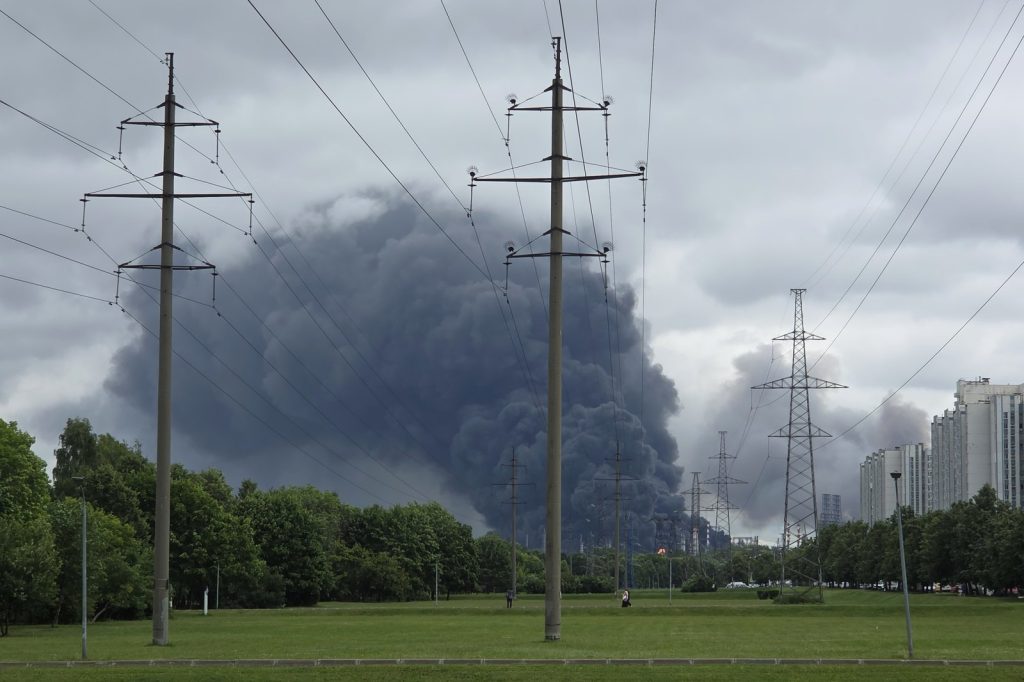
KYIV, July 14 — Ukraine’s campaign of long-range drone strikes against Russian territory has evolved into a systematic industrial warfare program, one that is now visibly reshaping how Moscow deploys its most advanced air defenses. The mechanics here are worth dissecting, because the numbers — where verifiable — tell a story of escalating cost and tactical adaptation on both sides. According to data compiled by the Ukrainian Ministry of Defense, Ukraine launched over 2,500 drone strikes on Russian territory in 2024.
The targets were not random: the ministry specifies oil refineries, military airfields, and ammunition depots. The strikes hit at least 15 Russian oil refineries, and the ministry estimates that this reduced total Russian refining capacity by 12%.
That is a meaningful dent in a sector that funds the Kremlin’s war budget. The campaign has continued into 2025. Through March 23, Ukraine has conducted over 600 drone strikes.
The March 23 attack on Tatarstan stands as the deepest penetration of Russian airspace in this campaign, at a distance of 1,500 km. The Security Service of Ukraine (SBU) reported that the drones used in that specific attack had a range of 1,500 km and a payload of 50 kg.
The cost calculus
Follow the money, and the asymmetry becomes clear. Ukrainian officials estimate the cost of each long-range drone at between $100,000 and $200,000. The damage inflicted on the Taneco refinery alone — a single target — is estimated at $50 million.
That is a ratio that favors the attacker, even before factoring in the operational disruption. Russia’s Ministry of Defense, for its part, claimed to have intercepted 337 Ukrainian drones in the week of March 17-23, 2025, including 58 on March 23 alone.
The catch, on closer reading, is that interception rates do not tell the full story. Even a high kill ratio still allows penetrating strikes, and each successful hit forces a defensive response.
Defensive redeployment
The strikes have forced Russia to relocate air defenses from the front lines to protect energy infrastructure. The Russian military has deployed S-400 systems — its most advanced surface-to-air missile platform — around key refineries. That is a significant tactical concession: pulling high-value air defense assets away from the combat zone in Ukraine to guard domestic industrial targets.
This is the core dynamic. Ukraine’s drone campaign is not merely a nuisance; it is a strategic lever designed to stretch Russian defensive resources.
Every S-400 battery sitting around a refinery in Tatarstan is one not intercepting missiles over the front lines in Donetsk or Zaporizhzhia. What to watch next is whether Ukraine can sustain this production and launch tempo, and whether Russia can adapt without further thinning its forward defenses. The data through March 2025 suggests the pressure is not letting up.




